There is a particular excitement that comes over a business owner in the first week of using an AI assistant. The first draft arrives in seconds. The first summary is tidy. The first reply to a customer sounds more polished than anything written that morning. In the glow of that moment, a dangerous thought appears: why not hand over everything?
The answer is that tasks are not all alike. Some are ideal for an assistant and some are a trap, and from the outside they can look almost identical. This essay offers five questions that, asked in order, sort one kind from the other. They do not require technical knowledge. They require only that you slow down for five minutes before automating, which is also the five minutes that most people skip.
Question one: does this task repeat?
An assistant earns its keep on repetition. If you write a similar message every week, summarise a similar kind of document every month or tidy the same sort of list every day, then every improvement you make to the instructions pays you back many times over. If the task happens once a year and is different each time, the effort of explaining it to an assistant may be greater than the effort of doing it yourself.
A useful test is to count. Think back over the last thirty days and ask how many times you did this task. If the answer is once, leave it alone. If the answer is ten or more, keep reading. Repetition does not by itself make a task suitable, but without it the case is weak.
Question two: can I describe what a good result looks like?
This is the question that separates people who get steady value from AI from people who get frustrated. An assistant can only aim at a target you have named. If you cannot say what a good result looks like, you will not be able to tell whether the assistant has produced one, and you will find yourself rewriting its output and wondering why you bothered.
Try the exercise of writing the description before you begin. For a customer reply it might read: "Two short paragraphs, polite, addressed by first name, states the delivery date, offers one clear next step, no promises about refunds." For a weekly sales summary: "One page, five lines, the three largest orders, the one customer who has gone quiet, and one thing to follow up." If you can write such a description in a few lines, the task is a good candidate. If you find yourself saying "I will know it when I see it", the task still depends on your judgement and should stay with you, at least until you have turned that judgement into words.

Question three: what does a mistake cost?
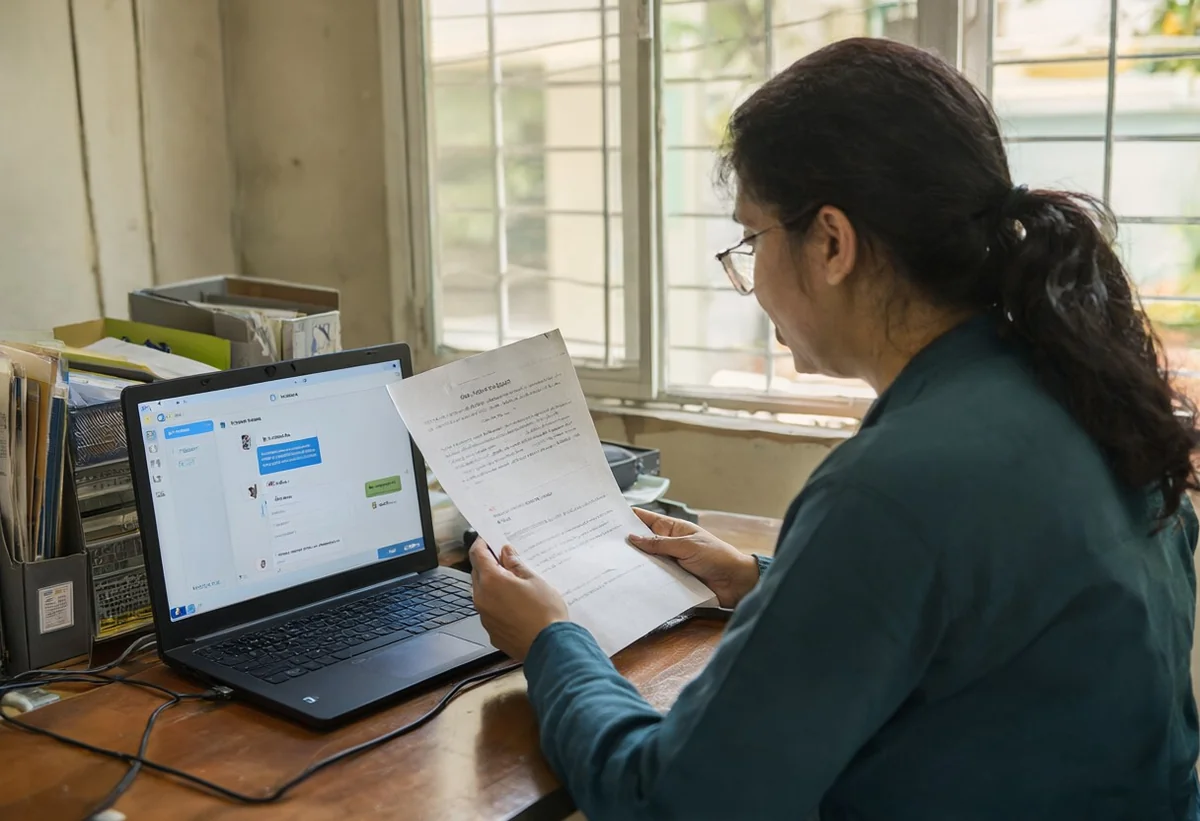
Assistants make mistakes. They do so with great confidence and in fluent prose, which is part of what makes the mistakes hard to spot. So before delegating, ask what happens if the output is wrong and nobody notices.
Place the task on a rough scale. At one end are the cheap errors: a clumsy sentence in an internal note, a poor suggestion for a social media caption. At the other end are the expensive ones: a wrong figure in a quotation, an incorrect statement in a contract, a promise made to a customer that the business cannot keep. The cheaper the error, the more freely you can delegate. The more costly, the more you must either keep the task or build a firm check around it.
Money is not the only cost. Trust is another. A message sent in your name that gets a customer's name wrong, or a promise that contradicts your usual policy, can cost more in goodwill than the time it saved. Count that too.
Question four: who will check, and how?
This question follows naturally from the last. Every task that goes to an assistant needs a named human checker and a defined moment for the check. Not "someone will look at it", but "I will read every reply before it is sent" or "the accountant will compare the totals against the ledger on Friday".
Be realistic about your own habits. If you know that you will not read a long output closely, do not delegate a task whose errors hide in the detail. Choose tasks where mistakes are visible at a glance, such as a list that either has the right number of items or does not, or a draft that either sounds like your business or does not. Design the work so that checking is quick. An assistant that saves an hour but demands an hour of careful review has saved you nothing.
There is a quiet danger here. After a few weeks of good results, checking tends to fade. The assistant has been right so many times that attention drifts, and the first serious error arrives exactly when no one is looking. The remedy is to keep the check in the routine, however reliable the tool seems, for anything where error is costly.
Question five: what information am I putting in?
The last question concerns what you hand over. To do its work, an assistant needs material: your emails, your price lists, your customer details, your drafts. Before pasting anything, ask whether it is information you would be comfortable seeing leave the building.
Customer phone numbers, bank details, identity documents, the contents of confidential agreements and anything that someone gave you in trust deserve particular care. Read the terms of the tool you are using, find out whether what you type is stored or used to improve the service, and use the settings that limit this where they exist. Where in doubt, remove names and numbers before you paste, or describe the situation in general terms. You will often find that the assistant helps just as well without the sensitive details.
A worked example
Consider a small trading business that sends payment reminders. The owner writes roughly fifteen of them each month, each a polite nudge with an invoice number, an amount and a date.
Question one: it repeats, fifteen times a month. Question two: good looks like a short, courteous note with the invoice number, amount, due date and a payment instruction, never a threat. The owner can describe that easily. Question three: a mistake could mean a wrong amount, which would embarrass the business and annoy the customer, so the cost is moderate. Question four: the owner decides to read every reminder against the invoice before it goes, a two-minute check each. Question five: the reminder needs a customer name and an amount, but no bank details, which are added by the owner afterwards.
The answers say: delegate, with a check. And so the task goes to the assistant on clear terms. Contrast this with negotiating a price with a long-standing supplier. It does not repeat in the same form. Good is hard to describe because it depends on the relationship. A mistake is costly. The task stays with the owner, perhaps with the assistant used to prepare notes beforehand.
Start small, and keep a log
Having sorted your tasks, resist the temptation to move them all at once. Pick one that passed all five questions and run it as a two-week pilot. Keep a simple log in a notebook or a spreadsheet: the date, how long the task took, whether the output needed changes and, if so, what kind. At the end of two weeks you will have something rare in this field, which is evidence from your own business rather than from an advertisement.
If the log shows that the assistant saves time and the errors are small and visible, extend its role slowly. If it shows that you are spending as long fixing as you would have spent writing, return the task to yourself without embarrassment. The point of the exercise is not to prove that the technology works but to find where it works for you.
Judgement stays human
There is an old teaching in the Indian tradition that the instrument is not the actor. A pen does not write the letter, and the hand that holds it answers for the words. The same holds for a machine that drafts at speed: the responsibility for what goes out under your name remains yours. Used with that clarity, an assistant is a diligent junior who never tires. Used without it, it is a very fast way of making mistakes at scale.
So before the next task goes across, ask the five questions: does it repeat, can I say what good looks like, what does a mistake cost, who checks, and what am I handing over? Pick one task this week, answer them in writing, and let the answers decide.
📬 Join 49,000+ Indian Professionals
The Inner Circle newsletter delivers curated MSME intelligence, leadership wisdom, and strategic insights every week — completely free. Plus receive the 20 Gita Lessons PDF as a welcome gift.
Subscribe Free →Ready to Go Further?
Is your MSME AI-ready? I help Indian businesses understand and deploy practical AI workflows — from automation to decision intelligence. Book a focused strategy session.
Book a Digital Strategy CallPublished 28 October 2026 · dibyenduchoudhury.com