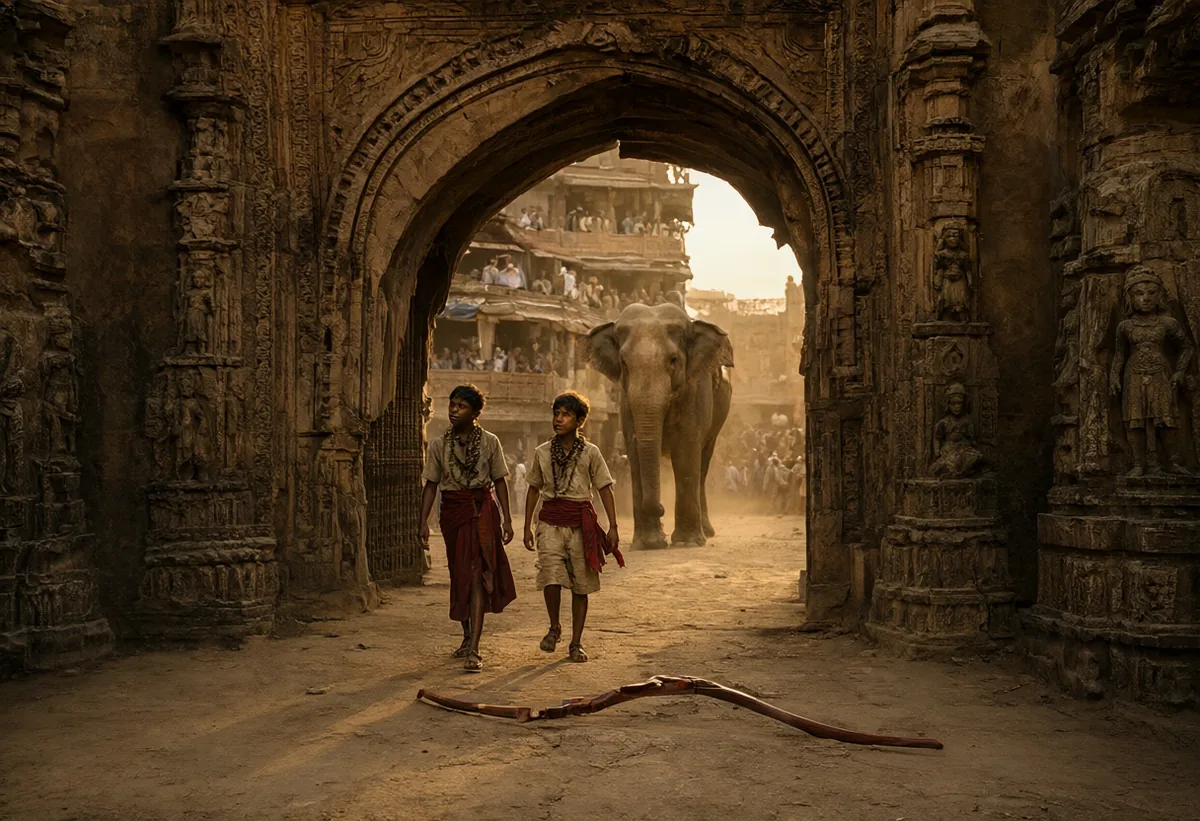
The Leadership Manual Hidden in Plain Sight
Every management school teaches Porter's Five Forces, Maslow's Hierarchy, and the BCG Matrix. None teaches the framework that Arjuna received on the battlefield of Kurukshetra — a framework that has guided leaders across 5,000 years of Indian civilisation.
The Bhagavad Gita is not religious instruction. It is a manual for making high-stakes decisions under uncertainty — the exact condition in which every entrepreneur operates.
Framework 1: Nishkama Karma — Action Without Attachment to Results
"You have a right to perform your prescribed duties, but you are not entitled to the fruits of your actions." (2.47)
Modern translation: focus obsessively on execution quality. Do not let outcome anxiety corrupt the quality of the decision or the work. Entrepreneurs who internalise this framework make better long-term decisions because they are not distorted by short-term fear of failure.
Framework 2: Svadharma — Know Your Rightful Role
Krishna tells Arjuna that it is better to perform one's own dharma imperfectly than another's perfectly. For the entrepreneur, this is clarity of role. The founder who tries to be CFO, CMO, and CTO simultaneously performs all three roles poorly.
Svadharma demands honest self-assessment: where is your genius? Build a team around your gaps and lead from your strengths.
Framework 3: The Three Gunas — Understanding Human Motivation
The Gita describes three qualities that drive all human action: tamas (inertia), rajas (passion/ambition), and sattva (clarity/wisdom). Great leaders recognise which guna is dominant in each team member and assign roles accordingly. The rajasic salesperson who closes deals; the sattvic strategist who sees beyond quarters; the tamasic operator who provides stability in routine functions.
Framework 4: Viveka — Discriminative Intelligence in Decision-Making
Viveka is the faculty that distinguishes the real from the unreal, the essential from the peripheral, the long-term from the short-term. Krishna's entire conversation with Arjuna is an exercise in sharpening viveka — cutting through the emotional fog to see clearly what must be done.
Entrepreneurs develop viveka through meditation, mentorship, and deliberate reflection. The leader who cannot separate signal from noise cannot lead at scale.
Framework 5: Sthitaprajna — The Steady-Minded Leader
"One who is not disturbed even in the midst of the threefold miseries, who is not elated when there is happiness, and who is free from attachment, fear and anger, is called a steady-minded sage." (2.56)
This is the founder who does not spiral when a key hire resigns, a funding round falls through, or a competitor launches. Equanimity is not indifference — it is the capacity to respond to events rather than react to them. It is the most undervalued leadership quality in India's startup ecosystem.
Integrating the Gita Into Your Leadership Practice
Start with ten minutes of the second chapter daily. The Gita does not require belief — it requires attention. Each shloka is a coaching session compressed into two lines. Read, reflect, and ask: where in my business is this principle being violated?
The leaders who will build India's next generation of great institutions are those who combine modern management science with ancient wisdom. The Gita is not a shortcut. It is a foundation.
Go deeper
Want the full playbook on this? Read The Bhagavad Gita: Timeless Wisdom for Modern Leaders — a companion e-book from the library.