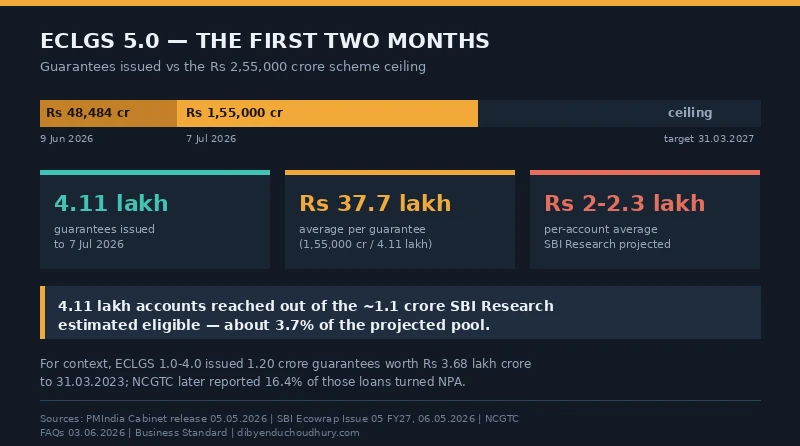
On 5 May 2026 the Union Cabinet approved a credit guarantee scheme worth Rs 2,55,000 crore, aimed at businesses whose working capital had been squeezed by the West Asia conflict. Two months later, banks had issued guarantees covering roughly Rs 1.55 lakh crore of it. Those two numbers have been widely reported. The number that has not been reported is what they imply when you divide one by the other — and that division tells a very different story from the one in the press releases.
What the Cabinet Approved, and Why West Asia Was the Trigger
The mechanism is not a subsidy and not a loan from the government. Under the scheme approved on 5 May, the National Credit Guarantee Trustee Company Limited (NCGTC), a wholly owned company of the Department of Financial Services, stands behind loans that banks make. For an MSME borrower the guarantee covers 100 per cent of any amount in default. For non-MSMEs and scheduled passenger airlines it covers 90 per cent. The government pays nothing unless a loan goes bad.
What a borrower can draw is capped at 20 per cent of their peak fund-based working capital outstanding during the fourth quarter of FY 2025-26 — that is, the highest utilisation recorded between 1 January and 31 March 2026 — subject to a ceiling of Rs 100 crore across all lenders. Airlines are treated separately: up to 100 per cent of peak credit outstanding, capped at Rs 1,500 crore per borrower, with anything above Rs 1,000 crore requiring matching promoter equity. MSME loans run five years including a one-year moratorium on principal; airline loans run seven years with a two-year moratorium.
The trigger was specific. SBI Research, in Ecowrap Issue 05 of FY27 dated 6 May 2026, set out the aviation channel plainly: aviation turbine fuel accounts for 30 to 40 per cent of airline operating costs, and the price quoted by Indian Oil at Mumbai for domestic routes had risen 35 per cent, with escalation across metros running between 35 and 52 per cent. Outstanding bank credit to the aviation sector stood at Rs 526 billion as of March 2026. The Rs 5,000 crore earmarked for airlines amounts to about 9.5 per cent of that book. For MSMEs the transmission was less direct but no less real: shipping costs, rerouted trade lanes and crude volatility all landing on enterprises that carry thin reserves.
The Funnel: What Happened to the First 2.62 Lakh Applications
Official implementation data reported by ANI on 1 June 2026, covering the position as on 29 May, gives an unusually complete picture of the first four weeks — and it is worth reading as a funnel rather than as a headline.
| Stage (as on 29 May 2026) | Accounts | Value | Avg. ticket |
|---|---|---|---|
| Applications sourced | 2,62,000 | Rs 1,71,000 cr | Rs 65.3 lakh |
| Sanctioned by lenders | 79,950 | Rs 35,194 cr | Rs 44.0 lakh |
| Guarantees actually issued | 26,000 | Rs 15,720 cr | Rs 60.5 lakh |
Three-tenths of applications reached sanction by number. By value the ratio was tighter still, at 20.6 per cent — meaning lenders were not only rejecting applications, they were cutting the surviving ones down, from an average ask of Rs 65.3 lakh to an average sanction of Rs 44 lakh. Of those sanctions, guarantees had actually been lodged for 26,000 accounts. End to end, roughly one application in ten had become a live guarantee four weeks in.
MSMEs did dominate the demand, as intended: Rs 1,31,107 crore of the application value and Rs 30,355 crore of the sanctions came from the sector, the latter being 86 per cent of all sanctioned value. That part of the design is working. The pace picked up sharply afterwards — guarantees reached Rs 48,484 crore across 1.06 lakh approvals by 9 June, and Rs 1.55 lakh crore across 4.11 lakh guarantees by 7 July.
The Arithmetic Problem Nobody Is Discussing
Here is where the published numbers stop and the division begins. SBI Research's preliminary estimate, in the same 6 May Ecowrap, was that about 1.1 crore MSME accounts — roughly 45 per cent of the total MSME portfolio — would be eligible, at an average additional credit flow of Rs 2 to 2.3 lakh per account.
The money is not moving at Rs 2.3 lakh per account. Rs 1.55 lakh crore across 4.11 lakh guarantees works out to an average of about Rs 37.7 lakh per guarantee — sixteen times the projected figure. At 9 June the average was higher still, at Rs 45.7 lakh.
If the average guarantee holds near Rs 37.7 lakh, the full Rs 2,55,000 crore is exhausted after roughly 6.8 lakh accounts — about 6 per cent of the 1.1 crore SBI Research expected to reach. The constraint on this scheme is not the March 2027 deadline. It is the money.
By 7 July, 4.11 lakh guarantees had already been issued. On that arithmetic, something in the order of 2.6 lakh guarantee slots remained. The run rate between 9 June and 7 July was about Rs 3,800 crore a day; sustained, that consumes the remaining Rs 1 lakh crore in roughly 26 days.
Two honest caveats belong here. First, the NCGTC FAQs confirm the Rs 2,55,000 crore is not released in one block: the first tranche is Rs 1,05,000 crore including the airline allocation, with further tranches released "based on assessing the situation as they arise." The government therefore controls the tap, and can slow it. Second, a 28-day run rate captured during the initial rush of a pipeline that had been building since 5 May is almost certainly an overestimate of the steady state; large borrowers with ready paperwork move first, and the average ticket has already fallen from Rs 45.7 lakh to Rs 37.7 lakh, which suggests smaller borrowers are entering. But even generous assumptions do not get from 6.8 lakh accounts to 1.1 crore. The gap is an order of magnitude, not a rounding error.
Six Disqualifiers Hiding in the Fine Print
The NCGTC FAQs updated to 3 June 2026 contain several conditions that will quietly disqualify applicants who assume they are covered.
You must already be a borrower. The scheme is only for existing borrowers on an MLI's books as on 31 March 2026. A business that has never taken a working capital facility cannot enter, however badly the conflict has hurt it. This single condition excludes the large informal segment the scheme is rhetorically aimed at.
Standard, and not SMA-2, across every lender. The account must be classified Standard excluding SMA-2 as on 31 March 2026 — and the FAQ is explicit that this test applies across all lenders, not just the one you are applying to. One stressed facility elsewhere sinks the application.
Ad-hoc limits do not count. Peak working capital utilisation is computed only from regular sanctioned facilities: cash credit, overdraft, WCDL, WCTL, bills discounted, packing credit. Ad-hoc limits, temporary overdrafts and one-time limits are excluded. Borrowers who ran on ad-hoc accommodation during Q4 will find their eligible amount far smaller than their actual usage.
Gold loans and loans against fixed deposits are out. NCGTC classifies these as consumption loans not generally granted for working capital, and excludes them outright — a meaningful exclusion in trading and retail segments where gold-backed credit is common.
Udyam registration or a Udyam Assist Certificate is mandatory for MSME status. Without one, the borrower is not treated as an MSME, which means 90 per cent cover rather than 100 per cent and, for many, no cover at all.
The negative list applies only to non-MSMEs. NBFCs, power, telecom service providers, sugar and ethanol, IT companies, paper and paper products, educational institutions, and beverages excluding tea and coffee, plus tobacco, are barred — but the FAQ is clear that the scheme is admissible for all sectors if the borrower is an MSME. An MSME in one of those sectors is still eligible, which is worth knowing before a branch turns you away.
There is also one exception worth carrying into a difficult conversation with a lender: where a borrower's loan accounts were under 60 days past due but small overdues beyond 60 days appeared on a credit card, savings or current account as on 31 March 2026, the case can still be considered eligible if those overdues do not exceed 1 per cent of the ECLGS 5.0 loan amount and are regularised before assistance is provided. That clause has kept otherwise clean borrowers in the scheme.
The Route Runs Through JanSamarth, Not Your Branch Manager
This is the procedural point most likely to cost a business time. The JanSamarth portal, administered by PSB Alliance, has been designated the exclusive platform for ECLGS 5.0 applications. The FAQ language is unambiguous: a borrower "shall mandatorily apply on the JanSamarth portal," self-declaring the required details, after which the application routes to the lender branch the borrower selects during the application journey. Sanction details entered by the lender flow to NCGTC in real time, and a Credit Guarantee Permanent Account Number is generated automatically.
Walking into a branch and asking for an ECLGS loan is not the entry point. If your lender is not yet onboarded to JanSamarth, they must partner with it before they can participate at all — which means the practical first question to ask a relationship manager is not "will you sanction this" but "are you live on JanSamarth for ECLGS 5.0."
Three conditions ease the process once inside. No fresh collateral, personal guarantee or corporate guarantee may be sought for MSME and non-MSME borrowers outside aviation. No processing fee may be charged, since the credit goes to existing customers. No pre-payment penalty may be levied. NCGTC charges no guarantee fee. The facility ranks as a second charge on existing securities, to be created within 90 days of first disbursement, and where the underlying loan was unsecured no charge is required at all.
What the 9 Per Cent Cap Protects, and What It Doesn't
Pricing is capped, which is genuinely valuable and rarely highlighted. For MSMEs borrowing from banks and financial institutions the rate is EBLR plus 0.75 per cent, subject to a hard ceiling of 9 per cent per annum. For non-MSMEs the benchmark is MCLR plus 0.75 per cent, capped at 9 per cent or MCLR plus 0.75 per cent, whichever is lower. Rates are floating, subject to that cap.
The exception deserves scrutiny. For NBFCs, the rate may go up to 13 per cent per annum. The credit risk in both cases is identical — for an MSME borrower the government is standing behind 100 per cent of the default. Yet an MSME that banks with an NBFC rather than a scheduled commercial bank may pay up to 400 basis points more for a loan on which the lender carries no residual risk. Whatever the operational justification for NBFC cost structures, the borrower's experience is that identical sovereign backing is priced very differently depending on which door they happened to walk through. It is a fair question to put to any policy review of the scheme.
The Precedent: What ECLGS 1.0 Left Behind
ECLGS is not new, and the record of versions 1.0 to 4.0 is genuinely double-edged. By the scheme's close on 31 March 2023, 1.20 crore guarantees worth Rs 3.68 lakh crore had been issued, of which 1.14 crore guarantees worth Rs 2.43 lakh crore went to MSMEs.
SBI Research's assessment, first published in January 2022 and restated in the May 2026 Ecowrap, is that at least 13.5 lakh MSME accounts were saved — 93.7 per cent of them micro and small — representing about 14 per cent of outstanding MSME credit, or Rs 1.8 lakh crore, kept out of NPA classification, with an estimated 1.5 crore jobs preserved. Gross NPA in MSME lending fell from 11.0 per cent in March 2020 to 3.3 per cent in September 2025.
Against that, NCGTC's own data, reported in September 2022, showed 1.6 million accounts — 16.4 per cent of the 9.8 million loans then disbursed — had turned non-performing. Both figures can be true simultaneously: the scheme prevented a great deal of distress and still produced substantial defaults, which is what a 100 per cent guarantee is for. The relevant caution for a borrower is different from the fiscal one. A guaranteed loan is still a loan on your books, and the guarantee protects the lender, not you. Recovery proceedings under SARFAESI, DRT or NCLT are exactly what NCGTC requires an MLI to initiate before it will pay an interim claim.
The distributional record is also instructive. Computing average loan size from NCGTC state-wise data as on 31 January 2023 shows how differently the same scheme landed across states.
| State | Loans guaranteed | Amount (Rs cr) | Average loan |
|---|---|---|---|
| Delhi | 93,672 | 12,422 | Rs 13,26,117 |
| Gujarat | 3,47,592 | 24,022 | Rs 6,91,098 |
| Maharashtra | 9,71,628 | 33,440 | Rs 3,44,165 |
| Tamil Nadu | 8,73,362 | 26,660 | Rs 3,05,257 |
| West Bengal | 20,07,453 | 13,640 | Rs 67,947 |
| Odisha | 9,25,611 | 5,388 | Rs 58,210 |
| Assam | 5,44,632 | 3,013 | Rs 55,322 |
| Bihar | 7,83,615 | 3,960 | Rs 50,535 |
West Bengal took the largest share of guarantees by number — about 18 per cent — but only 6 per cent by value, an average of Rs 67,947 per loan. Delhi took 1 per cent by number and 5 per cent by value, averaging Rs 13.26 lakh, roughly twenty times larger. Neither pattern is wrong on its face; they reflect genuinely different enterprise structures. But they mean that "MSMEs received Rs 2.43 lakh crore" describes two almost unrelated experiences depending on where a business sits, and the early ECLGS 5.0 ticket sizes suggest version 5.0 is skewing toward the Delhi end of that spectrum, not the Bengal end.
If You Qualify, Here Is the Order of Operations
The steps below follow from what this scheme's own documents and its first-quarter data actually show, in the order that determines whether an application survives.
First, pull your Q4 FY26 statements and compute peak fund-based utilisation yourself, counting only regular sanctioned facilities and stripping out any ad-hoc or temporary limits. Twenty per cent of that figure is your real ceiling, and knowing it before you apply prevents an inflated ask being cut back — which is what the drop from Rs 65.3 lakh average application to Rs 44 lakh average sanction largely represents.
Second, check your classification as on 31 March 2026 at every lender you deal with, not just your main banker, and pull a credit bureau report to confirm no stray credit card or current account overdue is sitting there. If one is, the 1 per cent materiality exception may still save the application, but only if you regularise it before assistance is extended.
Third, confirm your Udyam Registration Number or Udyam Assist Certificate is valid and matches the borrowing entity, since without it you lose MSME treatment and the 100 per cent cover that goes with it.
Fourth, ask your lender whether they are live on JanSamarth for this scheme before doing anything else, then apply on the portal and select that branch. This is the only sanctioned entry route.
Fifth, treat the timeline as tighter than the stated deadline. The scheme runs to 31 March 2027 or until Rs 2,55,000 crore of guarantees are issued, whichever is earlier. On the pace and average ticket size recorded through July, the money is the binding constraint, not the date.
For a fuller treatment of how working capital facilities, credit guarantee schemes and lender negotiation fit together across a financial year, the MSME Owner's Finance Playbook 2026 works through the underlying mechanics that determine eligibility under schemes like this one.
A final observation. The design of ECLGS 5.0 is coherent and its execution has been fast by the standards of Indian credit programmes. The gap is not between promise and delivery in any dishonest sense — it is between the scale at which the scheme was modelled and the scale at which credit actually moves through a banking system that lends to businesses it already knows, in sizes it is already comfortable with. That is a structural fact about guaranteed lending, and no amount of guarantee coverage changes it. Businesses outside the formal credit system on 31 March 2026 were never going to be reached by this instrument, and it is worth saying so plainly rather than waiting for the closing data to say it.
Sources
Prime Minister's Office, Cabinet approves Emergency Credit Line Guarantee Scheme 5.0, 5 May 2026.
SBI Research, Ecowrap, Issue No. 05, FY27, 6 May 2026 — eligibility estimates, ECLGS 1.0-4.0 guarantee totals, state-wise data as on 31 January 2023, aviation and ATF figures, MSME gross NPA series.
National Credit Guarantee Trustee Company Limited, Frequently Asked Questions on ECLGS 5.0, updated to 3 June 2026 — eligibility conditions, negative list, interest rate caps, JanSamarth process, claim procedure.
ANI, Weeks after launch, ECLGS 5.0 draws over 2.62 lakh applications; sanctions cross Rs 35,000 crore, 1 June 2026, reporting official implementation data as on 29 May 2026.
Press Information Bureau implementation updates of 10 June 2026 and 7 July 2026, as compiled in IMPRI Impact and Policy Research Institute, ECLGS 5.0: Strengthening MSME Resilience Amid Geopolitical Uncertainty, 2 August 2026.
Construction World, Banks Sanction Rs 600 bn Under ECLGS 5.0 as MSME Demand Surges, 28 July 2026 — bank-wise Q1 FY27 sanction figures.
Business Standard, One in every six MSME loans under ECLG scheme turned into NPAs, 8 September 2022, reporting NCGTC data.
Ministry of Finance reply in Parliament on MSME gross NPA ratios, RBI data to September 2025.
Average ticket sizes, funnel conversion ratios, state-wise average loan sizes and the implied account-coverage arithmetic in this article are the author's own calculations from the source figures cited above. This is analysis, not financial advice; eligibility under ECLGS 5.0 is determined by your lender under NCGTC's guidelines.