On 15 June 2026, at Mahatma Mandir in Gandhinagar, the Government of Gujarat announced a new five-year industrial policy, backdated in force to 1 June 2026. The headline that travelled fastest was a number: 45% — the maximum incentive a micro, small or medium unit can draw, expressed as a share of its Eligible Fixed Capital Investment. Two months on, that number is being quoted in loan applications and project reports across the state as though it were a grant rate.
It is not. Read against its own sub-caps, 45% is a ceiling on a combination of three separate instruments, no one of which reaches it. A unit that funds its plant entirely from its own reserves cannot get past 35%. The last ten percentage points are, in practice, only available to a promoter willing to borrow or to run a power-intensive line. That is a meaningful difference, and it is the sort of thing that gets lost between a press conference and a project file.
What follows is a reading of the published incentive structure, the gaps still open in it, and the specific decisions a Gujarat MSME owner can usefully make while the detailed rules are pending.
What was announced, and what has still not been issued
A state industrial policy is a statement of intent. The document that actually creates an entitlement is the Government Resolution (GR) and the operating guidelines issued under it — the paperwork that defines eligibility windows, claim formats, taluka lists, and the sanctioning authority at each stage.
In its tax alert dated 22 June 2026, PwC India recorded the position plainly: “The Government Order and detailed guidelines for this policy are still awaited.” As of this writing in late August, no public notification of those guidelines has surfaced. The policy is in force by its own terms from 1 June 2026; the machinery to claim under it is not yet published.
That gap is not unusual and not, by itself, a criticism. It does have a practical consequence. Every figure discussed below comes from the announced policy and from professional analyses of it — not from a notified GR. Where the GR eventually differs, the GR wins. Anyone signing a term loan today on the strength of a 45% expectation is taking a timing risk that nobody has priced for them.
Where the 45% actually comes from
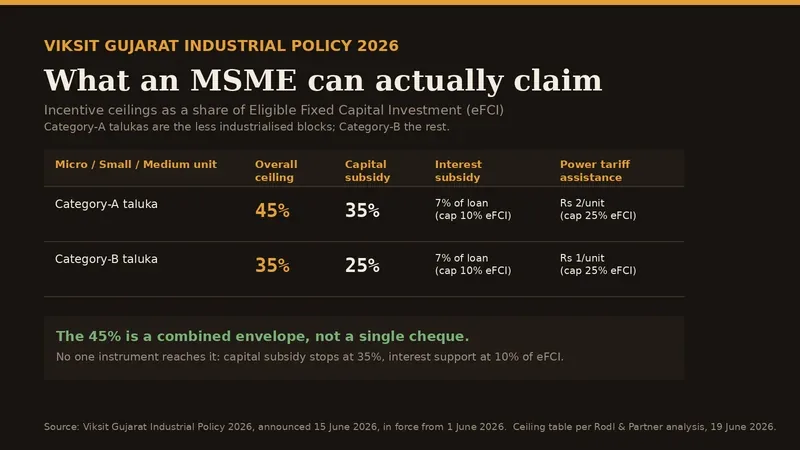
Gujarat classifies its talukas into two categories for incentive purposes. Category-A talukas are the less industrially developed blocks and carry the higher ceilings; Category-B covers the rest. All incentives are computed against Eligible Fixed Capital Investment (eFCI), and an eligible unit chooses a mix of capital subsidy, interest subsidy and power tariff assistance — the “Choose Your Incentive” mechanism the policy leads with.
| Micro / Small / Medium unit | Overall ceiling | Capital subsidy | Interest subsidy | Power tariff assistance |
|---|---|---|---|---|
| Category-A taluka | 45% | 35% | 7% of term loan, capped at 10% of eFCI | ₹2 per unit, capped at 25% of eFCI |
| Category-B taluka | 35% | 25% | 7% of term loan, capped at 10% of eFCI | ₹1 per unit, capped at 25% of eFCI |
Ceilings as set out in Rödl & Partner’s policy analysis, 19 June 2026.
Now do the subtraction. In a Category-A taluka the capital subsidy tops out at 35 points of the 45-point envelope. The remaining ten points cannot be filled with more capital subsidy; they have to come from the interest leg or the power leg. The interest leg reimburses 7% on a term loan and is itself capped at 10% of eFCI — so it only exists if there is a term loan. The power leg is generous on paper (25% of eFCI) but is paid at ₹2 per unit consumed, which means it accrues slowly and only rewards genuinely energy-hungry operations.
The consequence is specific and, as far as I can find, largely unremarked in the coverage so far: a debt-free micro unit in a Category-A taluka is structurally capped at 35%, the same headline rate a Category-B unit sees. The 45% is real, but it is priced in leverage and electricity. Promoters weighing own funds against a term loan should model both routes before assuming the higher number applies to them — the interest-subsidy leg can be worth up to a tenth of eFCI, which is often enough to flip that decision. Our MSME Owner’s Finance Playbook 2026 works through that comparison in detail.
Gandhinagar and Delhi are now using two different tests for “medium”
This is the part most likely to catch a real business out.
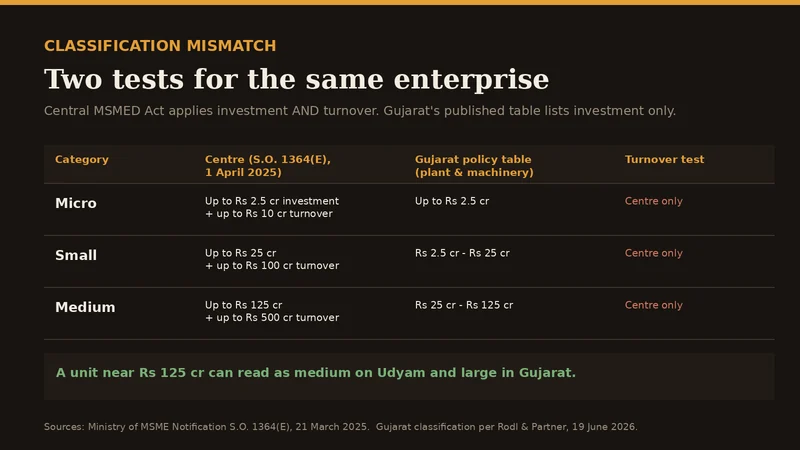
The Union Government revised the MSME classification with effect from 1 April 2025, through Notification S.O. 1364(E) dated 21 March 2025. Under it a micro enterprise is one with investment up to ₹2.5 crore and turnover up to ₹10 crore; small is ₹25 crore and ₹100 crore; medium is ₹125 crore and ₹500 crore. The MSMED Act applies both tests. Breach either limit and the enterprise moves up a category on Udyam.
Gujarat’s classification table, as published in the policy analyses, uses the same investment figures — micro up to ₹2.5 crore of plant and machinery, small above that to ₹25 crore, medium above that to ₹125 crore, large from ₹125 crore upward. But it states only the plant-and-machinery test. No turnover limb appears in the published table.
If that is what the GR ultimately says, a real gap opens. Consider a Rajkot engineering unit with ₹20 crore in plant and machinery and ₹140 crore in turnover. On Udyam it is a medium enterprise, because turnover has crossed the ₹100 crore small-enterprise limb. On Gujarat’s investment-only table it reads as small. Both categories are inside the MSME incentive band here, so the ceiling is unaffected — but the mismatch matters wherever a scheme keys off the Udyam certificate rather than the state’s own reading, and it matters a great deal for a unit sitting near the ₹125 crore line, where one test says medium and the other says large.
I want to be careful here: the guidelines are not out, and the turnover limb may simply have been left to the Udyam certificate rather than omitted. That is the honest state of the question. It is also precisely the kind of thing worth putting to the District Industries Centre in writing before a project report is finalised, rather than after a claim is rejected.
The thrust-sector list nobody quite agrees on
Sector eligibility is where the largest money sits, because the Mega and Ultra-Mega categories are open only to units in notified thrust sectors, and the top incentive band — 50% in a Category-A taluka — is reserved for selected thrust sectors.
The published accounts do not line up. Rödl & Partner’s 19 June analysis sets out 11 core thrust sectors: green energy (hydrogen, ammonia, electrolysers, battery storage, fuel cells); mobility including auto components, aviation and space manufacturing; capital equipment; textiles and apparel; critical mineral processing, metals and ceramics; recycling equipment; chemicals; agro and food processing; healthcare including bulk drugs, APIs and medical devices; semiconductor ancillaries; and nuclear power equipment including small modular reactors. Alongside these it lists further notified sectors — vehicle scrapping, e-waste and textile-waste recycling, shipping containers, heavy earth-moving equipment.
Several other summaries published in the same window describe 21 thrust sectors, expanded from 16. Both descriptions can be internally consistent — one counting core groupings, the other counting the notified list in full — but a business cannot plan against “somewhere between 11 and 21.” Until the GR publishes the schedule, sector eligibility for anything near the boundary is an assumption, not a fact.
Worth noting for the smaller end: sports goods, toys, footwear, robots and drones are singled out for the highest incentive levels available. That is a deliberate pairing of labour-intensive manufacturing with frontier technology, and it is unusually favourable ground for a small unit — a footwear or toy line does not require mega-scale capital to qualify for the top band.
The arithmetic of scale: 45% of small is still small
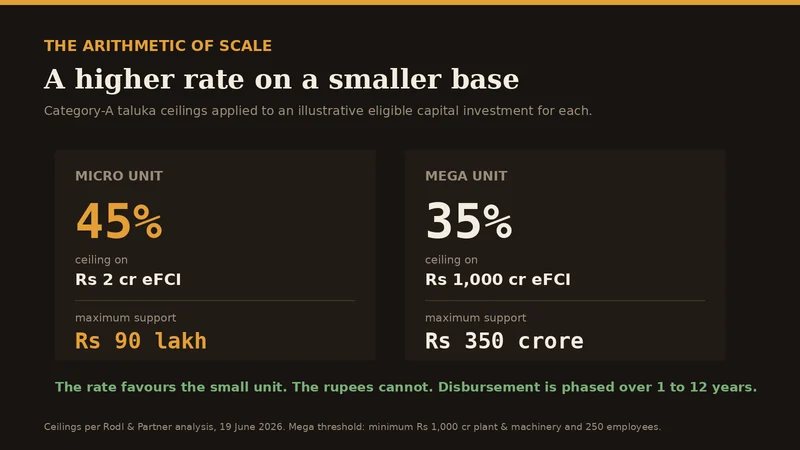
There is a genuine inversion in this policy that deserves credit. A micro or small unit in a Category-A taluka carries a 45% ceiling. A Mega unit — minimum ₹1,000 crore of plant and machinery and 250 employees — carries 35% in the same taluka. A large non-thrust unit carries 20%. On percentage terms, the smallest enterprise is treated more generously than the largest. That is not the usual shape of state incentive policy and it should be said clearly.
Then apply it to the base. Forty-five per cent of a ₹2 crore micro unit’s eFCI is ₹90 lakh, and the policy provides for phased disbursement running anywhere from one to twelve years depending on category. Thirty-five per cent of a ₹1,000 crore mega project is ₹350 crore. The rate favours the small; the rupees do not, and cannot. Generous percentages on a small base remain small numbers — which is why the non-fiscal side of this policy (single-window clearance, the GIS-enabled land bank, the investor facilitation portal, the simplified MSME compliance framework) may end up mattering more to a small promoter than the subsidy table does.
Two further asymmetries are worth naming. Full stamp duty and registration fee reimbursement is available exclusively to Ultra-Mega units — the single largest transaction-cost relief in the policy is explicitly out of MSME reach. And EPF reimbursement of the employer’s statutory contribution, running five to ten years subject to monthly caps, is genuinely valuable to a labour-intensive small unit, but it is a reimbursement: the money goes out first and comes back later, which is a working-capital question before it is an incentive question.
On the other side of the ledger, two provisions do reach smaller and less-advantaged promoters directly. Women entrepreneurs receive an additional 1% interest subsidy plus rental assistance of 75% of rent up to ₹3 lakh a year for five years. SC/ST-promoted MSMEs receive an additional 5 percentage points of incentive ceiling. These are separate claims, not automatic uplifts, and they need to be flagged at application.
Five things worth doing before the GR lands
None of this argues for waiting passively. It argues for preparing the specific things that the guidelines will ask for.
- Get your taluka’s category confirmed in writing. The A/B split is a ten-point swing on the ceiling and a rupee-per-unit difference on power. The taluka schedule rides on the GR; ask the District Industries Centre for the position in writing rather than inferring it from the 2022 list.
- Model the debt route against the own-funds route before you commit. The interest-subsidy leg is worth up to 10% of eFCI and only exists if there is a term loan. For a project near the boundary, that can change the financing decision entirely.
- Document your commissioning and invoice dates now. The policy runs from 1 June 2026, but the eligibility window and the cut-offs for what counts as eFCI will be defined in the guidelines. Contemporaneous records are cheap to keep and impossible to reconstruct.
- Reconcile your Udyam category against the state table. If turnover puts you in a higher central category than plant and machinery does, get the classification question settled with the DIC before it becomes a claim dispute.
- If the promoter is a woman or from an SC/ST background, prepare that documentation as a separate file. The additional 1% interest subsidy and the extra 5% ceiling are distinct entitlements and are far harder to add to a claim after the fact.
Gujarat has roughly 30.3 lakh Udyam-registered MSMEs as of June 2026, among the largest state cohorts in the country. Most of them will never make a claim under a policy like this one, for reasons that have very little to do with the ceiling rate and a great deal to do with whether the paperwork is ready when the window opens. The units that do well out of the next five years will not be the ones that read the headline number fastest. They will be the ones whose files were already in order when the guidelines were finally notified.
Sources
- PwC India, Viksit Gujarat Industrial Policy, 2026, tax and regulatory insight, published 22 June 2026 — policy validity, alignment with Viksit Bharat@2047, and the note that the Government Order and detailed guidelines remain awaited. pwc.in
- Rödl & Partner, From Viksit Bharat to Viksit Gujarat: Decoding Gujarat’s new industrial policy 2026, published 19 June 2026 (updated 4 August 2026) — incentive ceiling table by unit type and taluka category, enterprise classification thresholds, the 11 core thrust sectors, EPF and stamp duty provisions. roedl.com
- Ministry of Micro, Small and Medium Enterprises, Government of India, Notification S.O. 1364(E) dated 21 March 2025, effective 1 April 2025 — revised MSME investment and turnover classification limits (announced in the Union Budget 2025 speech; see PIB release on enhanced classification limits).
- IMPRI India, Viksit Gujarat Industrial Policy, 2026: Investment, Innovation and Industrial Transformation, policy update, June 2026 — thrust-sector count and Ultra-Mega category thresholds.
- Udyam Registration data reported via IBEF, June 2026 — Gujarat’s registered MSME cohort and national Udyam registration totals.
A note on method: every figure above is attributed to a named source with a publication date. Because the Government Resolution and operating guidelines had not been notified at the time of writing, the incentive figures reflect the policy as announced and as analysed by professional advisers, not a notified entitlement. Readers should verify against the GR once issued.
- Haryana’s MSME Policy 2026: Seven-Day Subsidies, 16 Barred Sectors and the Compliance Gap
- Nine Years On, Uttar Pradesh Bets Big on Industry, Investment and MSME Growth
- Union Budget 2026 MSME Highlights: Schemes, Subsidies and What to Apply For
- How to Use the CGTMSE Guarantee to Get Your First MSME Loan
- 📘 E-book: The MSME Owner’s Finance Playbook 2026 — capital subsidy, interest subsidy and the financing decision
📬 The Inner Circle
Weekly MSME policy intelligence, read closely and sourced properly — free. Plus the 20 Gita Lessons PDF as a welcome gift.
Subscribe Free →Working through a state incentive claim?
If you are sizing a project against a state industrial policy and want a second reading of the eligibility and financing mix, I offer focused strategy consultations.
Book a Free Strategy CallPublished 23 August 2026 · dibyenduchoudhury.com