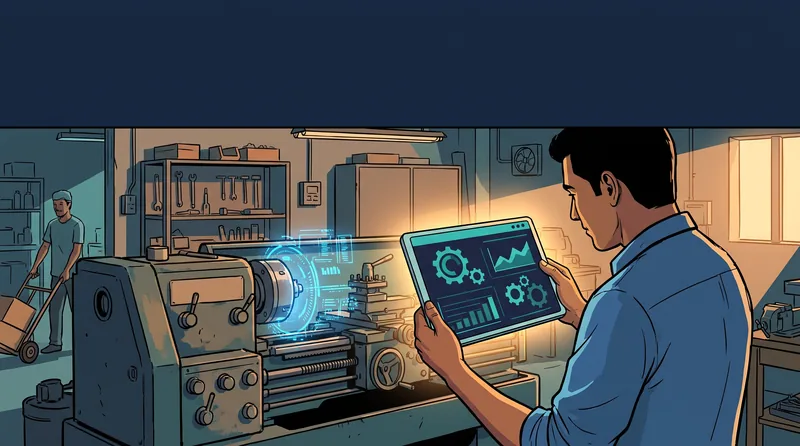
In May this year, at its India Partner Summit in Goa, Zebra Technologies told its reseller network that it would push harder into Indian small business — specifically manufacturing and retail — by opening its Mid-Market programme to Indian partners. The announcement, reported by KNN India on 6 May 2026, marked ten years of the company's PartnerConnect programme, which it says now has more than 10,000 partners worldwide.
The justification offered was the size of the opportunity. India, the company said, is home to over 70 million MSMEs contributing around 31% of GDP and nearly half of its exports. Subramaniam Thiruppathi, Zebra's Country Lead for India and the Subcontinent, put it this way: “India's MSME sector is a growth engine, yet many enterprises remain fragmented and lack access to scalable technology.”
Every part of that sentence is defensible. The number attached to it is not — and the gap between the number and the register turns out to be the most useful thing in the whole announcement.
A press release, a register, and a 21-million gap
India does not estimate its formal small-business population any more. It counts it. The Udyam Registration Portal has been live since 1 July 2020, and the Udyam Assist Platform — built specifically to bring informal micro enterprises onto the record — since 11 January 2023. Both produce a hard cumulative number, and the Ministry of MSME publishes it.
On 30 March 2026, replying in the Rajya Sabha, Minister of State Shobha Karandlaje placed the total at 7,83,02,882 enterprises as on 28 February 2026. Four months later, in the Press Information Bureau release accompanying the passage of the MSME Development (Amendment) Bill on 7 August 2026, the Ministry cited 9.16 crore.
| As on | Cumulative registrations | Source |
|---|---|---|
| End FY 2021-22 | 0.79 crore | PIB, 30 Mar 2026 |
| End FY 2022-23 | 1.64 crore | PIB, 30 Mar 2026 |
| End FY 2023-24 | 4.12 crore | PIB, 30 Mar 2026 |
| End FY 2024-25 | 6.19 crore | PIB, 30 Mar 2026 |
| 28 Feb 2026 | 7.83 crore | PIB, 30 Mar 2026 |
| 7 Aug 2026 | 9.16 crore | PIB, 7 Aug 2026 |
So the figure quoted in Goa in May — 70 million — was roughly eight million short of the register on the day it was spoken, and is about twenty-one million short today. That is not a rounding error. It is a company describing a market it has not measured recently, using a number that has been circulating in Indian business coverage for years after it stopped being true.
This matters more than it sounds. A vendor that undercounts a market by 23% is unlikely to have segmented it correctly either — and segmentation is exactly where a mid-market channel strategy lives or dies.
What “mid-market” means when 99 in 100 are micro
The Udyam number is enormous, but it is not evenly distributed. Micro enterprises account for roughly 98.9% of registrations. Apply that share to 9.16 crore and you are left with something on the order of ten lakh small and medium units. Separately reported counts from the register — about 4.9 lakh small and 37,042 medium — suggest the genuine non-micro base may be closer to half that. The two readings do not reconcile cleanly, and I would not pretend otherwise. What both readings agree on is the order of magnitude: the non-micro segment is measured in lakhs, not crores.
Now read the announcement again. Zebra is not opening a micro-enterprise programme. It is opening its Mid-Market programme to Indian resellers, aimed at businesses ready to move “from manual processes to automated, connected systems” and to scale into larger markets. That is a precise and perfectly reasonable commercial target. But it is a target of a few hundred thousand firms, not seventy or ninety million.
The 70-million framing does real damage here, and not to Zebra. It sets an expectation among Indian readers — and among the trade press that reprints these announcements — that enterprise hardware vendors are arriving to serve the kirana shop and the four-machine job-work unit. They are not, and there is no dishonesty in their not doing so. The dishonesty is in the headline arithmetic.
Zebra's own earnings call does not name India
There is a cleaner way to test how much of a bet this really is: look at what the company tells its investors rather than its channel.
Zebra's second-quarter 2026 results, filed on 4 August 2026, were strong. Net sales reached $1,557 million, up 20.4% year on year, with organic growth of 9.2%. Its Asset Visibility and Automation segment grew 11.4%; Connected Frontline grew 7.5%. Regionally, Latin America led at 15%, followed by Asia-Pacific at 13%, North America at 9% and EMEA at 7%.
The detail worth pausing on is what drove Asia-Pacific. The company attributed that 13% to China, Korea and Southeast Asia. India is not named. That is not evidence of failure — India may simply be too small a base to move a regional line, which is consistent with a market the company is only now building channel depth in. But it does calibrate the announcement. A partner summit in Goa is the beginning of a distribution experiment, not the report of one that has worked.
One handheld against one enterprise: the unit economics
Set the corporate framing aside and price the thing.
Indian distributors have listed Zebra's entry-tier TC2x-series Android handheld at around ₹26,000 per unit. Treat that as indicative rather than current — channel pricing moves and volume changes it — but it is the right order of magnitude for a rugged, warrantied, enterprise-grade scanner-computer. A small unit does not buy one. It buys three or four, plus a label printer, plus software, plus the integration work to make any of it talk to whatever it already uses for billing.
Now put that beside what the state actually spends per enterprise on digital adoption. The Ministry of MSME's Trade Enablement and Marketing (TEAM) initiative, launched on 27 June 2024 under the RAMP programme with the National Small Industries Corporation as implementing agency, carries an outlay of ₹277.35 crore over three years to onboard five lakh MSMEs onto ONDC, half of them women-led. Divide one by the other and the scheme's design budget is about ₹5,547 per enterprise.
One handheld therefore costs roughly four and a half times everything the flagship digital-adoption scheme is designed to spend on an enterprise across three years. That is not an argument against the hardware — a device that prevents one mis-shipped export consignment can repay itself in a week. It is an argument that shop-floor automation in India is, and will remain, a self-funded capital decision made by the owner, not something a scheme or a vendor programme will subsidise into existence. Anyone budgeting for it should treat it the way they would treat any other machine purchase, which is the framing I set out in the MSME Owner's Finance Playbook 2026.
The constraint that never appears in the announcement
Vendor announcements describe the buying decision. They rarely describe the running of the thing afterwards, which is where Indian small units actually stall.
SIDBI's MSME Outlook Survey, whose fifth edition appeared in February 2026, put the composite MSME Business Conditions Index at 60.8 for October–December 2025, marginally below 61.6 in the preceding quarter — expansionary, but flattening. Two findings from that survey bear directly on this announcement. First, around a quarter of surveyed MSMEs name the lack of skilled manpower among their major challenges. Second, exporting MSMEs are measurably better positioned on technology adoption than non-exporters.
Read together, those two say something a partner summit will not. The binding constraint on automating an Indian shop floor is frequently not the price of the device; it is whether anyone on the premises can configure it, maintain it, and rebuild the process around it when it changes. A partner-led model shifts exactly that burden onto the reseller — and the quality of Indian channel partners in tier-2 and tier-3 clusters varies enormously. Whether Zebra's Mid-Market programme succeeds here will be decided by reseller capability in Ludhiana, Coimbatore and Rajkot, not by anything said in Goa.
The exporter finding also tells you who buys first. Firms already exporting have external compliance pressure — traceability, labelling, batch records — that turns barcode and RFID infrastructure from a nice-to-have into a customer requirement. Ministry of MSME data shows exporting MSMEs rising from 52,849 in 2020-21 to 1,73,350 in 2024-25, with MSME exports reaching ₹12.39 lakh crore, about 45.8% of India's total. That population of roughly 1.7 lakh exporters, not the 9.16 crore register, is the honest addressable market for this announcement in its first phase.
Where India's MSME digitisation money actually moved
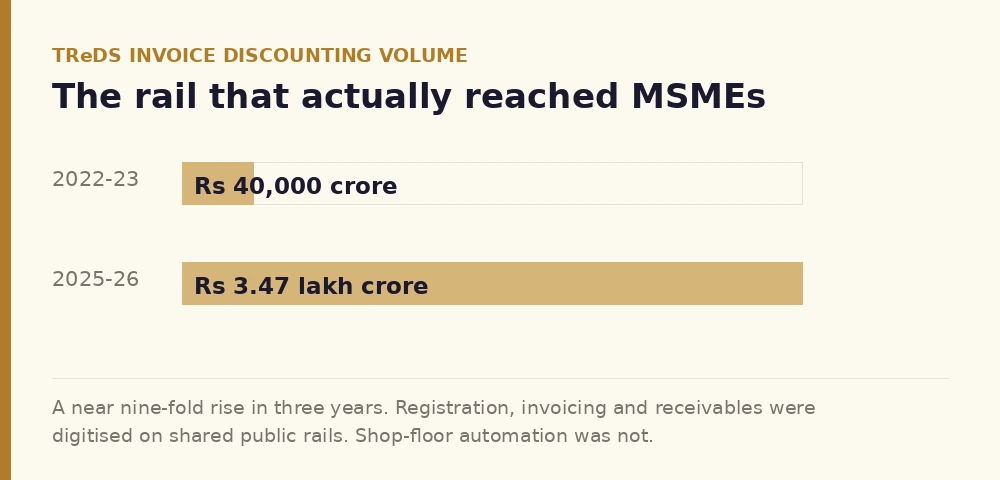
It is worth noting what did get digitised at scale in Indian small business over the same period, because it was not the shop floor.
The same PIB release that recorded 9.16 crore Udyam registrations disclosed that the volume of invoice discounting on the Trade Receivables Discounting System rose from ₹40,000 crore in 2022-23 to ₹3.47 lakh crore in 2025-26 — roughly nine-fold in three years. The MSME Development (Amendment) Bill passed by the Rajya Sabha on 3 August and the Lok Sabha on 7 August 2026 now mandates that Central Public Sector Enterprises route MSME invoice settlements through TReDS, introduces online dispute resolution, and requires courts to release at least 50% of an award to a micro or small supplier where a set-aside application has been pending beyond six months.
That is the pattern of the last five years: India's MSME digitisation has been overwhelmingly financial and administrative — registration, invoicing, receivables, dispute resolution — delivered through shared public rails at near-zero cost to the enterprise. Udyam registration itself is free and voluntary, and the amendment makes the portal permanent in statute. Operational digitisation, the kind Zebra sells, has no comparable public rail and no comparable subsidy. It has been left entirely to the market, which is precisely why a vendor channel strategy is the mechanism being used.
A payback test before you sign the purchase order
If you run a manufacturing or retail unit and a reseller is now going to call on you with this proposition, the useful question is not whether the technology works. It does. The question is whether your specific losses are large enough and recurring enough to repay it.
Work it in this order. Name the loss line first, in rupees, before anyone names a device: stock shrinkage, expiry write-offs, wrong-item dispatch, rework on mislabelled batches, penalties or debit notes from a buyer for documentation errors. Pull twelve months of that number from your own books. Then take the fully-loaded cost of the proposed system — devices, printers, consumables, software subscription, integration, and one person's time to run it — and ask what share of that loss line it credibly removes in year one. If the answer is under half, the payback is longer than the device's practical life in a dusty Indian shed, and you are buying a capability you are not yet ready to use.
Two situations invert that test. If a buyer — an OEM, an export customer, a large retail chain, or a CPSE tender — has made barcode-level traceability a condition of supply, the arithmetic is no longer about savings but about access to the order, and the loss of the contract is the number to compare against. And if you are already exporting, or intend to within the year, the compliance requirement will arrive whether you plan for it or not — a point I take up in more detail in Export Ready.
What would change this reading
I would revise this assessment on three specific signals, and it is worth saying what they are rather than hedging.
First, if Zebra or a peer names India in a quarterly regional attribution the way it currently names China and Korea, the channel build has begun converting. Second, if a state industrial policy or a central scheme brings shop-floor traceability hardware inside a capital-subsidy window — several state policies already subsidise plant and machinery, and there is no principled reason scanners and label printers sit outside that definition — the unit economics above change materially and quickly. Third, if the MSME Champions schemes the Ministry lists alongside TEAM, particularly the Lean and ZED components, start funding measurement infrastructure rather than certification and training alone, the public rail this category currently lacks would begin to exist.
Until one of those happens, treat the announcement as what it is: a serious global vendor building a distribution channel into a genuinely large and under-served market, describing that market with a number that is now twenty-one million short. The opportunity is real. The arithmetic in the press release is not.
Sources
• Press Information Bureau, Ministry of Micro, Small & Medium Enterprises — “Over 7.83 crore enterprises registered on Udyam Registration Portal (URP)”, Rajya Sabha reply by MoS Shobha Karandlaje, 30 March 2026 (Release ID 2246892).
• Press Information Bureau, Ministry of MSME — “The Micro, Small and Medium Enterprises Development (Amendment) Bill, 2026 passed by Parliament”, 7 August 2026 (Udyam 9.16 crore; TReDS volumes; employment).
• KNN India — “Zebra Technologies To Expand Partner-Led Strategy To Drive MSME Digital Adoption In India”, 6 May 2026 (India Partner Summit, Goa; PartnerConnect; Thiruppathi quote).
• Zebra Technologies Corporation — Second Quarter 2026 results, Form 8-K exhibit and earnings call, 4 August 2026 (net sales $1,557M, +20.4%; Asia-Pacific +13% led by China, Korea, Southeast Asia).
• Ministry of MSME, Annual Report 2025-26 — MSME share in GVA (30.1% in 2022-23); MSME exports ₹12.39 lakh crore and 45.79% share in 2024-25; exporting MSMEs 1,73,350.
• Ministry of MSME / ONDC — MSME Trade Enablement and Marketing (TEAM) initiative under RAMP, launched 27 June 2024, outlay ₹277.35 crore for 2024-27, target five lakh MSMEs, NSIC implementing agency.
• Small Industries Development Bank of India — MSME Outlook Survey, fifth edition, February 2026 (M-BCI 60.8 for Oct–Dec 2025; skilled-manpower constraint; exporter vs non-exporter technology adoption).
• Indian distributor listings for the Zebra TC21/TC22 mobile computer, cited as indicative pricing only.
Further reading
• The MSME Owner's Finance Playbook 2026 — how to structure and appraise a capital purchase of this kind.
• Export Ready: The Indian MSME's First 90 Days in Global Trade — the traceability and documentation requirements that turn this hardware into a condition of supply.
• Indian Firms Spent Big on AI at Scale, Only 12% See Proven ROI — the same gap between announced ambition and measured return, one layer up the stack.