← All Editions
Edition #21 · October 2026
There is a moment in writing fiction that nobody warns you about, and it arrives late enough to be expensive.
You have your characters. You have the shape of the thing. And then you need a place for it to happen, and you reach for the nearest available world — a cave system borrowed from a film you half-remember, a subterranean city assembled out of other people’s subterranean cities, lit by the same green phosphorescence that lights all of them. It works. It will pass. Every reader has seen it before, which is exactly why it passes, and exactly what is wrong with it.
I reached that moment writing the Patal Lok Series and I did the honest thing, which was to put the manuscript down and go and find out what my own tradition actually says about what is underneath.
I want to tell you what happened next, because it has changed how I think about the relationship between research and writing — and I suspect it applies well beyond fiction.
Ask an educated Indian adult to name the seven upper worlds and you will usually get Svarga, a pause, and an apology. Ask about the seven lower worlds and you will get one word — Patala — used as a loose synonym for hell.
I had been using it that way myself. Not deliberately. I had simply absorbed the equivalence from the air, the way you absorb the idea that the Mahabharata is a war story, and I had been about to build a novel on top of an assumption I had never once examined.
The Sanskrit sources are not vague here. The fifth canto of the Srimad Bhagavatam gives the lower worlds an entire chapter. It names seven, in order — Atala, Vitala, Sutala, Talatala, Mahatala, Rasatala, Patala — and places them seventy thousand yojanas below the earth. It describes their rulers, their architecture, their light, and their moral character with the sort of specificity that a cartographer would recognise.
And then there is the detail that stopped me, which is not in the body of the chapter at all but in its title. The chapter is called, in translation, The Subterranean Heavenly Planets.
Heavenly. Not infernal. The tradition that is supposed to have put hell down there filed the whole region under heaven and said so in the heading, and we have been translating “underworld” over the top of it for a century and a half.
I had gone looking for a setting. What I came back with was a correction.
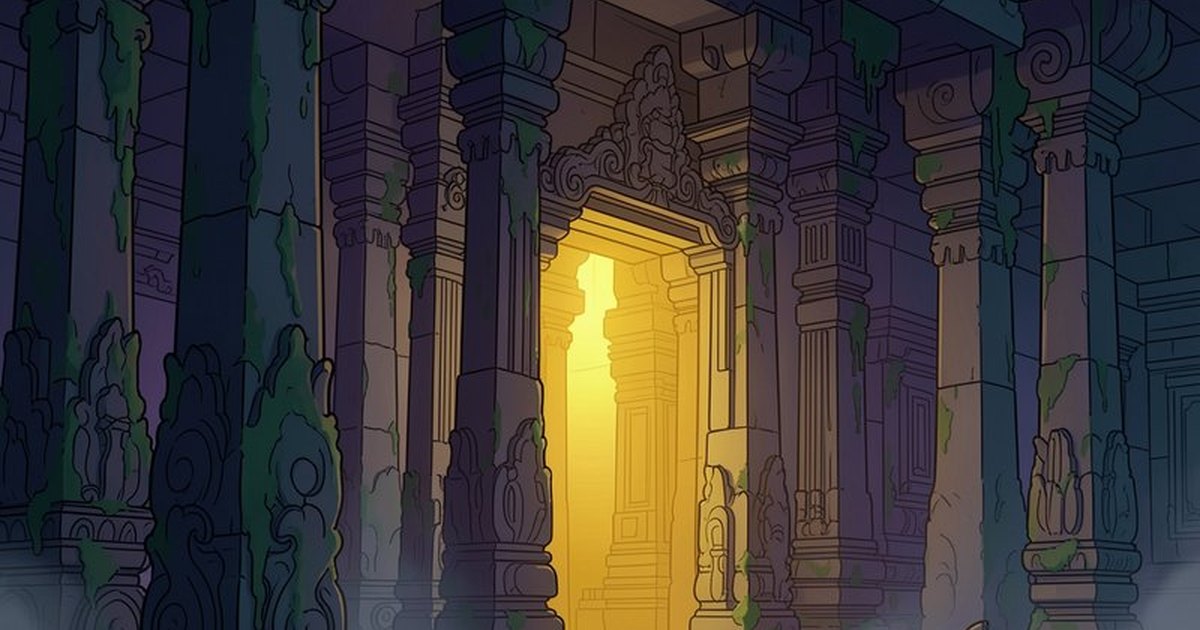
The lower worlds of the Bhagavatam are not a pit of punishment. By the text’s own description they are more beautiful than the heavens above — better lit, better built, better supplied. There are flying cities in them. There are kings who are not villains. There are jewels that serve as the light source for an entire world, which is a piece of worldbuilding so much better than phosphorescent moss that I felt faintly embarrassed on behalf of my own first draft.
And here is the thing I want to be careful about, because it is the actual point and it is easy to overstate.
None of that is more true than the cave system I had borrowed. I am not making a claim here about geology. What it is, is more sourced. It comes from somewhere. It has a provenance a reader can follow out of my book and into a text that is older than my book by a very long way, and that provenance does something to the reading that invention cannot do, however good the invention is.
A borrowed world asks the reader to suspend disbelief. A sourced world asks the reader to go and look.
Because the research did not fit in the novel, and I think that is the most useful part of the whole episode.
Fiction can only carry what the story can carry. A character does not stop mid-flight to explain the sevenfold enumeration of the lower worlds, or to note which of the seven houses which ruler, or to weigh the three quite different ways you can read who the nagas actually are. Put that in the chapter and you have killed the chapter. Leave it out and you have thrown away the better half of a year’s reading.
So I did what I have come to think every writer with a research habit should do, which is to stop treating the leftover as waste. The cosmology came out of the novel and became its own short illustrated volume — fourteen pages, one map, the seven worlds in order, and a closing chapter on how a novelist turns a cosmology into craft without turning the novel into a lecture.
I am not sure I would have seen that as a book two years ago. I would have seen it as notes.
Whatever you are building — a novel, a business, a course, a case for a policy — you will at some point reach for the nearest available version of the thing you need, because the nearest available version is free and arrives instantly and is good enough.
It is almost always good enough. That is the trap. Good enough is what a reader forgets.
The alternative costs weeks and has no guaranteed return, and occasionally it does something no amount of craft will do for you: it tells you that the thing you were about to build was resting on a word you had never looked up. I thought I was researching a setting. What I was actually doing was finding out that I had mistranslated the word my own series is named after.
I would not have found that by being more imaginative. I found it by being less.
If you want the full map rather than this edition’s sketch of it, the research behind the Patal Lok Series is now its own illustrated volume. The Real Geography of Patala — Nagas, the Seven Lower Worlds, and the Map Beneath the Map. Fourteen pages, illustrated: why “underworld” is the wrong translation, the kings and the flying cities, the nagas of the lower three worlds, and a closing chapter on turning a cosmology into craft. Rs 59.
Get the E-Book — Rs 59 →The nine published books, including the Nagaloka fiction this research grew out of, are gathered at the book portfolio.
MSME policy, Vedic wisdom, AI insights & book updates — weekly by Dr. Dibyendu Choudhury. Unsubscribe anytime.
🎁 Free gift: 20 Gita Lessons PDF on confirmation