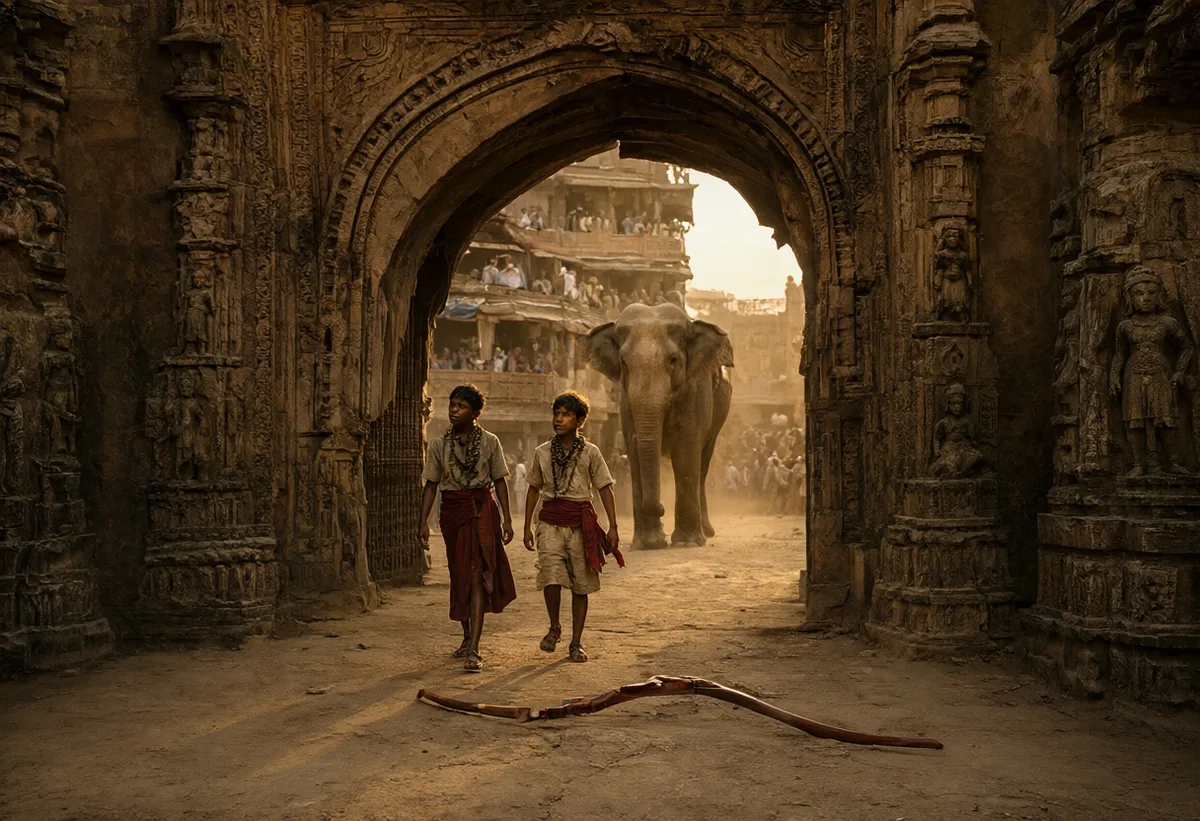
You have read that the Bhagavad-gītā is the great manual of spiritual instruction. Then notice what it makes you wait through. An entire chapter passes, and six verses of the next, before a single word of teaching is given. All of it is one man describing his collapse. Arjuna tells Kṛṣṇa that his limbs are failing, that his mouth is drying, that his skin is burning and his bow is slipping out of his hand, and Bhagavad-gītā 1.29 and 1.30 record every symptom without embarrassment. He is not corrected for feeling this. He is simply left to keep speaking. And nothing whatever is taught to him, because he has not yet asked anything. He has only described. Hold that fact. Your own suffering is sitting in exactly that stretch of the book, and the way out of it has nothing to do with feeling better first.
Depression Is a Question, Not a Verdict: Arjuna Becomes a Disciple
Look at what Arjuna is actually doing through that whole stretch. He is arguing. He supplies reasons, and the reasons sound principled — the dynasty will be destroyed, the family traditions will be ruined, and in Bhagavad-gītā 1.31 he declares that he foresees no good whatsoever coming from killing his own kinsmen. This is despair dressed in the costume of ethics, and you know that costume intimately, because your mind hands it to you every time you cannot move. You do not tell yourself you are paralysed. You tell yourself you are being careful, being responsible, protecting someone. Notice where all this argument lands him. By Bhagavad-gītā 2.6 he admits outright that he does not know which is better, that they should conquer him or that he should conquer them. A whole chapter of eloquence delivers him to a place of total blankness. That is the exact yield of despair spoken to oneself, and however long you extend it, the yield never changes. Then something breaks. In the very next verse Arjuna stops explaining himself and does something structurally different: he turns his condition into a question and hands it to somebody qualified to answer. He names his own disease first, and the name he gives it is precise.
kārpaṇya-doṣopahata-svabhāvaḥ pṛcchāmi tvāṁ dharma-sammūḍha-cetāḥ yac chreyaḥ syān niścitaṁ brūhi tan me śiṣyas te ’haṁ śādhi māṁ tvāṁ prapannam
— Bhagavad-gītā 2.7
Translation: Now I am confused about my duty and have lost all composure because of miserly weakness. In this condition I am asking You to tell me for certain what is best for me. Now I am Your disciple, and a soul surrendered unto You. Please instruct me.
Purport: Mark the word Arjuna chooses for himself: kārpaṇya-doṣa, the fault of the miser. A miser is not a man without wealth; he is a man who owns wealth and will not spend it. Arjuna possesses this human form, possesses Kṛṣṇa standing an arm's length away, and has been spending neither. That is the doṣa. Then mark what he does with the diagnosis — pṛcchāmi tvām, I ask You. Not I lament, not I explain. I ask. And he closes the verse by fixing the relationship in place: śiṣyas te 'haṁ, I am Your disciple, correct me. Nothing in his circumstances has changed. The armies still stand there, the grief is untouched. What has changed is that his misery now has a direction, and misery with a direction is no longer a circle.
Karpanya-Dosa: When Miserliness of Heart Clouds the Duty You Know
That single move is the hinge of the whole book, and Kṛṣṇa later states the principle in the open. In Bhagavad-gītā 4.34 He tells you how transcendental knowledge is actually received: by approaching a spiritual master, by submissive inquiry, and by service — praṇipāta first, paripraśna second. The order is not decorative. A question asked from above the teacher is a test; a question asked from below him is an opening. You have already run the first kind for years. You have interrogated your own grief, cross-examined it at three in the morning, demanded that it justify itself, and it has answered you in your own voice with your own material every time. A closed system cannot correct itself. Śrīmad-Bhāgavatam 3.25.25 puts the remedy exactly there: it is in the association of those fixed in truth, where the message of the Supreme is heard and discussed, that the path opens. Notice also that Arjuna's surrender does not switch off his condition like a lamp. In Bhagavad-gītā 2.9 he still says, I shall not fight, and then falls silent. He is still shattered. But he is shattered inside a relationship now, and Bhagavad-gītā 2.10 shows Kṛṣṇa beginning to speak precisely to that grief-stricken man, in the middle of both armies, without waiting for him to improve.
“Despair kept inside your own head is a closed circuit; despair handed to a qualified teacher becomes a problem with an answer. The Bhagavad-gītā does not begin when Arjuna stops suffering — it begins when he stops narrating and asks.”
The Moment Despair Turns Into Inquiry
Follow what Kṛṣṇa establishes immediately after. In Bhagavad-gītā 2.12 He tells Arjuna that there was never a time when He, or Arjuna, or any of these kings did not exist, and never will there be a time when they cease to be. In 2.13 He gives the analogy you can verify without any scripture at all: the embodied soul passes through boyhood, youth and old age within one body, and passes into another body at death, and the sober person is not bewildered by that change. In Bhagavad-gītā 2.20 He states it flatly — the soul is never born and never dies, and is not slain when the body is slain. Now put those verses against Arjuna's list of reasons. Every grief he catalogued was calculated on the assumption that these bodies are the people. Strip out that assumption and the arithmetic collapses. This is why Kṛṣṇa refuses to validate the lament: validating it would have confirmed the very error producing it. And notice that He does not tell Arjuna the pain is imaginary. Bhagavad-gītā 2.14 grants outright that the contacts of the senses produce heat and cold, pleasure and pain, that they come and go, and that they must be tolerated. Real, and not final.
śrī-bhagavān uvāca aśocyān anvaśocas tvaṁ prajñā-vādāṁś ca bhāṣase gatāsūn agatāsūṁś ca nānuśocanti paṇḍitāḥ
— Bhagavad-gītā 2.11
Translation: The Supreme Personality of Godhead said: While speaking learned words, you are mourning for what is not worthy of grief. Those who are wise lament neither for the living nor for the dead.
Purport: Read what Kṛṣṇa actually says in Bhagavad-gītā 2.11, because it is not what any sympathetic friend would say. Aśocyān anvaśocas tvaṁ — you are grieving for what is not worthy of grief. Prajñā-vādāṁś ca bhāṣase — and you are speaking learned words while you do it. He does not begin with comfort. He begins by taking apart the premise underneath the pain, which is Arjuna's conviction that these bodies before him are the persons he loves. Correcting a false premise is not coldness. A physician who agreed with your self-diagnosis to spare your feelings would be the cruel one. And mark the qualification hidden in the verse: paṇḍitāḥ, the wise, do not lament for the living or the dead. Kṛṣṇa is not forbidding Arjuna to feel. He is telling him what the feeling is built on.
Mourning for What Is Not Worthy of Grief
Here I must be exact with you, because this teaching is easily misused. Clinical depression is a medical condition. It has a physiology, it responds to treatment, and it kills people who do not receive treatment. If you cannot sleep, cannot eat, cannot work, if the weight has sat on you for weeks and thoughts of ending your life have started arriving, then go to a qualified doctor and go this week. That is not a defeat of faith and it is not a lapse in devotion; a fractured femur is set by a surgeon and no one calls the patient faithless for it. Bhagavad-gītā 2.14 concerns the tolerance of the soul, not the treatment of the body, and what I am placing before you here addresses the dimension medicine does not reach. Take both. Then, in that dimension: do what Arjuna did in Bhagavad-gītā 2.7. Convert the description into a question and give the question to someone above you — a bona fide teacher, the śāstra itself, Kṛṣṇa directly. Śrīmad-Bhāgavatam 11.2.37 identifies the root of fear as absorption in the illusory second thing, forgetfulness of the Lord, and Śrīmad-Bhāgavatam 1.2.17 promises that Kṛṣṇa, seated within the heart, actively removes what is inauspicious in the heart of one who takes up hearing about Him.
Arjuna's crisis ends at Bhagavad-gītā 18.73, where he tells Kṛṣṇa that his illusion is gone, his memory is recovered, and he is prepared to act. Seven hundred verses separate that sentence from the collapse you met in the first chapter, and every one of them was made possible by the four lines where he said, I am Your disciple, instruct me. The despair was never the disqualification. The refusal to hand it to anyone was. So do not wait until you feel strong enough to approach Kṛṣṇa; Arjuna approached Him unable to stand, his bow already on the ground. Bhagavad-gītā 6.5 tells you to deliver yourself by your own mind, not degrade yourself, and this asking is the one act by which a sunk mind lifts itself. Your depression is not a verdict. It is a question you have not yet addressed to anyone qualified to answer it. Address it.
From the Book
This article draws on the Depression chapter of Bhagavad Gita for Everyday Life, my forthcoming book applying Kṛṣṇa’s instruction to the specific afflictions of ordinary life. The chapter treats every verse the Gītā assigns to depression, verse by verse, with the word-by-word meaning and its application to work and family.
Go deeper now: The Steady Sage.