Most retellings of Krishna's victory over Kamsa go straight to the end: the arena, the throne, the fall of the tyrant. The Bhagavata Purana, however, spends a surprising amount of its attention on the road into the city. Before the great confrontation, there is a procession of smaller encounters, some hostile and some tender, and the order in which they come is deliberate. It is as though the text wants us to understand that the decisive day is never one event. It is a sequence of gates, and each gate asks a different question.
This is a retelling in my own words of that sequence, drawn from the tenth book of the Bhagavata, together with a reflection on what it offers anyone who has an important day ahead.
The road to Mathura
The story begins in Vraja, the cowherd settlement where the two brothers have grown up. Kamsa, the king of Mathura and the uncle who has long feared Krishna, arranges a great festival centred on a ceremonial bow and a wrestling match. His real purpose is to draw the boys into his city and be rid of them. He sends Akrura, a devotee in his court, to invite them. Akrura understands the danger perfectly well and carries the invitation anyway, loyal in his heart to the very children he has been sent to deliver.
The brothers go. Their foster parents and the people of Vraja grieve at the parting, and the text lingers on that grief. The journey to the city is not a triumphant march. It is a departure from home, and the feeling of leaving is part of the story.
The small encounters
As Krishna and Balarama walk through the streets of Mathura, the text introduces a series of ordinary people. A tailor decorates them with fine cloth, and he is blessed for it. A garland-maker, whom the tradition names Sudama, offers flowers freely and with evident joy, and receives a gift in return. A hunchbacked woman who carries fragrant ointments for the king, remembered as Kubja, gives them some of it, and Krishna straightens her back with a gentle touch.
Pause on these moments, because they are easily skipped. In a story that is about to arrive at a violent contest, the narrator slows down to show generosity being recognised, and cowardice and rudeness being met with equal clarity. The text is telling us how to read what comes next. The brothers are not merely strong. They are attentive to ordinary people, and the ordinary people respond.
The first gate: the bow
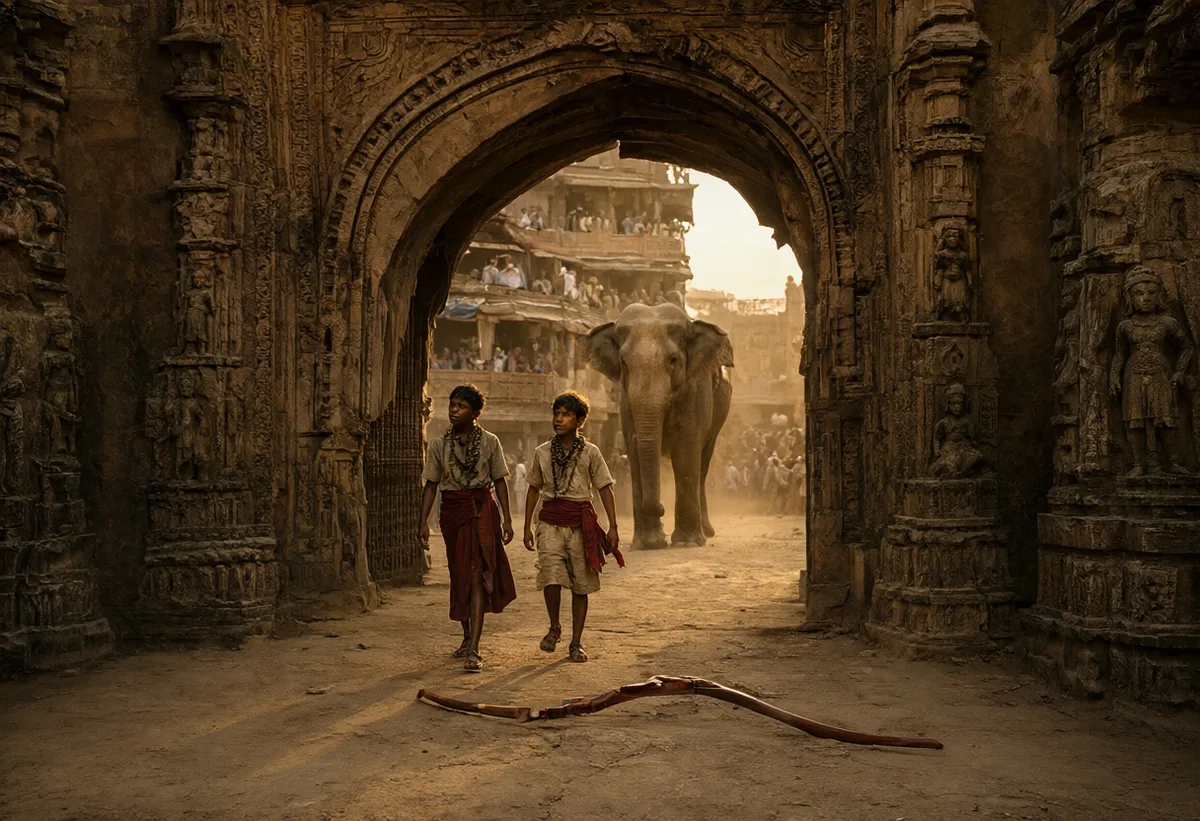
The first test is an object. In the hall of the festival stands an enormous ceremonial bow, guarded and worshipped as the king's own. Krishna walks up to it, lifts it, and bends it until it snaps with a sound that fills the city. The guards rush forward and are dealt with.
Symbolically, this is the test of the instrument. The bow represents the apparatus of power that a tyrant has built around himself: the ritual, the guard, the thing that everyone has agreed is untouchable. The lesson of the first gate is that much of what looks immovable is protected mainly by consensus. A confident, unhesitating hand often finds that the thing was heavier in the imagination than in the grip.
The second gate: the elephant
The next morning, as the brothers approach the arena, the way is blocked by a war elephant named Kuvalayapida, set at the gate by the king's order, with a driver instructed to urge it forward against them. The animal is massive and trained for exactly this. Krishna and Balarama do not retreat, and the text dwells on how they deal with the beast, avoiding its charge, using its size against it, and finally overcoming it.
This is the test of the unexpected obstacle. It is not the contest anyone advertised. It is an extra hazard placed in the way by someone who did not intend a fair match. Anyone who has prepared carefully for a major presentation, interview or negotiation will recognise the elephant: the delayed train, the unannounced question, the new person added to the panel. The second gate says that the obstacle you did not rehearse still has to be met, and that the preparation worth having is the kind that makes you steady in front of surprises, not only fluent in front of the expected.
The third gate: the ring of wrestlers
Only then do the brothers enter the arena itself, where the king sits high above the crowd and where Kamsa's champion wrestlers, Chanura and Mushtika among them, are waiting. The spectators, the text says, are troubled. They see two youths, barely grown, set against professional fighters, and they murmur that this is unjust, that no fair contest can be made of such a pairing. Some wonder aloud whether the king should permit it at all.
This is the test of the audience's doubt, and it is the subtlest of the three. The crowd is not hostile. It is concerned, and its concern is a kind of pressure. When everyone around you says that the match is unequal, there is a real temptation to accept their description of it. The Bhagavata shows the brothers entering without arguing the point. They simply take their places and fight, and the unequal contest resolves itself in a way the spectators did not expect.
The end of the tyrant
When the wrestlers have fallen, Krishna leaps to the high platform where Kamsa sits and brings the reign of fear to its close. In the tradition he then restores the old king, Ugrasena, to the throne, and frees his own parents, Vasudeva and Devaki, who had been kept in confinement. The resolution is not a seizure of power. It is a return of rightful order, and the brothers do not claim the city for themselves.
That detail is worth remembering. The story is not merely about winning. It is about what is done with the victory afterwards.
What the sequence teaches
Set the three gates side by side and a pattern emerges, one that applies well beyond mythology.
The bow teaches that some barriers are mostly reputation. Test them early and directly before you assume they are solid.
The elephant teaches that the real contest is rarely the one announced in the programme. Build the calm that handles the unscheduled problem, because the unscheduled problem is the one that is certain to turn up.
The wrestlers teach that a room full of sincere doubt can be a heavier thing to carry than a determined opponent. When the crowd describes the odds, listen politely, and then ask yourself whether you have actually done the work. If you have, take your place.
And the small encounters on the road remind us of something that busy people forget. The tailor, the garland-maker and the woman with the ointment are not delays on the way to the real event. They are part of the event. How you treat the ordinary people on the morning of your big day says a good deal about how you will treat the large moment when it arrives.
A practice for the night before
If you have an important day coming, try this. On the evening before, take a page and write three headings: Bow, Elephant, Ring. Under Bow, write the one thing that looks fixed and forbidding but that you have not yet tested. Under Elephant, write the one thing that could go wrong that is not on your plan, and a single sentence about how you will stay steady if it does. Under Ring, write the doubt you expect from the people watching, and the one fact about your own preparation that answers it.
Then, in the morning, add a fourth line: whom will I thank on the way in? It takes two minutes. It turns the myth into a rehearsal, which is what a good myth has always been for.
A closing thought
Stories like this one survive because they hold more than one level at once. At the surface, it is a tale of two young heroes and a cruel king. Underneath, it is a map of what a decisive day actually contains: an instrument, an ambush, an audience, and a long line of people who are watching how you walk in.
When your own day arrives, you may find that the bow was lighter than it looked and the elephant louder than it was dangerous. The one thing nobody can do for you is walk through the gate. The text suggests that, if you have been kind on the road and steady at the entrance, you will be better placed than you think.
This essay retells a traditional narrative for reflection and is not a literal or scholarly account of the text.
📬 Join 49,000+ Indian Professionals
The Inner Circle newsletter delivers curated MSME intelligence, leadership wisdom, and strategic insights every week — completely free. Plus receive the 20 Gita Lessons PDF as a welcome gift.
Subscribe Free →Ready to Go Further?
My mythology and fiction titles bring these stories alive for the modern reader. Available on Amazon India.
Explore My Books on AmazonPublished 25 October 2026 · dibyenduchoudhury.com