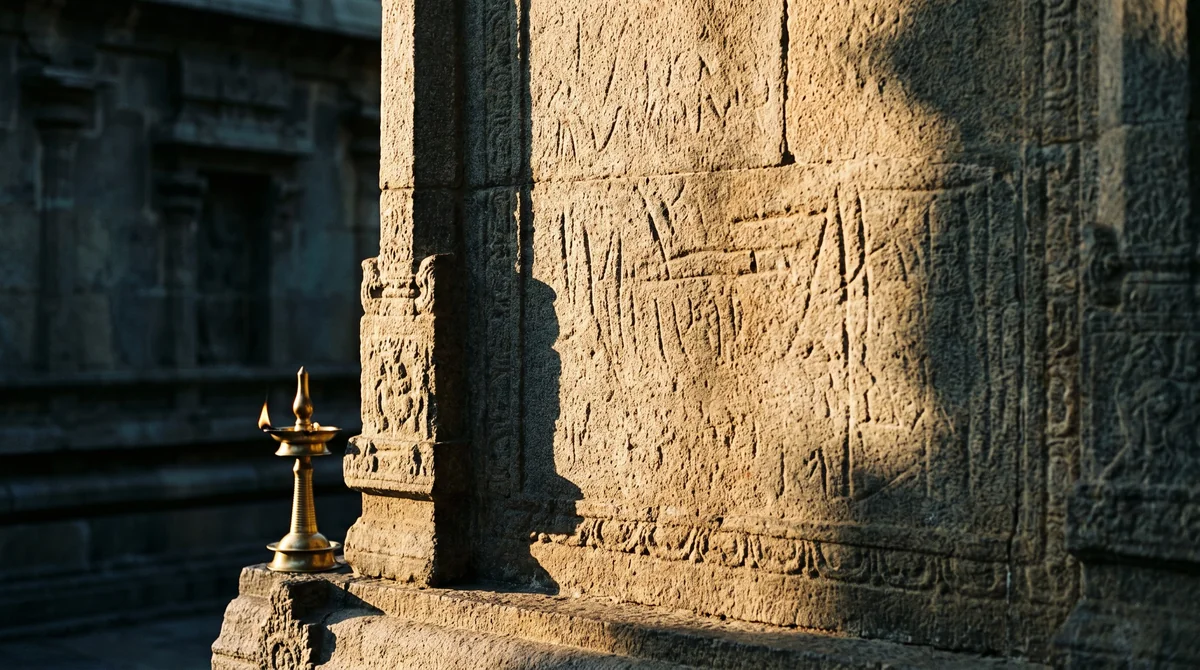
On 22 September 2026 The Hans India carried a short report from Andhra Pradesh: members of a local group had climbed Penukonda hill in Sri Sathya Sai district, found a dilapidated hilltop shrine, and noticed an inscription. Four days later, on 26 September, the Organiser ran its own account. Both name the same shrine, Sri Naga Lingeshwara Swamy temple, and the same date, 16 July 1363. A record of roughly 660 years has come into public view, and the useful question is not "what a sensational find!" but "what exactly has been reported, and what can it bear?"
I am an educator, not an epigraphist, and I have not seen the stone. What follows is a reading of the published reports, with the reasoning shown, so that you can judge how far to trust each step.
What the reports actually say
Taking the two accounts together, the claims are these:
- The inscription was noticed by members of the Vishwa Hindu Parishad's Penukonda chapter while ascending the hill by its northern and western approaches. They photographed it and sent the images to a historian, MyNaa Swamy, who is reported to have deciphered it.
- It is in what the reports call an ancient Kannada-Telugu script. It reportedly opens with the formula "Svasti Sri Saka Varusha 1285" and closes with "Mangala Maha Sri".
- It is dated to Saka 1285, on a day identified as Shravana Shuddha Panchami, which coincided with Naga Panchami.
- It names Bukka Raya I (reigned 1356 to 1377) and an official, Anantharasu Chikka Odeyar, described in the reports as prime minister, who is said to have consecrated a Shiva linga at the shrine.
- It mentions a water body beside the shrine, locally called Nagula Bavi, the "well of serpents". The Hans India report adds a sculpture of eight Naga maidens worshipping Shiva.
Everything else in this essay is context, or my own reasoning, and I will say which.
Doing the arithmetic on a Saka date
The first thing a careful reader can do is check the date. The Saka era begins in 78 CE, so Saka 1285 corresponds to 1363 CE; the reported conversion holds. The reports give 16 July. Calculated in the Julian calendar, which was in use then and is the usual convention for medieval dates, that day was a Sunday, which matches the Hans India's mention of a Sunday. That is a small consistency check and nothing more: it shows the reported date is internally coherent, not that the reading of the stone is right.
Shravana Shuddha Panchami, the fifth day of the bright fortnight of the month of Shravana, is the day of Naga Panchami in the traditional calendar, when serpent deities are worshipped. So the inscription, as reported, dates a consecration to the festival day of the very deities the shrine is named for. If the reading is correct, that choice of date was deliberate, and it tells us the founders were thinking in the ritual calendar, not merely the administrative one.
Bukka Raya I and the hill-town
The Vijayanagara empire is traditionally dated from 1336, with the brothers Harihara I and Bukka I as its early rulers. Bukka I is known from other records, among them a well-known inscription of 1368 at Shravanabelagola in which he is said to have mediated a dispute between Jains and Vaishnavas. Penukonda is a hill town with long fortifications; much later, after the defeat at Talikota in 1565, the court of Vijayanagara is generally said to have shifted to Penukonda. A general reference work also dates a Jain Parshvanatha temple in the town to 1359, which would fall inside Bukka's reign.
Put those together and a modest picture suggests itself, which I offer as inference rather than finding: in the 1360s Penukonda was already a place where a senior official of the new empire thought it worth building, and the town was religiously mixed. One hilltop, a Shaiva shrine to the serpent; elsewhere in the same town, a Jain temple. None of that is new to historians, but a dated shrine record is the kind of small, hard item that lets such pictures be tested.
Medieval inscriptions across the peninsula habitually date a local act by naming the reigning sovereign, and then name the person who actually paid for or arranged it. The opening formula "Svasti Sri", an auspicious invocation, is among the commonest ways such records begin, so its reported presence is unremarkable and reassuring rather than special. What is more telling is the pairing, as reported: the emperor supplies the date, and a high official supplies the act. Historians of the period have long treated officers of the state as major patrons of temples, partly out of piety and partly because a visible shrine anchors an official's standing in a locality. If the reading holds, this stone would be one more small witness to that pattern. I would not build more on it than that.
The well and the serpents
I find the well the most interesting detail. Southern India has an old, widespread practice of naga worship, with carved serpent stones set under trees and beside water. A shrine with a named water body, Nagula Bavi, fits that pattern: serpent, water and Shiva in a single compound. It also reminds us that temple building was an economic act, not only a devotional one. A hilltop shrine needs water; a well makes the site habitable for priests and pilgrims. Whoever dug it was providing for people as well as for the deity.
Here I should be careful. The reports I have seen do not mention any land grant, tax assignment or endowment of the kind that makes many medieval inscriptions socially informative. If the stone has such a clause, it has not been described publicly. That absence is a limit on our knowledge, not evidence that nothing of the kind exists.
What we do not know
This is the section that matters most, because the news cycle usually leaves it out.
- No independent epigraphist's edition has, so far as I can tell, been published. The reading rests on photographs and on one historian's account, relayed through newspapers.
- "Prime minister" is the press's term. I cannot tell from the reports which title appears on the stone, or what the office carried in the 1360s.
- I cannot tell whether this inscription was already known. Survey of Andhra's hill temples has gone on for generations, and a stone "discovered" by a visiting group may already sit in an official register. That does not diminish the report, but it does matter for the word "discovery".
- The reports do not describe the condition of the stone or the temple structure in any detail, beyond calling the shrine dilapidated.
The way the discipline settles these questions is slow and dull, and it works. An epigraphist takes an estampage, a paper impression of the surface, reads it in good light, compares it with known records of the reign, and publishes an edition that others can check. India's Epigraphy Branch publishes its findings in annual reports; the Culture Ministry, for example, has released the report on Indian epigraphy for 2024-25. Until a stone reaches that stage, the fair status of a report like this is "promising and provisional".
How to read the next heritage headline
Over the years I have settled on five questions for any announcement of this kind. They take two minutes and spare a great deal of confusion.
- Who read the text, and are they named and qualified?
- Is the date given in a form I can check, such as an era, a year and a day?
- Which claims come from the text itself, and which are the reporter's or the reader's gloss?
- Has an independent specialist seen the stone, or only photographs?
- What would change my mind?
Applying them to Penukonda, the answers so far are encouraging but incomplete: a named historian, a checkable date, a plausible historical setting, and no published edition.
What an ordinary reader can do
If you live near a hill temple and see lettering on a stone, resist the instinct to rub chalk or whitener into it. That makes it easier to photograph and permanently damages the surface, and it makes the epigraphist's work harder. Photograph it in raking light, early or late in the day, with a scale object in the frame, note the exact location, and send the images to the State Department of Archaeology or the nearest circle of the Archaeological Survey of India. Then wait for the slow, careful reading. A stone that has waited six and a half centuries for someone to notice it can wait a few more months for someone to read it properly.
📬 Join 49,000+ Indian Professionals
The Inner Circle newsletter delivers curated MSME intelligence, leadership wisdom, and strategic insights every week — completely free. Plus receive the 20 Gita Lessons PDF as a welcome gift.
Subscribe Free →Ready to Go Further?
My mythology and fiction titles bring these stories alive for the modern reader. Available on Amazon India.
Explore My Books on AmazonPublished 14 October 2026 · dibyenduchoudhury.com