Every organisation I have worked with has a written code of conduct and an unwritten one. The written one hangs on a wall or sits in a handbook. The unwritten one is learned in the first fortnight, mostly by watching the person at the top: when they arrive, how they speak to the peon and to the chairman, whether the rule about expense claims applies to them, what they do when a mistake is theirs. New recruits rarely quote the handbook. They quote the boss.
The Bhagavad-gita says this in one verse, and it says it without any management vocabulary at all. Verse 3.21 is short enough to memorise and uncomfortable enough that most readers move past it quickly.
The verse and what it says
yad yad ācarati śreṣṭhas tat tad evetaro janaḥ
sa yat pramāṇaṁ kurute lokas tad anuvartate
(Bhagavad-gita 3.21)
In my own words: whatever the best among people does, others do that very thing. Whatever standard such a person sets, the world follows it. The two key words are ācarati, "conducts himself" or "behaves", and pramāṇa, a measure, a standard of proof, the thing against which other things are checked. The verse does not say that people follow what the leader says. It says they follow what the leader does, and that the leader's doing becomes the measure.
That is a sobering sentence for anyone who holds authority, because it removes the comfortable gap between instruction and example. A manager may issue a hundred instructions about punctuality. If she walks in twenty minutes late every Monday, the hundred instructions are noise and the twenty minutes is the policy.
Where the verse sits in the argument
It helps to remember what Arjuna has just been told. In the second chapter Krishna has taught the imperishable self and the steadiness of mind that goes with it. Arjuna, understandably, concludes that if knowledge is higher than action, he should step back from the battlefield. Chapter 3 opens with exactly that confusion, and Krishna spends the chapter dismantling it. Action cannot be abandoned by simply refusing to act, he says, because nature keeps everyone working in any case. The question is how to act, not whether.
Then, in verse 3.20, he gives Arjuna a historical argument: Janaka and others reached perfection through action itself (karmaṇaiva hi saṁsiddhim āsthitā janakādayaḥ). Janaka was a king, a ruler who governed and was also known for his steadiness of understanding. The same verse adds a phrase worth pausing on: lokasaṅgraham evāpi sampaśyan kartum arhasi, you ought to act keeping in view the holding together of the world. Verse 3.21 follows directly as the reason. You should keep the world together because the world takes its cue from you.
So 3.21 is not an isolated moral maxim. It is the second half of an argument about responsibility. Arjuna has a position of visibility. Whether he likes it or not, what he does will be copied. His retreat would not be a private act of renunciation. It would be a signal.
Krishna points at himself
What I find most striking is the next move. Having stated the principle, Krishna does not remain a teacher standing above the example. He applies it to himself.
na me pārthāsti kartavyaṁ triṣu lokeṣu kiñcana
nānavāptam avāptavyaṁ varta eva ca karmaṇi
(Bhagavad-gita 3.22)
In my words: there is nothing in the three worlds that I am obliged to do, Arjuna, and nothing unattained that I need to attain, and yet I remain engaged in action. Krishna has no unmet need, no target, no appraisal due. And still he works. In verse 3.23 he adds the consequence: if he were ever to stop, people would follow his path in every direction, and in 3.24 he says that the worlds would fall into ruin if he did not act.
The logic is demanding. The more secure and free a leader is, the less excuse that person has for withdrawing from the shared work, because the people watching do not share that security. They will read the leader's absence as permission. A senior person who says "I no longer need to do the routine work" is technically right, and practically teaching everyone else that routine work is for people of lower rank.
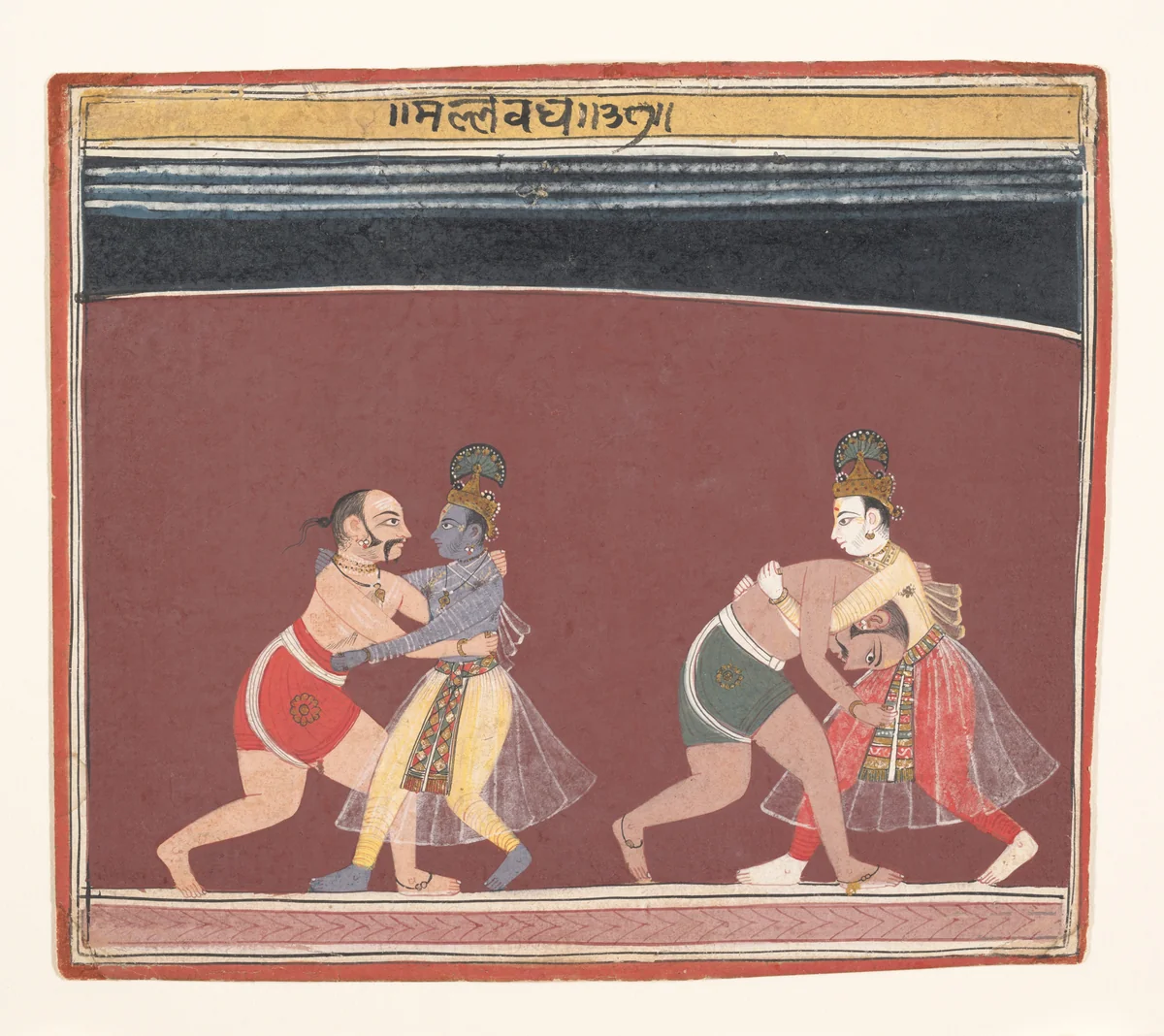
The hero image for this essay is an Indian miniature painting from the Bhagavata Purana tradition, held by the Metropolitan Museum of Art and released into the public domain. It shows Krishna and Balarama taking on the court wrestlers, and I chose it for a modest reason: the two brothers are in the arena themselves, hands on, not directing from the gallery. It is a different text and a different episode from the Gita, so I offer it as an illustration of the idea of leading from inside the work, not as a picture of the verse.
A composite example from a workplace
The following is a composite, assembled from patterns I have seen several times. It is not a report about one named organisation.
A mid-sized manufacturing firm has a rule that every shop-floor visitor, including executives, wears safety shoes and a helmet. The rule is on a poster at the gate. The plant head, a capable and well-liked engineer, often walks through the floor in office shoes because he is only passing through for five minutes. Nobody says anything to him. Within a few months, supervisors begin to skip the helmet when they are only going to be inside for a minute, and then contract workers begin to do the same. When there is a minor accident, the investigation finds that the poster was in perfect condition and the practice had collapsed.
Nothing in the plant head's intention was careless. What failed was that he treated his own conduct as private when it was a measure. By the logic of 3.21, he had issued a new rule: the rule applies to people who stay long enough to matter.
The repair, in that composite, was not a new poster. It was the plant head keeping a spare pair of safety shoes in his car and wearing them for every visit, including the five-minute ones, for a full year. The compliance numbers followed him, quietly, within a quarter.
What this does not mean
It would be easy to misread the verse as a demand for perfection, or as a licence for a leader to perform virtue. Neither reading fits the text.
First, the verse speaks of the śreṣṭha, the best or the foremost, not of the loudest. In the Gita's vocabulary, excellence is tied to steadiness of understanding, to action without clinging to its fruit, and to taking responsibility for the people who are watching. A leader who stages good behaviour for an audience is performing, and people tend to detect performance within weeks. The verse works because the conduct is real and consistent when no one is looking, so that the visible conduct is simply a sample of the whole.
Second, the verse does not say that followers are passive copies. It describes a tendency, not a rule of nature, and Arjuna himself is a counter-example in the same chapter: he questions, objects and asks for clarity. Good followers do the same. But the tendency is strong enough that anyone with authority should assume it.
Third, the verse is not a recipe for control. Krishna's framing is lokasaṅgraha, the holding together of the world, not the managing of subordinates. The standard being set is one that keeps a community functioning for its own sake. When a leader uses conduct only to produce compliance, the logic of the verse is turned upside down.
Three questions I ask myself after reading it
I use this verse as a private audit, and I find that three questions are enough. The first is: which of my rules would I be embarrassed to see applied to me exactly as I apply them to others? If I cannot answer quickly, I have not looked hard enough. The second is: what do the people closest to me do when they are tired or hurried, because that is when they copy me most directly? If they cut corners in the same place I do, the corner is mine. The third is: what do I do on the days when no one will check? The verse suggests that this is where the standard is actually made.
These questions are uncomfortable in the way the verse is uncomfortable. They remove the option of treating leadership as a title and put it back into conduct. For a teacher, a parent, a founder or a manager of five people, the principle is the same. The size of the audience differs. The mechanism does not.
Reading it alongside the Gita's other portraits
Readers who enjoy the Gita's longer portraits of character may like to set 3.21 beside the description in chapter 12 that I wrote about earlier, the person nobody dreads and nothing rattles. That verse describes the inner steadiness; this one describes its outward effect. A leader who is steady inside tends to become, without effort, the measure that others use. A leader who is agitated inside tends to export that agitation, and the team copies that too.
Likewise, the opening movement of the whole poem, Arjuna's collapse in chapter 1, is a lesson in what happens when a respected person's nerve fails in public. His allies are watching him. The verse we have just read explains why his hesitation mattered beyond himself, and why Krishna did not accept the withdrawal as a private matter.
A closing thought
I do not read 3.21 as a threat. I read it as a piece of unsentimental information about how groups of people work: they learn what is normal from the people they respect, and they learn it through behaviour, not through speeches. If that is true, then the most practical leadership development is also the least glamorous: to become, a little at a time, the sort of person whose ordinary day is worth copying.
If this reading was useful, you may find more of my notes on the Gita and on leadership under the blog index. I write for people who have to run something, whether a firm, a classroom or a household, and who would like the old texts to earn their place in that work.
📬 Join 49,000+ Indian Professionals
The Inner Circle newsletter delivers curated MSME intelligence, leadership wisdom, and strategic insights every week — completely free. Plus receive the 20 Gita Lessons PDF as a welcome gift.
Subscribe Free →Ready to Go Further?
Explore my books on the Bhagavad-gita, leadership, and ancient wisdom — available on Amazon India.
Get the Book on AmazonPublished 17 October 2026 · dibyenduchoudhury.com