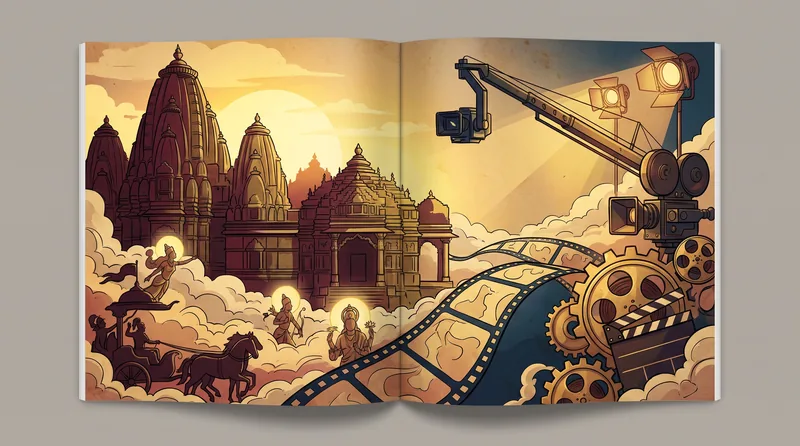
When a film's poster reveal causes a stampede, you know you are dealing with something beyond entertainment. The Ramayana 2026 first look — featuring Ranbir Kapoor as Lord Ram — triggered crowd surges across multiple Indian cities in June 2026, leaving venue managers scrambling and social media exploding with devotion, debate, and disbelief. India had not seen this kind of cultural electricity since the release of Baahubali 2 nearly a decade ago. And this time, the force driving it is not spectacle alone. It is memory. It is myth. It is a story that has lived inside every Indian household for three thousand years, now arriving on the largest canvas Bollywood has ever built.
A Story That Has Waited Too Long
The Ramayana is not simply a narrative. It is a civilisational document. Over five hundred versions exist across Asia — in Sanskrit, Tamil, Bengali, Malay, Thai, and Javanese — each culture having absorbed the story and made it its own. Yet despite this global reach, no Indian filmmaker had attempted a genuinely world-scale cinematic adaptation until now. The earlier attempts, including the controversial Adipurush of 2023, were broadly considered artistic disappointments. They demonstrated the hazard of treating the Ramayana as spectacle without engaging its moral architecture.
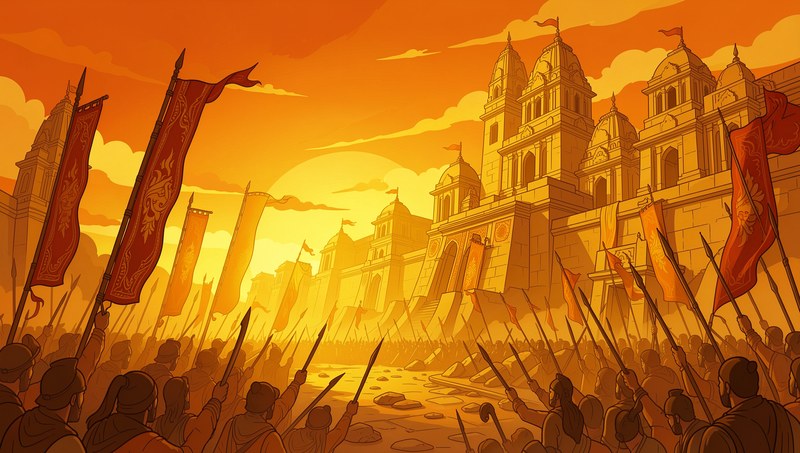
What has changed is ambition. Nitesh Tiwari and his producers at Namah Pictures have committed ₹835 crore — the largest reported budget for an Indian production — to telling this story across two feature films. The first part is scheduled for Diwali 2026. The second is expected in 2027. This two-part structure is the correct choice. The Ramayana is not a plot. It is a journey through every dimension of human virtue, and compression is its enemy. The decision to give it space is itself a statement of respect.
The Casting That Stopped India Mid-Sentence
Ranbir Kapoor as Lord Ram was, at first announcement, a genuinely divisive choice. His reputation was built on roles of urban ambivalence — the broken romantic of Rockstar, the philosophical wanderer of Tamasha, the morally complicated gangster of Saawariya. He was not a figure associated with divine stillness. And yet, when the first look images circulated — Ranbir in golden armour, bow in hand, eyes carrying something quiet and immovable — the conversation shifted almost overnight.
The reason, on reflection, is not surprising. Ram is not a character who roars. He is a character who endures. His power is the power of restraint, of dharma held steady under unbearable circumstances. Ranbir Kapoor, in his best work, has always been an actor of internal weather — of what is not said, of emotion carried without explosion. That quality, which made him seem miscast in the early discussion, is precisely what this role requires. Nitesh Tiwari, who spent two years in screen tests before finalising the cast, has said publicly that Ranbir's eyes convinced him. Eyes that hold grief and composure simultaneously. Eyes that look like they could carry a kingdom's exile without breaking.
Sai Pallavi as Sita is the casting decision that carries equal weight. Sita is not a passive figure in the Ramayana, though she is often reduced to one in popular imagination. She is a woman of extraordinary moral clarity who chooses exile, chooses the forest, chooses her husband's dharmic path — and when that path asks too much, she chooses herself. Sai Pallavi, whose work in films like Fidaa and Virata Parvam established her as an actor of rare emotional precision, is the first major casting choice for Sita in modern Bollywood that does not feel like a concession. Yash as Ravana completes a trinity that, on paper at least, has the depth to match the myth it is serving.
Nitesh Tiwari's Quietly Enormous Track Record
The instinct to trust this project is anchored not just in casting but in the man directing it. Nitesh Tiwari's filmography is small by Bollywood standards — Chillar Party, Bhootnath Returns, Dangal, Chhichhore — but each entry is defined by a particular quality that is rarely discussed: emotional restraint in service of structural power. Dangal did not need to manipulate the audience into caring about Geeta and Babita Phogat. The story, handled correctly, did that work itself. Chhichhore dealt with student suicide and competitive pressure without a single scene of cinematic excess. It trusted its characters to carry its meaning.
That quality — the refusal to overstate — is exactly what the Ramayana requires in a filmmaker. The epic's most devastating scenes are not battles. They are a father's farewell. A wife's trial by fire. A brother's unwavering loyalty. A king who chooses his word over his son. These are interior events. They require a director who knows that the camera's job, in those moments, is to stay still and let the human face do the work. Tiwari has demonstrated that capacity across every film he has made. The question this production answers is whether that capacity scales to ₹835 crore and ten thousand extras. Every indication from the first look suggests the answer is yes.
What the Ramayana Actually Teaches
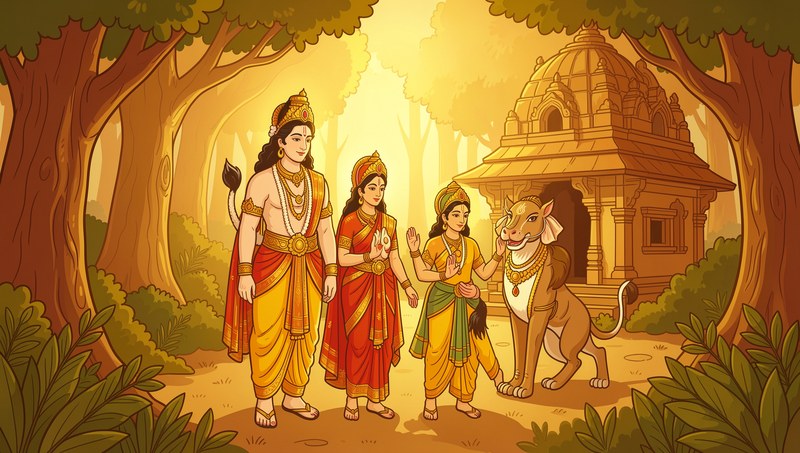
The Ramayana does not promise that virtue wins easily. That is perhaps its most honest quality. Ram's path is one of relentless loss — his throne, his forest years, his wife's abduction, his greatest war — and the story does not pretend these losses are painless. What it insists on, with every chapter, is that how you carry loss defines what you are. The kingly bearing is not the bearing of triumph. It is the bearing of one who has been tested completely and has not broken.
This teaching lands differently depending on the age at which you encounter the story. A child sees the adventure — Lanka burning, the vanara army building the bridge, the arrow finding Ravana across impossible distance. An adult sees something quieter: the weight of public duty carried by private human beings, the exhausting cost of being someone others look to for rightness when you yourself are uncertain. And in middle age, the story reveals its deepest layer: that dharma is not a rule to be followed but a practice to be built, daily, in ordinary choices that receive no audience and generate no applause.
The best version of the Ramayana film will carry all three layers simultaneously. It will give younger audiences the epic they came for and give older audiences the philosophy they did not know they needed. The casting and the director suggest that ambition is real. The stampede at the poster reveal suggests the audience is already there, waiting.
Why This Film Could Cross Every Border
The international dimension of this production is not an afterthought. RRR and Baahubali demonstrated that Indian cinema, when made with genuine scale and emotional commitment, travels. The Ramayana, unlike those stories, does not require explanation in Southeast Asia, in Fiji, in Mauritius, in the Indian diaspora across the United Kingdom, Canada, and the United States. It is already there. Diwali in London is celebrated with reference to this story. Thai royal ceremonies carry its iconography. The Ramlila — the annual theatrical retelling of the Ramayana — is performed in more countries than most Indian diplomats visit in a career.
What the film needs to achieve global resonance is not to translate the story but to make it feel alive in the specific way that cinema, unlike scripture or theatre, can accomplish: through the weight of a close-up, the texture of a performance, the emotional architecture of a two-hour journey through a single character's choices. If Tiwari achieves that — and the evidence suggests he might — this film does not merely compete with global mythological cinema. It redefines what mythological cinema can be.
The ₹835 crore budget, which initially seemed like a gamble, now looks more like a strategic statement: India is capable of making the films that match the scale of its stories. The world, which has consumed Greek mythology through Hollywood and Norse mythology through Marvel, is entirely prepared to receive the Ramayana at that scale. It has been waiting, in many places, longer than we have.
This Is Not Just a Film — It Is an Invitation
Every generation needs its own telling of the stories that made it. The Ramayana has been told in Doordarshan's landmark 1987 serial, in devotional theatre, in illustrated books, in temple carvings that predate the printing press. Each telling has served its moment. The question for 2026 is whether cinema — the art form that India has made its own more fully than perhaps any other — is ready to give the Ramayana its fullest contemporary voice.
The first look says: possibly yes. The casting says: the people making this have thought seriously about what the story requires. The crowd stampede says: the audience is not waiting for a review. They already know what this story means to them. They came running — literally — the moment they heard the drum.
That is not a box-office metric. That is a civilisational reflex. And Nitesh Tiwari, Ranbir Kapoor, Sai Pallavi, and the entire team behind this film have inherited the responsibility that comes with it. To honour a story that belongs not to any studio but to everyone who has ever told it to a child at bedtime, whispered it in a moment of personal crisis, or walked past a temple and paused, without quite knowing why.
The Ramayana is scheduled for release in two parts — Part 1: Diwali 2026, Part 2: 2027. This is the most anticipated Indian film in more than a decade. And that anticipation, when you understand the story beneath the spectacle, makes complete sense.
Explore India's mythological tradition
The Ramayana is one of several explorations of India's wisdom traditions on this site. Subscribe to receive new essays on Indian philosophy, cinema, and culture every week.
Subscribe — It Is Free