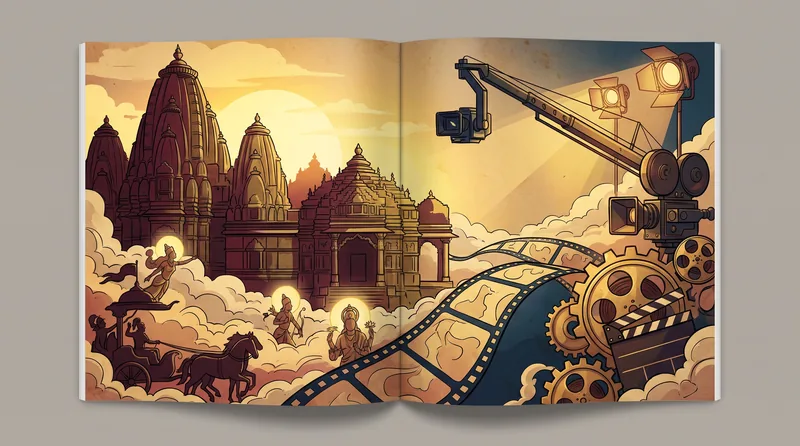
The great Indian epics were never just stories. They were mirrors — held up to the most difficult questions human beings face: about duty, loyalty, justice, and identity. Today's reflection is on Video | Can Indian Mythology Become The Next Global Anime Phenomenon? Comic Con Founder Answers.
The Scene That Changes Everything
India's great epics never deal in simple heroes and villains. Video | Can Indian Mythology Become The Next Global Anime Ph is one of those moments where the story demands the reader sit with genuine moral weight — where every option carries a real cost. Every major character bound up in this moment has a legitimate claim to being right, which is exactly what makes it impossible to read as simple entertainment.
What Most Retellings Miss
Most retellings focus on action — battles, betrayals, curses. What they miss is the interior life of each character: the moment of choice before the action, when every option is visible and every cost is clear. It is in these moments that the epic truly speaks. Popular adaptations tend to compress this interior moment into a single dramatic line or gesture, because film and television reward pace over reflection. The written epic does the opposite — it slows down exactly where the moral weight is heaviest, and that slowing down is where the real teaching lives. Sit with the original text rather than a summary, and this difference becomes immediately visible: the pacing itself is doing philosophical work, not merely narrative work. It rewards patience over speed, which is an increasingly rare thing to ask of a reader, and an increasingly valuable one to practice.
The Dharma Question at the Heart of It
The central preoccupation of India's great epics is dharma — not as a fixed rule but as a question answered freshly in each situation. In the case of Video | Can Indian Mythology Become The Next Global Anime Ph: what does right action look like when loyalty conflicts with justice? These questions are as alive today as they were three thousand years ago. Every reader eventually meets a version of this same test in ordinary life, stripped of its epic scale but carrying the same weight of consequence.
Why This Character Still Speaks to Us
The reason Video | Can Indian Mythology Become The Next Global Anime Ph continues to resonate is that the dilemma it presents has not been solved. We still live in a world where extraordinary ability can be negated by circumstance of birth, where institutional systems reward compliance over excellence, where the question of whether to fight a rigged game has no clean answer. Every generation rediscovers this dilemma in its own vocabulary — merit versus privilege, loyalty versus conscience, individual versus institution — which is exactly why a three-thousand-year-old scene can still feel like it was written about a decision made this year. Look closely at any contested promotion, any whistleblower weighing loyalty against disclosure, any founder choosing between a company survival and personal principle, and the same underlying architecture of the dilemma reappears, dressed in the vocabulary of the present decade rather than the language of dharma.
Lessons for the Modern World
- Greatness is not diminished by circumstance — what you do with what you have defines you, not what was withheld from you.
- The system will not always recognise you. Build your identity independent of its validation.
- Dharma is not a formula. It is the discipline of asking the right question in the right moment — even when the answer is costly.
In My Books
These questions are at the heart of my fiction and non-fiction work. The characters I write are people at precisely this crossroads — where ancient wisdom meets contemporary pressure. If these themes resonate, I invite you to explore the books. I did not set out to modernise these epics — I set out to ask whether their central dilemmas would still hold up under contemporary scrutiny. In every case, they did, which is itself the most persuasive argument for reading them not as history but as a live philosophical inquiry. That inquiry is ongoing, not settled — each new reading surfaces a question the previous one missed, which is the clearest evidence I know that these are not finished texts but living ones.
How This Story Reads in 2026
Read in 2026, Video | Can Indian Mythology Become The Next Global Anime Ph loses none of its force. Replace the battlefield with a boardroom, a courtroom, or a family dispute over inheritance, and the same pressures reassert themselves: loyalty pulling one way, justice another, and no institution willing to fully resolve the tension for you. What has changed is the pace at which these dilemmas now arrive and the audience watching how we resolve them — social media has made every private moral choice a potential public spectacle, which raises the stakes on the very kind of clarity these epics were written to cultivate. India's own renewed cultural interest in these epics — through cinema, theatre, and popular retellings — suggests the audience senses this relevance even when it cannot always name it precisely.
What the Epic Is Really Teaching
What India's great epics teaches through Video | Can Indian Mythology Become The Next Global Anime Ph is not a rule but a habit of attention: notice when a situation is being simplified for your comfort, and resist the simplification. The great epics reward readers who sit with discomfort. That refusal to simplify is itself the inheritance worth carrying forward — a habit of mind that resists the modern pressure to resolve every difficult question into a clean, shareable takeaway. It is a slower, harder way to read a story — and a far more useful one to carry into decisions that will not fit on a single slide.
"India's great epics do not give easy answers because they know the questions are never easy." — Dibyendu Choudhury
Final Thought
The story at the heart of Video | Can Indian Mythology Become The Next Global Anime Ph is not a tragedy. It is a teaching. India's great epics preserves it not to mourn — but to make us ask whether we would choose differently, and whether we have the clarity to know our own dharma in the moment it is required. That question does not resolve neatly, and it is not supposed to — the epic's purpose is to leave the reader carrying it, returning to it at unexpected moments long after the story itself has been set down.
📬 Join 49,000+ Indian Professionals
The Inner Circle newsletter delivers curated MSME intelligence, leadership wisdom, and strategic insights every week — completely free. Plus receive the 20 Gita Lessons PDF as a welcome gift.
Subscribe Free →Ready to Go Further?
My mythology and fiction titles bring these stories alive for the modern reader. Available on Amazon India.
Explore My Books on AmazonPublished 18 July 2026 · dibyenduchoudhury.com