← All Editions
Edition #23 · October 2026
Dear Inner Circle,
Twice this month I have sat down to write about a slab of stone, and both times I have ended up writing about something else — about how we decide that we know a thing.
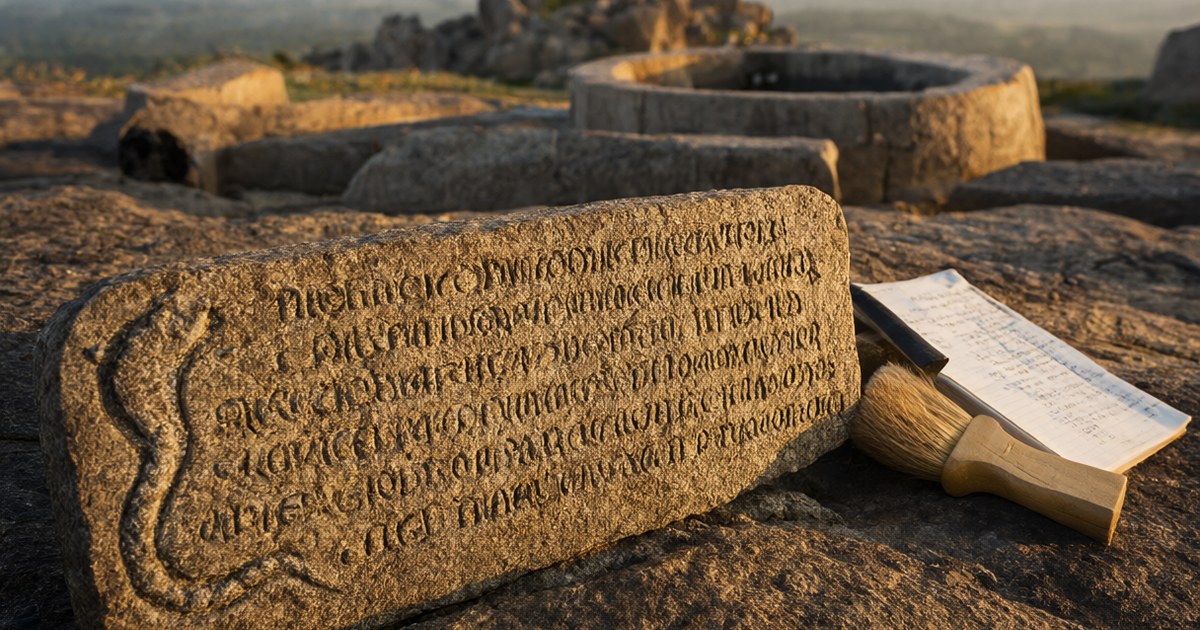
The first was in the Eriyur hills near Tirupattur, in Tamil Nadu. The second was on a hilltop at Penukonda, in Andhra Pradesh, beside a well that the people around it call the well of serpents. Eight days apart, two stones came into public view. Neither of them has yet been read in the way such things need to be read. I want to tell you what that gap has been teaching me, because I think it is a spiritual discipline before it is a scholarly one.
We have been trained to look at an inscription as decoration: a line of old script on a wall that a specialist squints at on our behalf.
In medieval southern India it was nothing of the kind. It was closer to a public register. A grant of land, a remission of tax, an agreement between a village assembly and a body of traders, a promise to keep a lamp burning — these were cut into stone for a reason that has nothing to do with beauty. Stone could not be quietly edited later. The medium was the guarantee. When a community wanted a commitment to outlive the people who had made it, it paid a mason.
I cannot get past that. We are a civilisation often accused — sometimes by its own children — of indifference to record-keeping, of letting everything dissolve into myth. And here is a technology of accountability whose central feature is that you cannot go back and improve your own position.
Ask yourself what you have committed to in a medium you cannot revise.
Now the careful part, and I am going to be slower here than a newsletter normally is.
I have not seen either stone. I am not an epigraphist. Everything I know, I know from newspapers, and I am going to tell you which newspapers, because that is the whole point of this letter.
The Penukonda record was reported by The Hans India on 22 September this year and, four days later, by the Organiser. As those accounts have it: members of a local group climbing the hill came upon a dilapidated shrine of Sri Naga Lingeshwara Swamy, noticed lettering, photographed it, and sent the images to a historian reported to have deciphered them. The reports date the record to Saka 1285 — which, since that era begins in 78 of the common era, works out to 1363 — on the fifth day of the bright fortnight of Shravana, the day serpent deities are worshipped. They name Bukka Raya I, in whose reign it would fall, and an official said to have consecrated a Shiva linga there.
The Tirupattur record I know from a single report, carried by ETV Bharat on 21 September. That account speaks of an inscription naming an individual, a parushai — a people’s council — and a body described as a prominent medieval merchant organisation.
I have set those paragraphs out in that fashion deliberately. Not one clause in them is my finding. Each is an account of an account. The dating might hold; the readings might hold; the press’s word for an office might not be the word on the stone. No independent edition of either text has been published that I can point you to. Until an epigraphist takes a paper impression of the surface, reads it in good light, compares it against the dated records of that reign and publishes something others can check, the honest status of both is: promising, and provisional.
What I will say is narrower. If the Tirupattur reading is broadly right, then a council of local people and an organised body of merchants appear together in one public record — which is to say somebody had to settle who spoke for the traders, who spoke for the locality, and who stood as witness. That is governance, committed to the one material chosen because it resists revision.
I have spent my working life around small enterprises, and almost every question that dominates that world is a trust question wearing other clothes. Will the buyer pay on time? Who settles it when the invoice is disputed? Whose recognition makes a man’s word good? If you belong to an association, a cluster body, a guild of any kind, you already live inside somebody’s parushai, whether or not you could name it.
Here is where the two essays turned on me.
I had assumed the discipline of saying I do not yet know was a modern, scientific import — a habit of the laboratory grafted onto older and more credulous ways of thinking. I no longer think that is true.
Our own tradition of knowledge is, at its root, a tradition about the means of knowing: what may be accepted on direct perception, what on inference, what on testimony, and what weight each carries. The question how do you know that? is not an interruption of reverence. It is an old and indigenous instrument, handled in the texts with far more care than our headlines manage.
So I have borrowed five questions, which cost two minutes and spare a great deal of foolishness. Who read the text, and are they named and qualified? Is the date given in a form I can check? Which claims come from the text itself, and which are a reporter’s gloss? Has a specialist seen the stone, or only a photograph? And — the one that matters — what would change my mind?
Applied to Penukonda, the answers come back encouraging and incomplete: a named historian, a date that checks out internally, a plausible setting, no published edition. That is not a disappointing result. It is simply where the matter stands, and sitting with where a matter stands, without hurrying it into certainty, is a practice.
One small thing, if you ever meet such a stone. Do not rub chalk into the lettering to make it photograph better. It works, it damages the surface permanently, and it makes the reader’s job harder. Photograph it in low, raking light, with something in the frame for scale, note where you are, and send the images to your state archaeology department or the nearest circle of the Survey. Then wait.
A stone that has waited six and a half centuries for somebody to notice it can wait a few more months to be read properly. I am trying to extend the same courtesy to most of my own opinions.
The Penukonda shrine sits beside a well that its neighbours call the well of serpents, and the reports mention carved Naga maidens attending Shiva there. That imagery is not local colour; it belongs to a whole cosmology of serpent realms and lower worlds that most readers have only ever met as decoration. The Real Geography of Pātāla: Nāgas and the Seven Lower Worlds walks through that material properly — fourteen pages, illustrated. It is on the e-books shelf at ₹59.
Get The Real Geography of Pātāla — ₹59 →Both essays behind this edition are on the blog, free to read, and I read every reply.
MSME policy, Vedic wisdom, AI insights & book updates — weekly by Dr. Dibyendu Choudhury. Unsubscribe anytime.
🎁 Free gift: 20 Gita Lessons PDF on confirmation