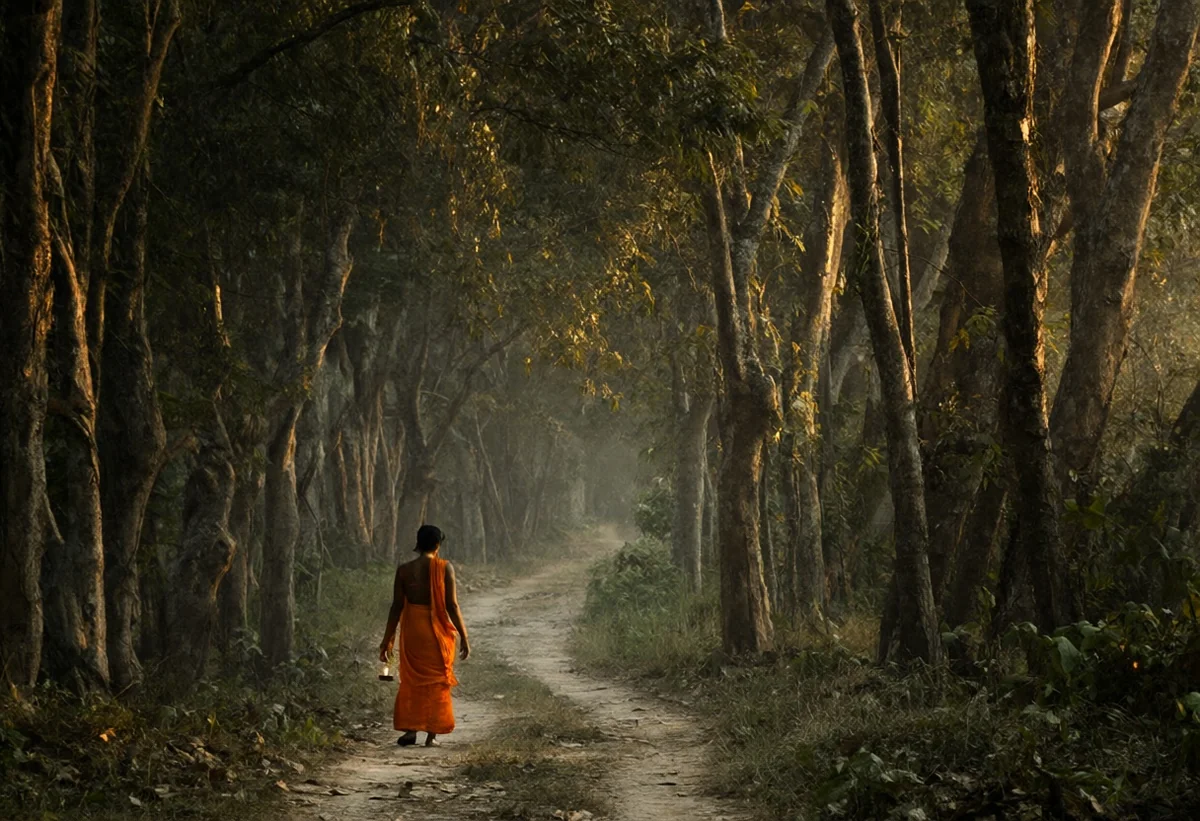
Every year, on the night of Deepavali, millions of small clay lamps are lit along thresholds, windowsills, courtyards and rooftops. Nobody who lights one believes it will defeat the night. A single diya cannot light a room properly, let alone a street. And yet the custom has lasted for as long as anyone can trace it, and it will be repeated again this year on 8 November. It is worth asking why a gesture that looks so small has carried so much meaning for so long.
My own answer, after turning the question over for many years, is that the diya teaches something quite different from the slogan we usually attach to it. We say that light conquers darkness. The lamp itself says something gentler and more useful: darkness is not an enemy to be fought, it is the ordinary condition of any place where no one has yet paid attention. A diya does not struggle against the dark. It simply occupies one small place, steadily, and the dark steps back from that place without being asked.
Three stories, one lamp
Deepavali is not told through a single story, and that is part of its strength. In much of North India it is the night the people of Ayodhya lit lamps to welcome Rama home after fourteen years in the forest. In the South, and in several other regions, it is remembered through the defeat of Narakasura, and the festival begins before dawn with an oil bath and the first lamps of the day. In Gujarat and many trading communities it is the night for Lakshmi, when old account books are closed and new ones opened with a prayer. In Bengal and Odisha, the same new-moon night belongs to Kali, who is worshipped in the dark, with lamps, through the hours when most of the household would normally be asleep.
These accounts do not compete with each other, and a village does not need to choose among them. What they share is more interesting than what separates them. In each, a house that has been neglected, or a home that has been without its rightful person, is set in order, cleaned, and then lit. The lamp comes last. Before there is light there is work: sweeping the floor, mending the door, settling what was left unsettled. The flame is the final act of a preparation, not a replacement for it.
I wrote earlier, in the post on Lakshmi Puja, about how the goddess of wealth is traditionally invited only into a house that is clean and awake. The same logic runs through the whole festival. You cannot ask for more light while the existing rooms stay dusty.
What the old prayer actually says
The most quoted line about light in the Indian tradition comes from the Brihadaranyaka Upanishad: tamaso mā jyotir gamaya, "lead me from darkness to light." It is usually recited on Deepavali, and it is usually understood as a request addressed to someone else, to a god or a teacher, to be led.
Read slowly, the grammar adds something. The verb is a causative: gamaya, "cause me to go." The speaker is not asking to be carried. The speaker is asking to be set walking. The prayer sits in a sequence of three lines, the first asking to be led from the unreal to the real, the second from darkness to light, the third from death to immortality. Each asks for a direction, not a destination. The one who prays still has to walk.
This matches how the Gita speaks of light. In the thirteenth chapter, verse 17, Krishna describes the supreme as the light of all lights, jyotiṣām api taj jyotis, which is said to lie beyond darkness. The point is not that there is a very bright lamp somewhere far away. The point is that whatever lights up anything in us, a clear thought, a sound decision, a moment of honest seeing, is borrowing from one source. When you light a diya from another diya, nothing is lost by the first. The flame is shared, not divided.
Why a small flame is the right size
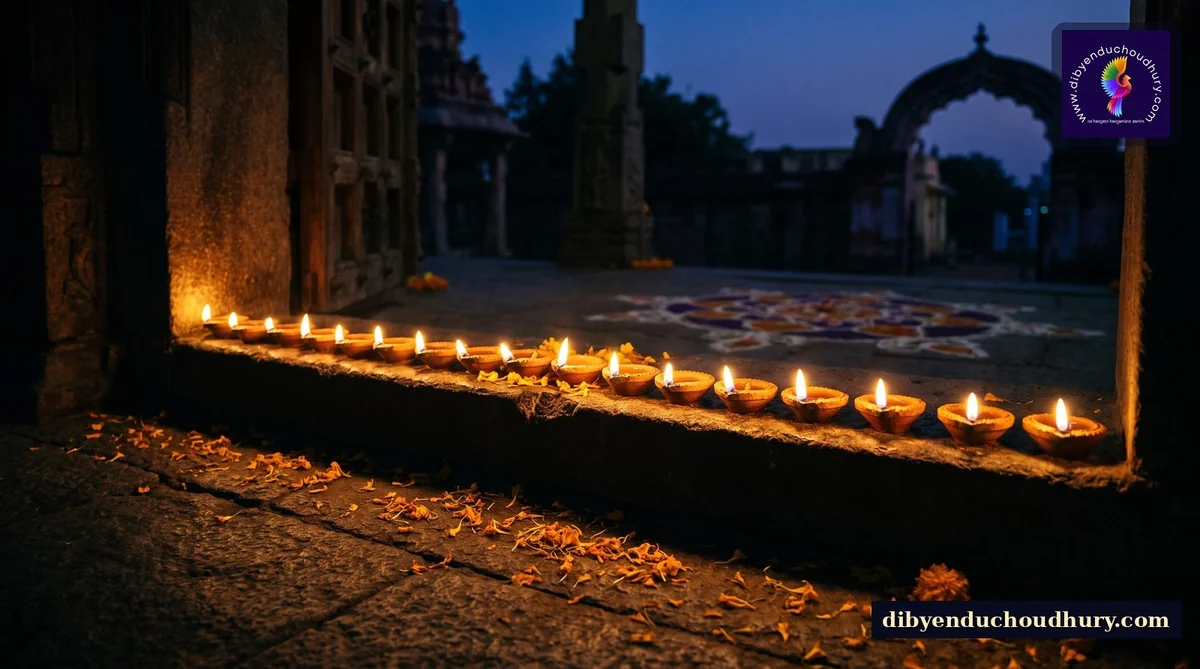
It is tempting, in a season of grand illumination, to read the festival as an argument for scale. Bigger strings of lights, louder celebration, wider reach. But the oldest form of the practice is the opposite. It is a clay cup, a little oil, a cotton wick, and a match. Whoever has these three things can take part, and the lamp they light is complete in itself.
There is a quiet instruction here for anyone who builds anything, whether a small business, a family routine, a body of writing or a classroom. A diya has three parts, and each corresponds to a discipline. The clay holds the flame in place and gives it a shape; that is structure. The oil is what actually burns; that is the sustained effort that nobody photographs. The wick is the point where the two meet; that is attention, the narrow place where preparation turns into light. Take away any one and the lamp goes out, however beautiful the others are.
Most of us spend our energy on the visible flame. We want a larger one, sooner, seen by more people. The festival turns our attention to the oil. A lamp with too little oil gutters out within the hour, and no amount of polishing the clay will help. In a working life, the oil is the unglamorous daily practice: the account entered on the day it was earned, the page written before breakfast, the phone call returned, the promise kept when it has become inconvenient.
The dark is not your enemy, it is your information
There is another layer. Anyone who has stood in a dark room for a few minutes knows that the eyes adjust. Shapes emerge. The darkness, at first total, turns out to be full of information that bright light would have drowned. A lamp is valuable partly because it is small: it lights what is near without erasing the rest.
I find this a useful way to think about the difficult parts of a year. Deepavali comes at the end of a season when many of us take stock, of money, of relationships, of work half-finished. The temptation is to flood the whole picture with bright resolution at once, and the usual result is that nothing is looked at carefully. The diya suggests a better method. Light one small place. Look at what is there. Then light the next.
The old merchants understood this in their own practical way. On the night they opened a new account book, they did not attempt to repair every loss of the previous year. They closed the old book honestly, wrote the first entry in the new one with care, and let the habit carry the rest. The ritual was less about luck than about the dignity of starting cleanly, with the old figures acknowledged rather than hidden.
Kali, the lamp and the night that does not pretend
It is worth saying a word about the Bengali form of the festival, because it tells the story from the other side. On the night of Kali Puja the lamps are lit, but the goddess worshipped is dark, and the worship takes place in the deepest hours of the new moon. This is not an accident, and it is not a contradiction of the lamps in the rest of the country. It is the same teaching told from the opposite end: that the dark is not to be feared as an absence, because the divine is present in it too, and that you do not honour light by pretending the night is not there.
Both forms ask the same thing of the person who lights the lamp. Stay awake. Pay attention. Do not hurry to leave the dark room; be the person who stays long enough to see what it holds.
A small practice for this week
If the festival is only decoration for you this year, that is a perfectly ordinary thing, and no one is required to turn a holiday into a project. But if you would like to take one thing from the lamp, here is a simple practice, in three parts, that fits into an evening.
First, clean one place that you have been avoiding. A drawer, a desk, a folder on your computer, a pile of unopened letters. The size does not matter; what matters is that it is real and that you finish it. This is the preparation that comes before the light.
Second, settle one small thing that has been left open. A message you owe someone, an amount you meant to return, an apology that has grown heavier by waiting. Do it before you light the lamp, so that the flame is not asked to cover for a debt.
Third, light the lamp and sit with it for a few minutes without your phone. Watch how the flame behaves. Notice that it leans when the air moves and rights itself when the air settles. Notice that it needs nothing from you in those minutes except that you stay. If you have a verse you like, the line from the Upanishad is a good one to have in mind: tamaso mā jyotir gamaya, set me walking from the dark toward the light.
Readers who have followed the posts on Savitri and Yama will recognise the same pattern: the wise request is rarely for the largest thing, it is for the right thing, asked for clearly and then followed through with patience.
One question to take away
When you light your lamp this Deepavali, which small, dark corner of your own life are you willing to stay beside long enough to see what is actually in it? Write one line in the comments if you wish to share it; I read every one.
A note for those who enjoy their myth with a thriller's pulse: my novel Secret of Kakanmath Temple, Patal Loka Book 3, is published on Deepavali, 8 November, on Amazon Kindle. It is a work of fiction built on the same old idea, that a night can hold a door, and details are on the Patal Loka series page. Whichever story you carry into the festival, I wish you a quiet, well-lit Deepavali.
📬 Join 49,000+ Indian Professionals
The Inner Circle newsletter delivers curated MSME intelligence, leadership wisdom, and strategic insights every week — completely free. Plus receive the 20 Gita Lessons PDF as a welcome gift.
Subscribe Free →Ready to Go Further?
My mythology and fiction titles bring these stories alive for the modern reader. Available on Amazon India.
Explore My Books on AmazonPublished 9 November 2026 · dibyenduchoudhury.com