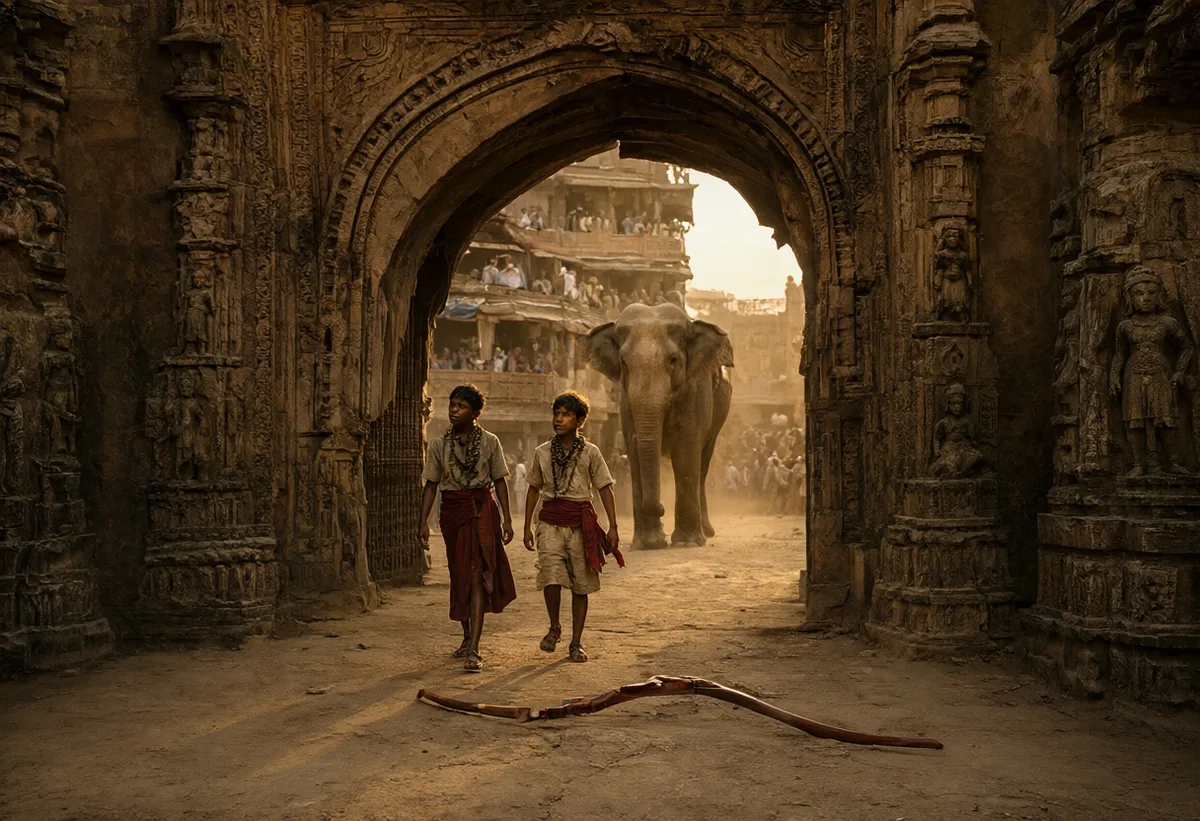
Many of the stories we inherit are about strength: the archer who never misses, the king who never yields, the sage whose curse cannot be turned. The story of Savitri is different. Its hero holds no weapon. She has no curse to hurl and no army to summon. What she has is attention, patience and a rare sense of how to ask. With these she walks into the territory of Death himself and returns with what she came for. It is one of the quietest and cleverest tales in the Mahabharata, and it repays a slow retelling.
A princess who chooses for herself
Savitri was the daughter of Ashvapati, king of the Madras. Her father had long been without a child, and he had performed austerities to the goddess Savitri, after whom the girl was named. She grew up radiant and capable, so much so that suitors hesitated to approach her; it is said that no one felt worthy. When she came of age, her father told her to travel and find a husband of her own choosing.
She journeyed through the hermitages and forests and returned with a decision. She had chosen Satyavan, the son of Dyumatsena, a king who had lost his sight and then his kingdom, and who now lived in the forest with his wife and son in humble circumstances. The young man was devoted to his parents, honest by nature and gentle with every creature.
At the moment she announced her choice, the sage Narada happened to be at her father's court. He gave a warning that no parent wishes to hear. Satyavan was virtuous in every respect, but he was fated to die within a year. Ashvapati begged his daughter to choose again. Savitri did not. She said that a person chooses once, that a thought, a word and a deed are given once, and that she had already given hers. The marriage took place, and Savitri exchanged her royal garments for the simple dress of the forest and went to live with her husband and his parents.
A year of quiet counting
Here the story does something worth noticing. Savitri knew the date. She carried it in her mind every day of that year, and she did not announce it or complain of it. She served her in-laws with care, kept the household, and smiled when Satyavan smiled. When the final days drew near, she took up a vow of three days of fasting and vigil. Her family worried that she was straining herself. She said only that she had undertaken it.
Preparation is the unglamorous centre of this tale. Many of us meet our crises unprepared because we have refused to look at them until they arrive. Savitri looked at hers a year early. She did not escape it by denial, nor was she crushed by dread. She used the time to deepen her discipline, so that when the day came she was steady.
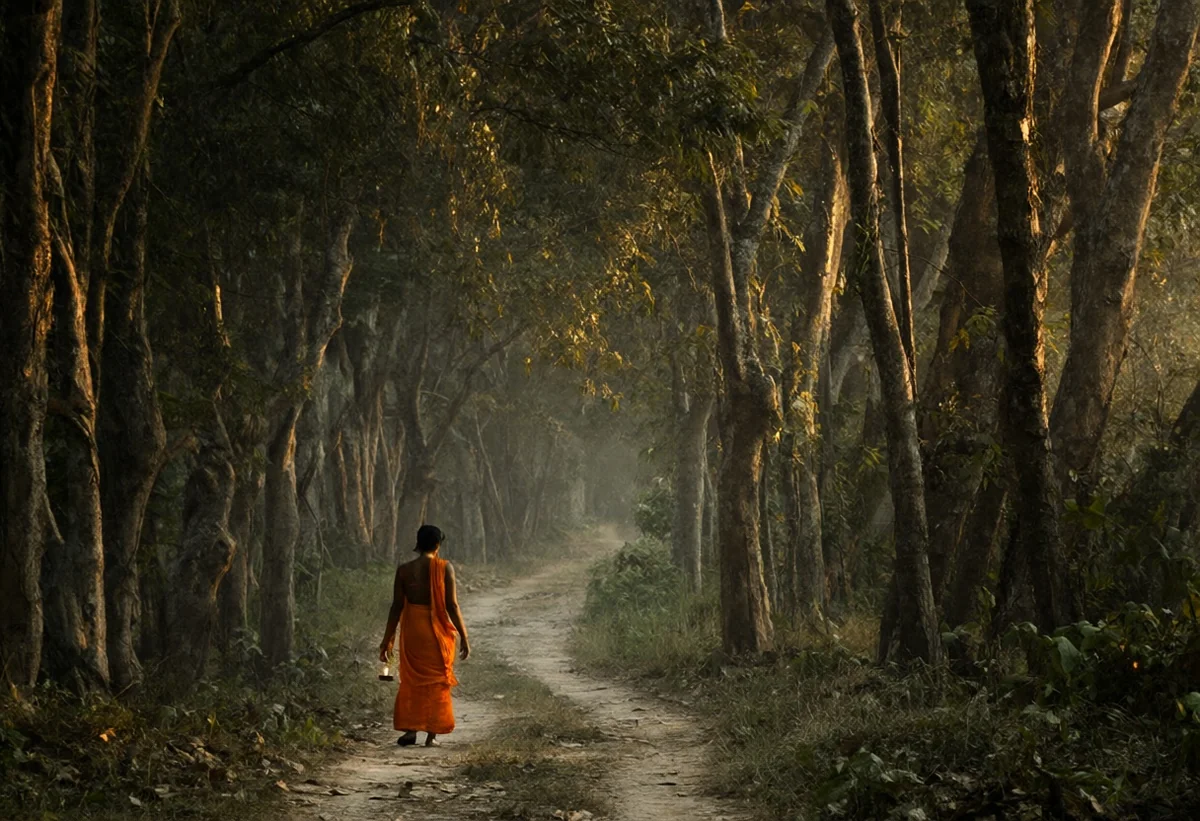
The day in the forest
On the appointed morning, Satyavan took his axe to the forest to gather wood and fruit. Savitri asked to go with him, and although he was concerned about her fasting, he agreed. As he worked, he was suddenly seized by a violent pain in his head. He told her that he felt faint, and she took him on her lap, sitting under a tree as he lost consciousness.
Then she saw a presence approaching: a dark figure in red garments, crowned, with eyes that shone like fire and a noose in his hand. It was Yama, the lord of death and of dharma, who had come himself instead of sending his messengers because Satyavan was so righteous. He drew the soul from the body, thumb-sized, and began to walk south, the direction of his realm.
Savitri rose and followed.
The woman who would not turn back
Yama turned and told her to go back and perform the funeral rites. His authority was complete and his tone was kind, but she kept walking. When he asked her again, she answered not with a plea but with a statement that sounded almost like conversation: wherever her husband is taken, she should go, and that is the eternal rule. She added that by her vow, her austerity, her love for her elders and by his own grace, her way would not be blocked.
What follows is one of the most delicate exchanges in the epic. Savitri does not plead, argue or accuse. She speaks of dharma. She mentions that the wise say friendship is made by walking together seven steps, and that she and Yama have now walked many more than that. Every statement she makes is something Yama, as the upholder of dharma, cannot deny. She is not defeating him; she is inviting him to be what he claims to be.
Yama is moved. He tells her that her words are pleasing to his mind and that he will grant her a boon, anything she wishes, except the life of Satyavan.
The boons and the pattern in them
This is the crux, and the tellings vary slightly in the order of what follows, but the shape is constant. Savitri does not ask for her husband's life. She is too wise for that. She asks for something else, and the something else is generous.
For her first boon she asks that her father-in-law, the blind and exiled Dyumatsena, regain his sight and his strength. Yama grants it. He tells her to turn back, since she must be tired. She replies that she cannot be tired when she is near her husband, and that being near a good person is a rest in itself. She continues to speak of the company of the virtuous, how even a single meeting with them is never in vain. Yama is pleased again, and says she may ask for another boon, still not the life of Satyavan.
She asks that her father-in-law be restored to his lost kingdom, and that he never abandon his dharma. Yama grants it. Next, in the versions that follow, she asks for her own father, who had no son, to be blessed with a hundred sons. Granted again.
Look at what she is doing. Each request lifts someone else: the blind father-in-law, the dispossessed king, her own father. She asks nothing for herself. And with each boon, Yama is drawn a little further into a frame in which he is the protector of a family, not the collector of a soul. She is changing the character of the conversation with every sentence.
The last boon
Finally Yama, charmed and a little weary of being out-argued so gently, offers one more: a boon for herself, anything but Satyavan's life. This time Savitri asks for a hundred sons, born of herself and Satyavan, to carry on the line.
Yama, who has been granting boons in a mood of warm approval, says yes before he has considered what it entails. Then he understands. A hundred sons born of her and Satyavan require Satyavan to be alive. He has bound himself with his own word, given in the name of dharma, which he cannot break.
The epic tells us that he laughed, or in some tellings smiled, in appreciation of her wit, and released the soul. He told her that her husband would live long, that he would live four hundred years, and that she had won back more than a life. She returned to the tree where Satyavan lay, and he stirred as if waking from sleep. The sight of Dyumatsena, his vision restored, awaited them in the hermitage.
What the story teaches about asking
It is easy to read this as a tale of wifely devotion, and it is that. But read slowly, it is also a manual of the art of asking, one that applies to ordinary rooms and ordinary negotiations.
First, Savitri understood who she was speaking to. She did not argue with Yama as an enemy. She addressed him as the lord of dharma, and so she asked him to be consistent with his own nature. Anyone who negotiates, with a supplier, a regulator, a customer, would do well to learn this. People respond best when invited to act in line with what they believe about themselves.
Second, she did not demand the thing she most wanted at the beginning. She built a path toward it by asking for things that were good, generous and easy to grant. By the time she reached her real request, the conversation had a momentum of agreement.
Third, she stayed. The whole victory depended on her willingness to keep walking while being told, courteously and repeatedly, to turn back. Persistence is rarely loud. Here it is simply a woman walking behind a god, speaking quietly, refusing to leave.
Fourth, she asked from abundance. Her requests were for others. People who ask from generosity tend to be heard differently from those who ask from fear.
A thought to carry
The tradition remembers Savitri as the model of the steadfast woman, and women still observe a vow in her name. But the story speaks to anyone who has had to face an outcome that seems fixed and unalterable. Savitri did not pretend that death was not real, and she did not ask it to cease being death. She asked, in the right order and in the right spirit, for the things that dharma itself could not refuse.
The next time you find yourself in a conversation where the other side seems to hold every card, ask yourself what Savitri would ask. Not the one thing you want, but the sequence of good things that makes your real request the natural conclusion. And before you walk in, spend your preparation as she did, a long time before the day, looking squarely at what is coming. Choose one conversation you have been dreading this week, and write down the first three things you could ask for that would be good for the other person.
📬 Join 49,000+ Indian Professionals
The Inner Circle newsletter delivers curated MSME intelligence, leadership wisdom, and strategic insights every week — completely free. Plus receive the 20 Gita Lessons PDF as a welcome gift.
Subscribe Free →Ready to Go Further?
My mythology and fiction titles bring these stories alive for the modern reader. Available on Amazon India.
Explore My Books on AmazonPublished 30 October 2026 · dibyenduchoudhury.com