Few episodes in the Mahabharata leave a reader as unsettled as the story of Ekalavya. A boy comes to the best teacher of his age and is turned away at the door. He does not argue and does not go home. He makes an image of that teacher out of clay, sets it up in a clearing in the forest, and trains before it every day until his skill astonishes the very people who refused him. Then the teacher comes, asks for a fee, and the fee is his right thumb. Most of us hear the story once as children and carry a vague sorrow about it for the rest of our lives.
This article does not try to settle the old arguments about the story. Scholars and storytellers have read it in many ways, and the epic itself is quiet about the inner life of everyone involved. What I want to do is read it as a story about institutions, teachers and leaders: about who gets taught, who gets promised, and what happens to talent that grows outside the room where decisions are made.
The story, as the epic tells it
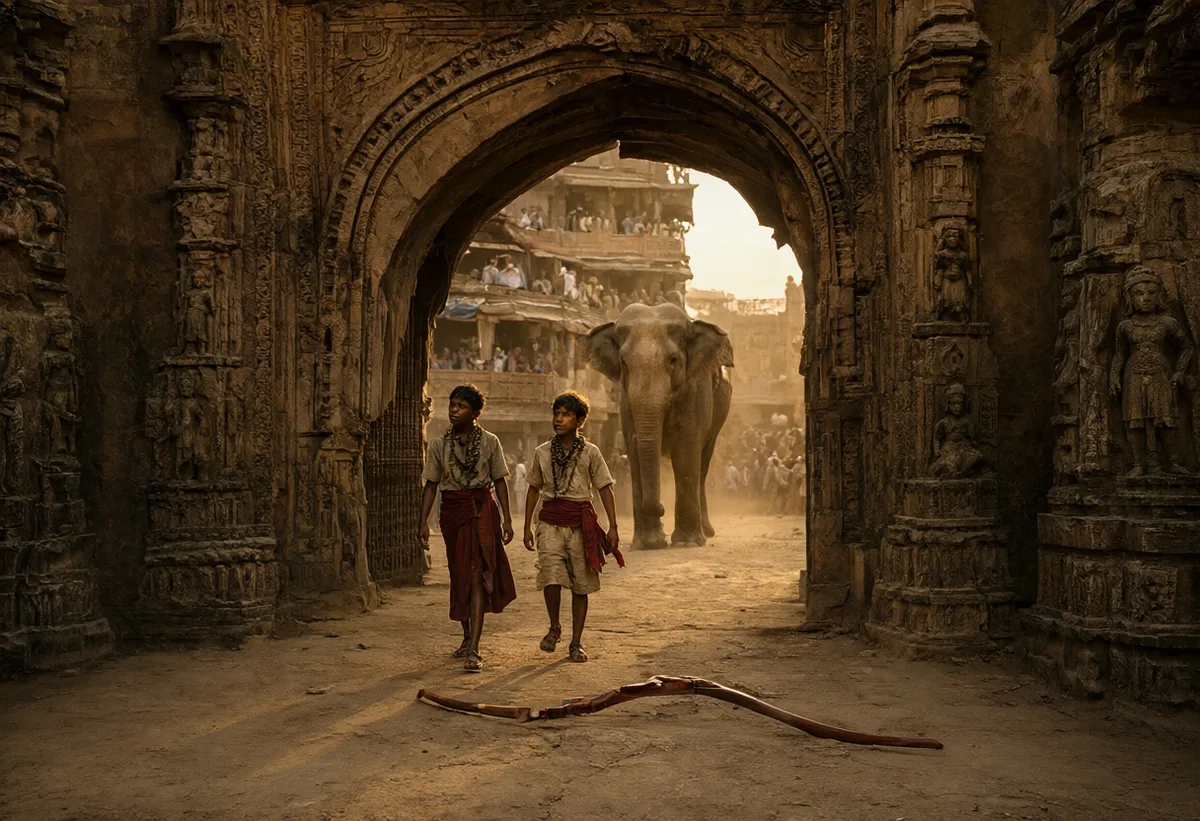
Ekalavya was the son of Hiranyadhanus, a chief of the Nishadas, a forest people. He heard of Drona, the master of weapons who taught the Kuru princes at Hastinapura, and came to ask for instruction. Drona declined. He had a standing commitment to the princes, and in particular he had given Arjuna his word that no pupil would ever surpass him. A forest boy with no court standing had no place in that arrangement.
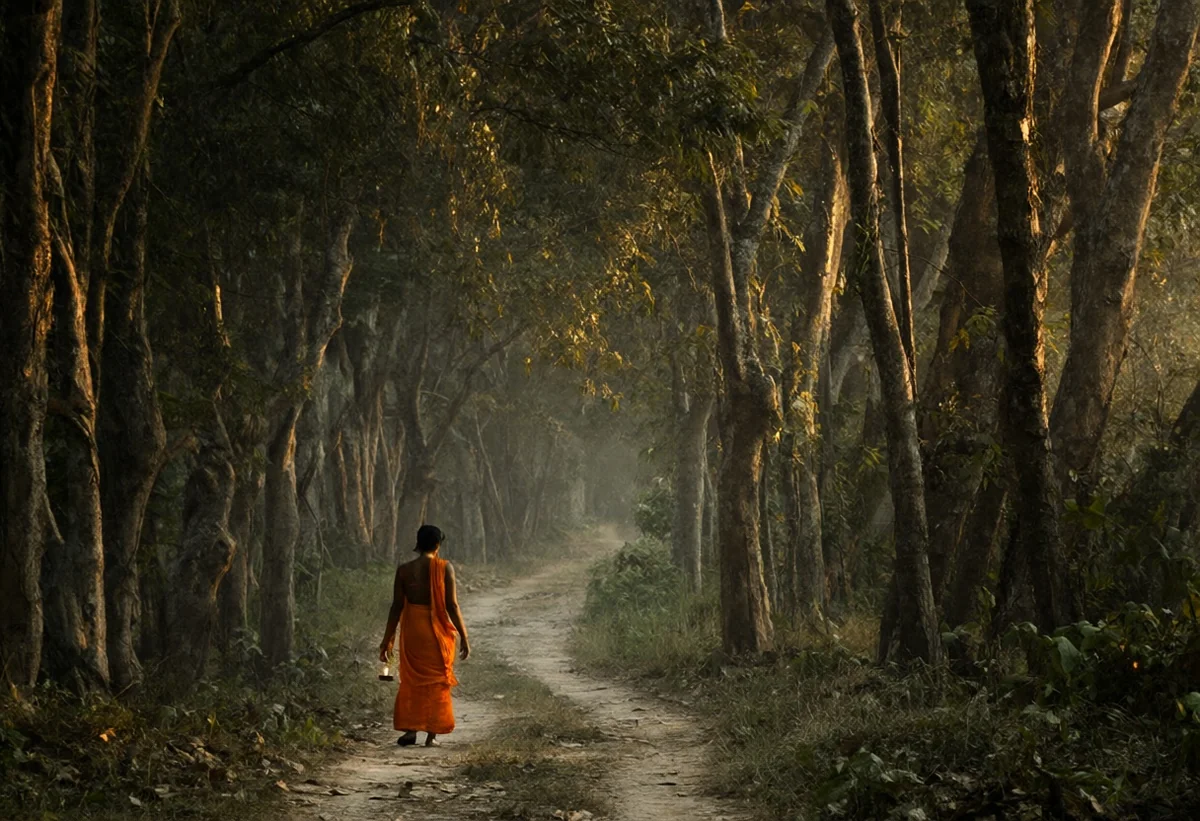
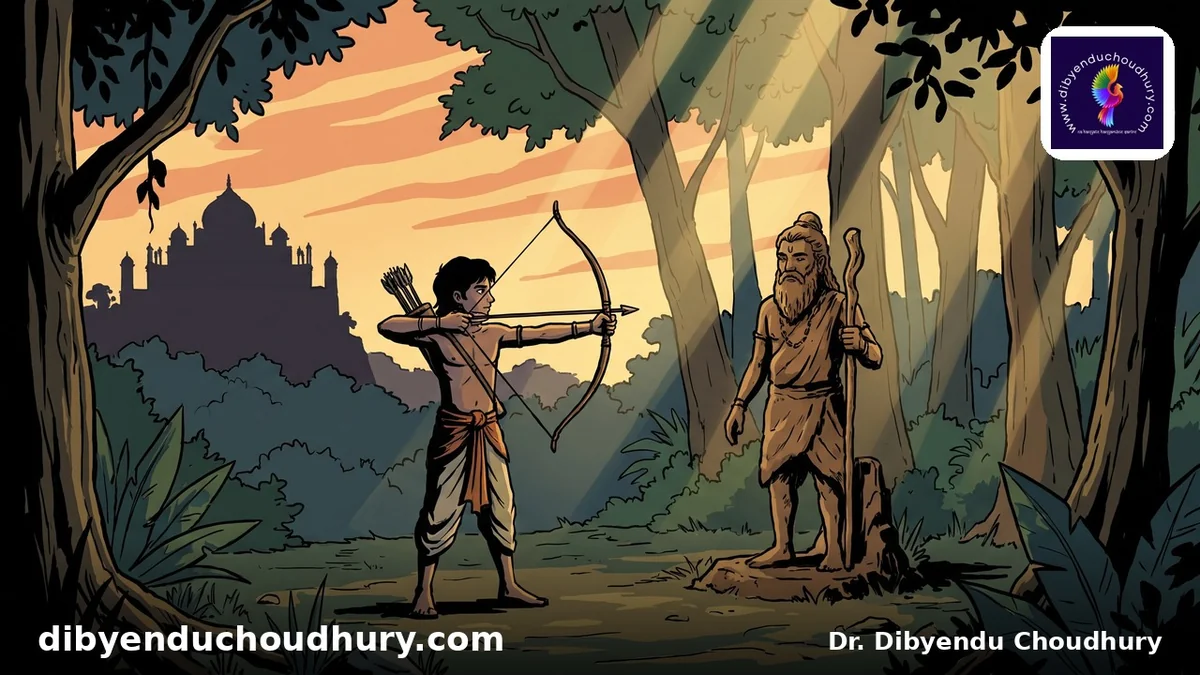
Ekalavya touched Drona's feet, went back into the forest, and shaped a clay figure of the teacher. Before it he practised with a faith that the epic describes in careful detail. His discipline was complete: he rose before light, repeated the exercises until his hands knew them without thought, and treated the clay image as if it could correct him. Over time he became an archer of extraordinary precision.
One day the princes were hunting in the forest and their dog wandered off. It found Ekalavya, and its barking broke his concentration. In answer he loosed seven arrows so quickly and so exactly that they filled the dog's mouth and silenced it without a wound. The dog ran back to its masters with its mouth full of arrows. The Pandavas were amazed, and Arjuna went to his teacher in distress, reminding him of the promise that no one would equal him.
Drona went to the forest, found Ekalavya, and asked who his teacher was. Ekalavya answered without hesitation that it was Drona himself. The teacher then asked for his fee, the guru-dakshina. Ekalavya offered anything. Drona asked for the right thumb. Ekalavya cut it off and gave it, and the epic says he did so with a cheerful face. Afterwards he could still shoot, but never again with the old speed.
Three readings, and why each matters
The first reading is the reading of devotion. On this view the story honours Ekalavya's single-minded faith: the clay teacher, the daily practice, the unquestioning gift. Many traditional tellings stay here, and there is real force in it. Mastery does come from repetition, and a student who gives full attention can learn from very little.
The second reading is the reading of injustice, and it is the one most readers reach for today. Drona refused a worthy student because of his birth and his standing, kept a private promise to a favourite, and then claimed a fee for teaching he had never given. Read this way, the story is an indictment of a system that rations opportunity by privilege and then punishes talent that grows without permission.
The third reading is the reading of cost. It asks what any organisation loses when it closes its door to capable people for reasons that have nothing to do with capability. Ekalavya became excellent anyway, and the loss was borne by everyone who might have benefited from an archer of his ability.
These readings are not mutually exclusive, and a thoughtful leader does not need to pick one. Each of them points to a question worth putting to oneself.
Question one: who is standing outside your door?
Every team, school, department and business has a door. Behind it are the people who receive mentoring, interesting work and the attention of senior people. In front of it are others who are equally able but have no introduction, no pedigree, no one to vouch for them. Drona was not a cruel man in the usual sense. He was bound by prior commitments, and the door closed on Ekalavya almost by default.
The practical exercise is simple and a little uncomfortable. List the three most capable people you know who are not currently part of your inner circle of colleagues or students. Ask what stops them from being inside. If the honest answer is that nobody thought to invite them, you have found something you can fix this month.
Question two: which promises are quietly shaping your decisions?
The pivotal detail in the story is the promise to Arjuna. It was made in private, long before Ekalavya arrived, and it could never be honoured fairly once a better archer appeared. A promise like that shapes every later choice while remaining invisible to the people it harms.
Leaders make versions of this promise all the time. We tell a favoured colleague that their position is safe. We assure a long-serving team that no one will overtake them. We promise a department that its budget will not shrink. Such assurances feel generous when we give them. They become unjust when circumstances change and we protect the promise rather than the principle behind it. Before you reassure anyone about their standing, ask yourself what you will do if someone better turns up.
Question three: what do you ask for when you ask for a fee?
The most troubling moment in the story is the thumb. Drona had given Ekalavya nothing except a refusal, yet he claimed the highest price a teacher could name. The epic does not hide the discomfort of this. In many retellings even the other characters seem uneasy.
Teachers and managers receive payment in many forms: loyalty, credit, deference, silence. The test of a healthy arrangement is whether what you ask in return is proportionate to what you have actually given. If someone has grown largely by their own effort, and you step in only at the end to claim a share of the credit, you are standing where Drona stood. The better practice is to give first, ask little, and ensure that nobody pays with the very ability that made them worth teaching.
What Ekalavya teaches us about self-education
It would be a mistake to read the story only from the teacher's side. Ekalavya himself offers a model that remains useful. He did not wait for permission. He identified the best source of knowledge available to him, built a daily routine around it, and held himself to a standard no outsider was checking. In an age when more people than ever must teach themselves a skill, a language or a new line of work, that discipline is worth borrowing.
The clay image is the detail I find most instructive. It stood for a standard, not a person. Ekalavya asked each day whether Drona would have approved, and answered honestly. Anyone who works alone, whether a small business owner, a freelancer or a student without a mentor, can build a version of the clay teacher: a clear picture of what excellent work looks like, and the habit of measuring each day's effort against it.
The story also warns against one thing. Ekalavya's skill was real, but he built it without feedback from a living teacher, and in the end he was exposed to a demand he could not refuse. Self-education is powerful, but it is stronger still when it is joined to honest guidance from someone who wishes the learner well. If you are teaching yourself, look for at least one person who will read your work and tell you the truth.
A closing reflection
The Bhagavad Gita, which sits within the same epic, asks the reader to act with full effort while loosening the grip on reward. Ekalavya's practice in the forest fits that teaching almost perfectly. His effort was complete and his attachment to recognition was small. The scene at the end does not read as defeat. It reads as a question handed to everyone else: what kind of world do we build when we let a thumb be the price of excellence?
If you lead people, the question is not abstract. Somewhere near you is a student, a junior colleague or a young entrepreneur practising in front of a clay image of what they hope to become. You may never see the practice. You may only hear the arrows. What you do when you find them is, in the end, what your leadership will be remembered for.
One question to take away
Who in your world is practising outside the door, and what is one small, specific thing you could do this week to open it? Tell me in the comments; I read every reply.
If you would like reflections like this in your inbox, you can join the free newsletter.
📬 Join 49,000+ Indian Professionals
The Inner Circle newsletter delivers curated MSME intelligence, leadership wisdom, and strategic insights every week — completely free. Plus receive the 20 Gita Lessons PDF as a welcome gift.
Subscribe Free →Ready to Go Further?
My mythology and fiction titles bring these stories alive for the modern reader. Available on Amazon India.
Explore My Books on AmazonPublished 16 November 2026 · dibyenduchoudhury.com