Every working life has the bad week. The order is cancelled on Monday, a trusted colleague resigns on Wednesday, and by Friday a small remark from a customer feels like a verdict on your whole career. Then, some weeks later, the opposite arrives: praise, a payment that clears early, a message from someone you admire. In the first week you were ready to close the shop. In the second you were ready to open three more. The work was the same in both weeks. Only the weather had changed.
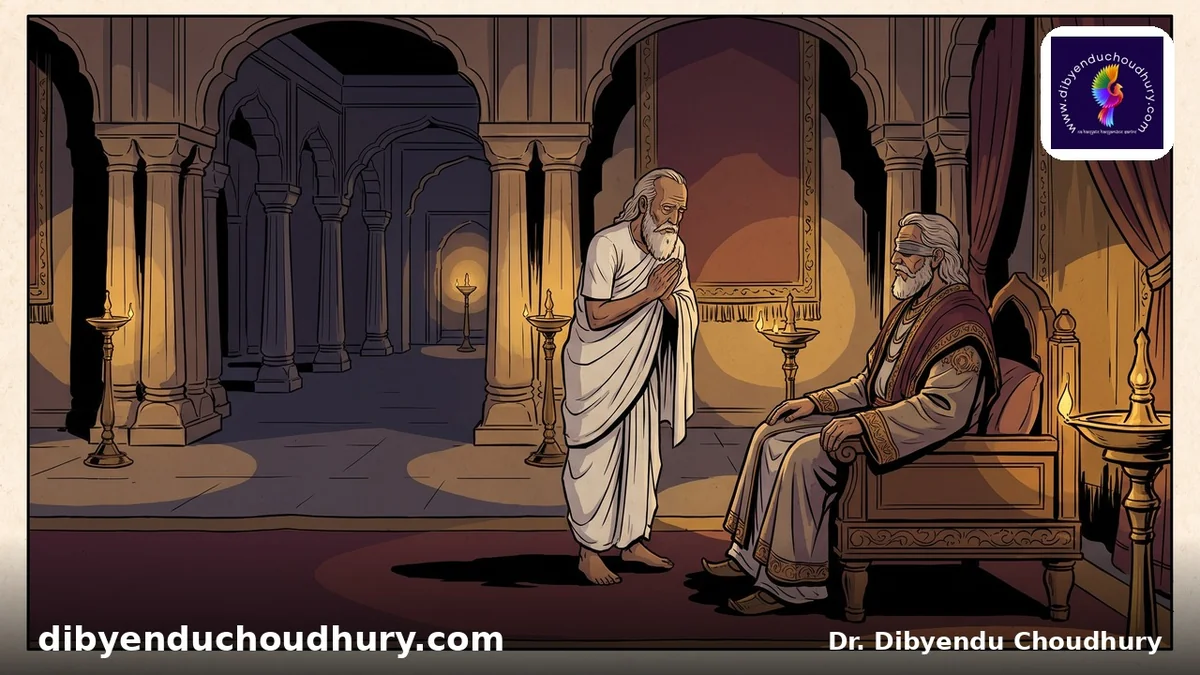
The Bhagavad Gita has a verse for exactly this, and it comes very early, before any of the famous teaching on action and duty. In the second chapter, verse 14, Krishna tells Arjuna that the contacts of the senses with their objects give rise to cold and heat, pleasure and pain. They come and they go. They do not last. And then the instruction, in one word: bear them.
What the verse says
The Sanskrit is compact. Matra-sparshah are the touches of the senses on the world. From these touches come shita and ushna, cold and heat, and sukha and duhkha, pleasure and pain. The verse then gives them two descriptions. They are agama-apayinah, things that arrive and depart. And they are anitya, not permanent. The last line is the instruction: tams titikshasva, endure them, learn to bear them.
Notice the comparison Krishna chooses. He does not compare pain to a wound or pleasure to a prize. He compares both to the seasons. Nobody takes winter personally. Nobody believes that summer has arrived because of their own merit, or that it will stay because they deserve it. We put on a shawl, or open a window, and carry on with the day. The verse asks us to hold praise and blame, gain and loss, in the same way: as weather that touches the skin, and not as a judgment on the person inside.
Why this verse comes so early
Arjuna, at this point in the story, is not asking about philosophy. He is overwhelmed. His limbs are weak, his mouth is dry, and he has put down his bow. Krishna has just begun to speak, and one of the first things he offers is not a grand theory but a small, sturdy observation: what you are feeling is real, and it is also passing.
There is kindness in that order of teaching. A person in distress cannot use a complicated idea. He can use a simple one. Before anything is said about how to act, the Gita steadies the one who must act. The very next verse explains why this matters: the person who is not thrown about by these pairs, who stays even in pleasure and pain, is the one who becomes fit for what is lasting. Steadiness is not the goal of the teaching. It is the condition for receiving the rest of it.

What titiksha is not
The word for this bearing is titiksha, and it is easy to misread. It does not mean pretending that nothing hurts. The verse plainly says that cold is cold and pain is pain. It does not ask Arjuna to feel nothing. It asks him not to be carried away.
Nor does it mean doing nothing about a problem. If the roof leaks, you repair the roof. If a customer is unhappy for a good reason, you put it right. Titiksha applies to the part that cannot be repaired this afternoon: the sting, the worry at night, the wish to send an angry reply. Those are the heat and cold. They have to be borne while the practical work goes on.
And it does not mean a hard face. The teachers of the tradition describe titiksha as bearing difficulty without complaint and without planning revenge, which is quite different from bearing it with clenched teeth. A person who endures and resents has not endured. He has only postponed the outburst.
The same rule for the good week
We usually hear this verse as advice for hard times, and forget that pleasure is on the list beside pain. The good week needs the same treatment as the bad one, and in practice it is the harder discipline. Pain announces itself. Pleasure persuades. After a run of praise we begin to believe that this is how things are now, and we make promises, hire, spend and speak on the strength of a season.
The Gita does not ask us to refuse the good week. Enjoy the warmth. Only remember what kind of thing it is. It arrived, so it will leave. The owner who can say "this is summer" in a good month is the same owner who can say "this is winter" in a bad one, and neither month will push him into a decision he would not make in ordinary weather.
A plain practice for a bad week
An idea like this is only useful if it can be done on a Tuesday. Here is one way to practise it, which needs nothing but a notebook.
First, name the weather. When something stings, write one line: what happened, and what you feel. "Order cancelled. Angry and afraid." Writing it down separates the event from the person. It is now a thing on a page, and you are the one looking at it.
Second, ask the verse's own question: did this arrive? Then it will also depart. You do not have to believe that with your whole heart. You only have to remember one earlier week that felt just as final, and notice that you can no longer recall the details.
Third, separate the repair from the weather. Draw a line down the page. On the left, write what can actually be done: the call to make, the figure to check, the apology to offer. On the right, write what can only be borne: the disappointment, the embarrassment, the waiting. Do the left side today. Leave the right side alone, and let it pass at its own speed.
Fourth, delay the large decision. No resignations, no price cuts, no long messages on the day of the storm. Give it three days. If the decision is right, it will still be right on Friday, and you will make it in a steadier hand.
Fifth, keep one small duty unbroken. The morning walk, the prayer, the ledger, the page of reading. In a bad week the temptation is to drop the ordinary things because they seem too small for the crisis. They are the thread. Hold it.
What steadiness gives back
People sometimes fear that this teaching will make them dull, that a person who bears everything evenly will stop caring. The experience of those who practise it is the opposite. When less energy goes into being thrown about, more is left for the work, for the family, and for the person across the table. The steady owner hears the complaint properly because he is not busy defending himself. He sees the opportunity in the good month because he is not drunk on it.
The verse does not promise that the heat and cold will stop. It makes a smaller and more honest promise: that they are visitors. You can be a good host to visitors without handing them the keys of the house.
One question to take away
Think of the last week you were sure was a disaster. How much of it can you still feel today, and what did you decide in the middle of it that you later wished you had waited on? Tell me in the comments; I read every reply.
If you would like notes like this in your inbox, you can join the free newsletter.
📬 Join 49,000+ Indian Professionals
The Inner Circle newsletter delivers curated MSME intelligence, leadership wisdom, and strategic insights every week — completely free. Plus receive the 20 Gita Lessons PDF as a welcome gift.
Subscribe Free →Ready to Go Further?
Explore my books on the Bhagavad-gita, leadership, and ancient wisdom — available on Amazon India.
Get the Book on AmazonPublished 24 November 2026 · dibyenduchoudhury.com