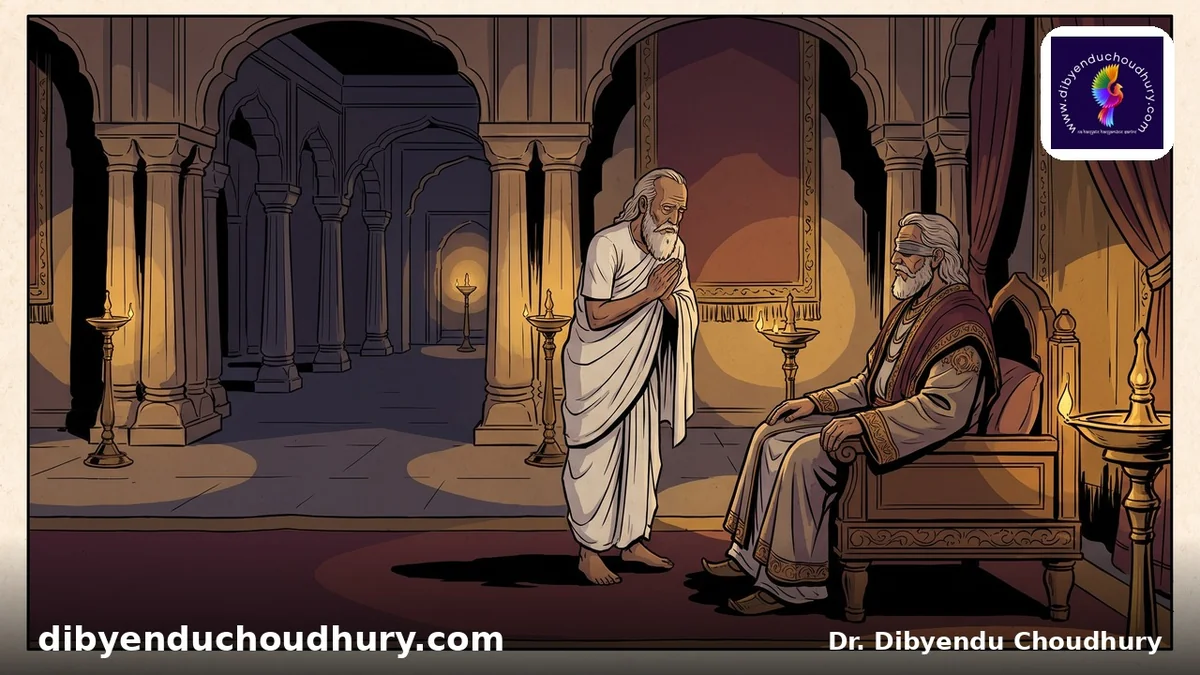
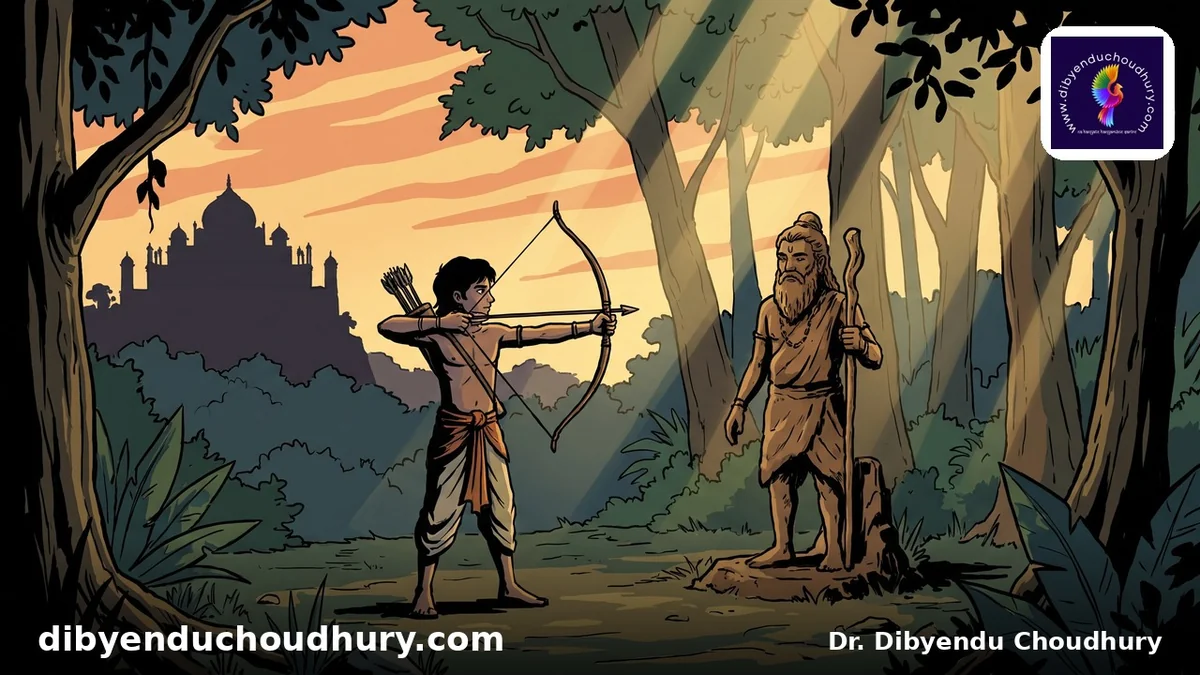
Everyone has stood where Arjuna stood, though not on a battlefield. Two duties pull in opposite directions. Each has a good argument, and each argument is your own. You weigh them at night and again in the morning, you ask three friends and receive three opinions, and after a month you are more tired and no clearer. We call this being confused, as if it were weather that will pass. The Bhagavad-gītā does not treat it as weather. It treats it as a condition with a name and a cause, and it shows the one act by which a confused man became fit to be taught. That act takes a single verse. Until it happens, Kṛṣṇa says almost nothing. After it happens, He speaks for seventeen chapters.
Kārpaṇya-doṣa: Arjuna's Honest Confusion
Consider how much Arjuna had already said. In the first chapter he argues at length and argues well: the family will be destroyed, the elders will be killed, tradition will collapse, sin will follow. These are not foolish points. He is a learned kṣatriya quoting principles of dharma. Yet at the end of his speech he is not standing firm on his conclusion. He casts aside his bow and sits down, his mind overwhelmed with grief (Bhagavad-gītā 1.46). Then he admits the real position: we do not know which is better, to conquer them or to be conquered by them (Bhagavad-gītā 2.6). Mark this carefully. Fine arguments and paralysis were living in the same man at the same hour. That is the first lesson for anyone who is confused. The mind that is bewildered is the same mind that is producing the reasons, so more reasoning of the same kind will only produce more of the same bewilderment. An instrument that is out of order cannot test itself. Arjuna is intelligent enough to see this, and what he does next is the turning point of the whole Gītā.
kārpaṇya-doṣopahata-svabhāvaḥ pṛcchāmi tvāṁ dharma-sammūḍha-cetāḥ yac chreyaḥ syān niścitaṁ brūhi tan me śiṣyas te ’haṁ śādhi māṁ tvāṁ prapannam
— Bhagavad-gītā 2.7
Translation: Now I am confused about my duty and have lost all composure because of miserly weakness. In this condition I am asking You to tell me for certain what is best for me. Now I am Your disciple, and a soul surrendered unto You. Please instruct me.
Purport: Arjuna gives the diagnosis in his own words: kārpaṇya-doṣa, the fault of miserliness. Who is a miser? Not only one who hoards money. The Bṛhad-āraṇyaka Upaniṣad (3.8.10) says that he is a kṛpaṇa, a miserly man, who quits this world like the cats and dogs, without solving the problems of life and without understanding the science of the self. The human form is a great asset, given for inquiry into who I am, why I suffer and what my relationship is with the Supreme. One who spends that asset only on family affection, position and anxiety about them is a miser, however generous he may be with rupees. The opposite is the brāhmaṇa, one intelligent enough to use this body to solve the real problems. Arjuna says that this weakness has covered his svabhāva, his own nature, and that he is dharma-sammūḍha-cetāḥ, bewildered in mind about duty. Then he does three things in one line. He asks: pṛcchāmi tvām, I am asking You. He specifies what he wants: yac chreyaḥ syān niścitam, tell me for certain what is best, not what is pleasant. And he changes his position: śiṣyas te 'ham, I am Your disciple, prapannam, surrendered. Until now he spoke to Kṛṣṇa as a friend and equal. Friendly talk cannot remove perplexity, because friends debate. A disciple hears. So Arjuna voluntarily gives up the right to argue back.
Miserliness of Heart Is the Real Name of Our Confusion
See what happens once he has done so. In the very next verses Arjuna says that he can find no means to drive away the grief that is drying up his senses, not even by winning an unrivalled kingdom on earth (Bhagavad-gītā 2.8), and he falls silent (Bhagavad-gītā 2.9). Then Kṛṣṇa, smiling, begins to speak (Bhagavad-gītā 2.10), and His first instruction is a correction: while speaking learned words, you are mourning for what is not worthy of grief (Bhagavad-gītā 2.11). A friend would not say that. A teacher must. This is the practical difference between complaint and question. In the first chapter Arjuna presented conclusions and wanted agreement. In 2.7 he presents ignorance and wants instruction. Most of us, when we say we are seeking advice, are doing the first thing. We go to the person most likely to approve what we have already half decided, and we come away with the same confusion and a little more company in it. The Lord states the proper method plainly in the fourth chapter.
Confusion, then, is not cured by more thinking. It is cured by a change of position, from judge to student. As long as I remain the final authority on my own case, I am asking a bewildered mind to certify itself, and it will certify whatever it is attached to. This is why Arjuna names the cause as miserliness and not as lack of information. He had information. What he lacked was the willingness to place his life's real question before a higher authority and abide by the answer. The moment he says śādhi mām, instruct me, the Gītā begins.
Śiṣyas Te 'Haṁ Śādhi Māṁ Tvāṁ Prapannam
Someone will object that this is weakness, that a grown man should decide for himself. But look at ordinary life. When the body is diseased, the intelligent man does not hold a debate with his own symptoms. He goes to a qualified physician, describes the condition honestly, and follows the prescription. When there is a legal difficulty he goes to one who knows the law. Nobody calls this weakness. It is called good sense. Only in the most important matter, what this life is for and what I should do with it, do we insist on being our own doctor. The result is what we see everywhere: educated, capable people who can manage a company and cannot settle their own minds. Arjuna's surrender was not the act of a weak man. It took more courage for the foremost archer of his time to say I do not know, in front of both armies, than it would have taken to fight.
tad viddhi praṇipātena paripraśnena sevayā upadekṣyanti te jñānaṁ jñāninas tattva-darśinaḥ
— Bhagavad-gītā 4.34
Translation: Just try to learn the truth by approaching a spiritual master. Inquire from him submissively and render service unto him. The self-realized souls can impart knowledge unto you because they have seen the truth.
Purport: Three conditions are given, and all three are required. Praṇipāta means to approach with submission, to offer obeisances, to accept that the other person knows what I do not. Paripraśna means sincere inquiry, asking in order to understand and not in order to defeat. Sevā means service, the practical willingness to act on what is taught and to assist the teacher. Take away any one and the transmission fails. Submission without inquiry is blind following, and blind following is condemned. Inquiry without submission is mere challenge, a display of one's own learning, and nothing enters a full vessel. Both without service remain theory. The Vedic literature gives the same order elsewhere: to learn the transcendental science one must approach a spiritual master (Muṇḍaka Upaniṣad 1.2.12). And the verse states the qualification on the other side as well: the teachers are jñāninas tattva-darśinaḥ, those who have seen the truth. One does not surrender to anyone who happens to be confident. Arjuna chose the Supreme Personality of Godhead Himself. For us the standard is one who speaks what Kṛṣṇa speaks, without addition and without subtraction, and who lives by it.
Praṇipāta, Paripraśna, Sevā: The Three Conditions of Receiving an Answer
Notice also that surrender did not end Arjuna's questions. It began them. Throughout the Gītā he asks, and asks sharply. If knowledge is better than action, why do You engage me in this ghastly warfare (Bhagavad-gītā 3.1)? What impels a man to sin even unwillingly (Bhagavad-gītā 3.36)? The mind is restless and as hard to control as the wind (Bhagavad-gītā 6.34). That is paripraśna. Kṛṣṇa never rebukes him for asking. The difference from the first chapter is the mood. Now each question is put in order to act on the answer. And at the end the Lord does not force him. Having explained everything, He says: deliberate on this fully, and then do what you wish to do (Bhagavad-gītā 18.63). Discipleship is therefore not the loss of intelligence. It is intelligence applied in the right direction. Arjuna's reply is the proof that the method works: naṣṭo mohaḥ, my illusion is gone, I have regained my memory by Your mercy, and I am prepared to act according to Your instructions (Bhagavad-gītā 18.73).
So when you find yourself going round the same decision for the tenth time, stop adding arguments. Say honestly what Arjuna said: I am confused about my duty. Then take the question where it can be answered. Kṛṣṇa's words are available to everyone in Bhagavad-gītā As It Is. Read one verse with its purport each morning as a student reads, not hunting for support for what you have already decided, but asking what is being instructed. Seek the company of those who live by these teachings, inquire from them submissively, and render some service. And chant Hare Kṛṣṇa Hare Kṛṣṇa, Kṛṣṇa Kṛṣṇa, Hare Hare, Hare Rāma Hare Rāma, Rāma Rāma, Hare Hare, which clears the mirror of the mind so that instruction can be received. The one who answered Arjuna is still answering. What is required from our side is only what Arjuna gave: an honest admission, a sincere question and a willingness to follow.
From the Book
This article draws on the Confusion chapter of Bhagavad Gita for Everyday Life, my book, out now on Amazon Kindle, applying Kṛṣṇa’s instruction to the specific afflictions of ordinary life. The chapter treats every verse the Gītā assigns to confusion, verse by verse, with the word-by-word meaning and its application to work and family.
Go deeper now: 20 Gita Lessons for Entrepreneurs.