Every court in the Mahabharata has warriors, and the epic remembers them in long lists. It remembers very few advisers. One of them stands apart, because he held no army, wanted no throne, and spent his life saying things his king did not wish to hear. His name was Vidura, and the tradition has kept his counsel alive under a title of its own, the Vidura Niti.
We usually read the Mahabharata as a story about the people who fought. I want to read it here as a story about a warning that was given clearly, given early, given more than once, and not acted upon. That is a situation every organisation knows. The interesting questions are why the warning failed, what the adviser did afterwards, and what both sides of that conversation can learn.
Who Vidura was
Vidura was the half-brother of Dhritarashtra and Pandu. The epic tells us he was born to a maid of the palace, and for that reason he could never be king, though he was raised and taught alongside the princes. He became the chief counsellor of Hastinapura. The text describes him as a man devoted to dharma and free from anger, and later tradition regards him as dharma itself born in human form.
His position is worth noticing. He was inside the family and outside the succession. He had nothing to gain from flattering the king and nothing to inherit by removing him. In the language of a modern boardroom he was the independent voice at the table, close enough to know everything and with no personal stake in the outcome.
The warnings
The epic records Vidura speaking at each turning point of the Kuru story. When Duryodhana was born amid ill omens, Vidura and the learned men of the court advised the king that the welfare of a whole family must weigh more than attachment to one member of it. Dhritarashtra loved his son and could not do what was asked.
Years later, when the Pandavas were sent to the town of Varanavata, to a house built of lac and other things that burn, it was Vidura who understood the plan. He warned Yudhishthira in guarded words that others present could not follow, and then sent a trusted miner to dig the passage through which the brothers and their mother escaped the fire. Here he did more than advise. He acted, quietly, to protect people who were about to be wronged.
Before the game of dice he told the king plainly that the invitation would end in ruin and begged him to stop it. When the game went ahead and Draupadi was dragged into the assembly, Vidura was among the very few who spoke against what was happening while the elders sat silent.
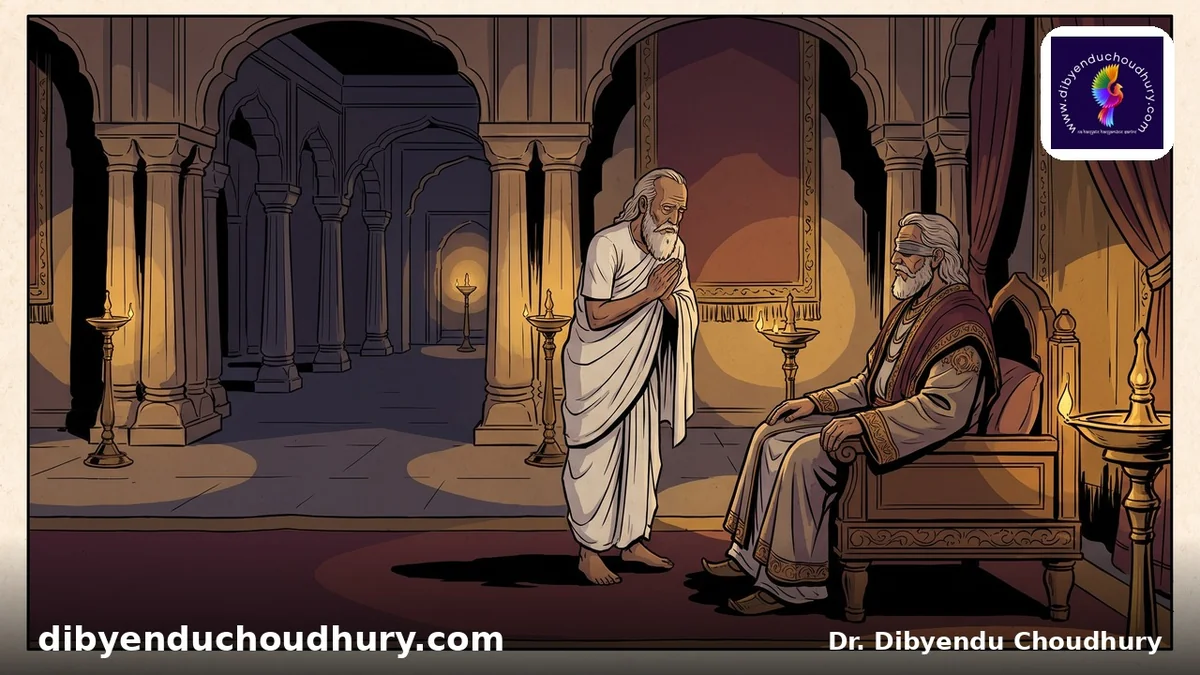
And on the eve of the war, when Dhritarashtra could not sleep, he sent for Vidura. The long conversation that followed is the Vidura Niti. It ranges over the marks of a wise person and a foolish one, the habits that ruin a ruler, and the conduct of a household. Running through it is one appeal, repeated in many forms: give the Pandavas their share, and restrain your son.
Why a clear warning was not heard
It would be easy to say that Dhritarashtra was simply a weak king. The epic is more careful than that. He was an intelligent man. He understood Vidura perfectly, and he often said so. He would agree with the advice in the evening and fail to act on it in the morning.
What stood in the way was affection. Dhritarashtra admits more than once that he knows what is right and cannot bring himself to do it because of his love for Duryodhana. That is the sober lesson for any leader. We rarely ignore good advice because we fail to understand it. We ignore it because acting on it would cost us something we are attached to: a favourite colleague, a pet project, a picture of ourselves, a quiet life at home.
One of the best-known sayings in the Vidura Niti names the difficulty exactly. People who say pleasant things are easy to find, Vidura tells the king. A person who will say what is unpleasant but good for you is rare, and rarer still is the one who will listen. The verse puts two burdens side by side. One belongs to the speaker and one to the hearer, and the hearer's is the heavier.
What the adviser did when he was sent away
There is a passage after the dice game that deserves more attention than it gets. Vidura pressed his advice once again, and the king, stung, told him to go wherever he pleased. Vidura left Hastinapura and went to the Pandavas in the forest. Almost at once Dhritarashtra was overcome by remorse and sent his charioteer Sanjaya to bring his brother back. Vidura returned, and the two were reconciled.
Three things in that short episode are instructive. Vidura did not soften his counsel to keep his place. When he was dismissed, he went without bitterness and without plotting. And when he was asked to return, he came back and resumed his duty, with no demand for an apology first. He kept the relationship and the honesty together, which is the hardest part of advising anyone.
Whose house Krishna chose
When Krishna came to Hastinapura as an envoy to make a last attempt at peace, Duryodhana offered him a grand reception. Krishna declined to dine with him. Food, he said, is accepted where there is affection, or where there is need, and here there was neither. He went to stay with Vidura, in the plain house of the one man at that court whose word and conduct matched.
The epic makes its judgement through that choice. Power sat in the palace. Trust sat in a modest house nearby. Every institution has both addresses, and wise visitors learn quickly which is which.
Three questions for anyone who gives advice
The first is about interest. Vidura could speak freely because he wanted nothing from the outcome. Before you offer hard counsel, ask what you stand to gain or lose by it, and say so if the answer is anything at all. Advice from a person with a declared interest can still be useful. Advice from a person with a hidden one seldom is.
The second is about manner. Vidura was direct, and he was never contemptuous. Even his sharpest words to the king are framed as concern for the king's own welfare and that of his house. Unwelcome truth delivered with scorn gives the listener an easy reason to reject both.
The third is about limits. An adviser advises. Vidura did not seize the decision from the king, and where he acted on his own, as at Varanavata, it was to shield the innocent and never to take power. Knowing where counsel ends and command begins is part of the adviser's discipline.
Three questions for anyone who receives it
Ask first who in your circle plays Vidura's part. If you cannot name a single person who has told you something unwelcome in the past year, the likelier explanation is not that you have made no mistakes.
Ask next what happens to that person after they speak. Dhritarashtra never punished Vidura for long, and it is to his credit that he always called him back. But he taught his court, over many years, that honest counsel changed nothing. People notice that, and in time they stop offering it.
Ask last which attachment is doing your deciding for you. Dhritarashtra's blindness in the epic is physical, and the poets plainly intend it to be read as something more. Each of us has a Duryodhana, some loved thing that we cannot bear to refuse. Naming it honestly is the beginning of being able to hear.
A closing reflection
Vidura did not prevent the war. By the measure of results his counsel failed, and the Mahabharata does not pretend otherwise. Yet the tradition remembers him with a reverence it gives to very few, because he did what was his to do: he saw clearly, spoke truthfully, acted where he could to protect the vulnerable, and stayed at his post. The Gita, spoken on the field that his advice might have kept empty, asks for exactly that, right action without a claim on the result.
Most of us will be Vidura on some days and Dhritarashtra on others. The story asks us to be a little braver on the first kind of day and a little humbler on the second.
One question to take away
Who told you something you did not want to hear this year, and what did you do with it? Tell me in the comments; I read every reply.
If you would like reflections like this in your inbox, you can join the free newsletter.
📬 Join 49,000+ Indian Professionals
The Inner Circle newsletter delivers curated MSME intelligence, leadership wisdom, and strategic insights every week — completely free. Plus receive the 20 Gita Lessons PDF as a welcome gift.
Subscribe Free →Ready to Go Further?
My mythology and fiction titles bring these stories alive for the modern reader. Available on Amazon India.
Explore My Books on AmazonPublished 21 November 2026 · dibyenduchoudhury.com