Lucknow University has added two vocational papers built on the Bhagavad-gītā — Shrimad Bhagavad Gita for Holistic Wellbeing and Shrimad Bhagavad Gita for Navigating Contemporary Challenges. The announcement, reported by Organiser on 19 May 2026, was received the way these announcements usually are: as a cultural signal, argued about on the strength of the headline alone.
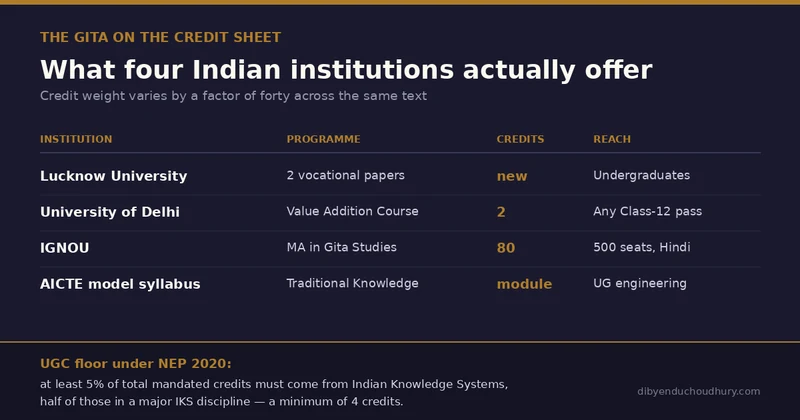
Almost nobody read the syllabus. That is a pity, because the syllabus is where the interesting question lives. Four Indian institutions now teach this text for credit, and they have arrived at four different answers to the same problem — how much of an 18-chapter Sanskrit dialogue can you responsibly fit into a modern degree, and what exactly are you certifying when a student passes? The answers differ by a factor of forty.
What Lucknow actually added
The two Lucknow papers sit in the vocational slot — the elective category NEP-aligned undergraduate structures use for skills that are meant to travel outside the discipline. The stated content is self-management, duty and responsibility, leadership, conflict resolution, decision-making under pressure, and holding steady through difficulty. Read that list without the Sanskrit and it is indistinguishable from a corporate soft-skills module. Read it with the Sanskrit and it is a compressed course on sthitaprajña, the steady intelligence of Chapter Two.
Which of those two things the student receives depends entirely on who is standing at the front of the room. That is not a rhetorical flourish; it is the operational risk in the whole design, and I will come back to it.
Worth noting: this is not Lucknow’s first attempt. In 2020 the university ran an online Gītā certificate course called Discover Yourself — not for students, but for its own faculty, in collaboration with the ISKCON Youth Forum. A university that teaches its teachers first has understood something about sequencing that the debate around these announcements almost always misses.
Delhi’s syllabus, read line by line
The University of Delhi publishes its version in full, which makes it the most useful document in this entire discussion. The Gita for Holistic Life is a Value Addition Course carrying 2 credits — one lecture hour and one practical hour. Eligibility is a pass in Class 12. There is no prerequisite, in Sanskrit or anything else. It was placed before the Executive Council in an appendix dated 13 February 2025.
The theory runs to roughly 15 hours across four units: Panchakosha and holistic development; the three guṇas and the modes of learning (śravaṇa, manana, nididhyāsana); a unit frankly titled “Modern Day Arjuna”; and a closing survey of karma-yoga, jñāna-yoga and bhakti-yoga. The reading list is serious — Śaṅkara’s Bhāṣya in the Gita Press Gorakhpur edition, Tilak’s Gītā-Rahasya, Aurobindo’s Essays on the Gita, Eknath Easwaran. Four commentators who disagree with one another profoundly.
Then there is the practical component: 15 sessions of two hours each, 30 hours in total — double the theory. And here the document becomes genuinely revealing. Students are asked to conduct a SWOC analysis of themselves, keep a ten-day prāṇāyāma or selfless-service diary and report changes in patience and concentration, classify a friend’s qualities as sāttvika, rājasika or tāmasika, and perform a Krishna–Arjuna role-play in pairs.
Two-thirds of the contact hours go to structured self-reflection. One-third goes to the text. Whatever else this is, it is not a course in Vedanta.
The verse list attached for classroom use is short and specific: 2.19, 3.42; 2.31, 2.38–39, 2.47–48; 2.48, 2.50, 2.54–59; 16.1–5; 6.3; 3.18–19. Around twenty-five verses out of seven hundred. The Chapter Two cluster is the sthitaprajña passage — the same ground covered in The Steady Sage, which works through 2.47–72 verse by verse and takes roughly the time DU allots to its entire theory component. The 3.18–19 and 3.42 references are the karma-yoga core, treated at length in Karma-Yoga at Work.
The credit arithmetic nobody quotes
The UGC’s guidelines for incorporating Indian Knowledge Systems into higher education curricula set a floor: every student in a UG or PG programme should take IKS credits amounting to at least five per cent of total mandated credits, with half of those in a major IKS discipline, subject to a minimum of four credits. The implementation horizon is ten years, with review every five.
Put a number to it. A four-year NEP undergraduate degree runs to roughly 160 credits. Five per cent is about eight. DU’s Gītā course supplies two of them. It is a quarter of a requirement, not the requirement — which means the interesting policy question is not whether the Gītā belongs on the list, but what fills the other six credits, and nobody is arguing about that at all.
The spread across institutions is stark. IGNOU’s MA in Bhagavad Gita Studies, launched in open and distance mode from July 2024, is an 80-credit programme over two to four years, priced at ₹12,600 for the full degree or ₹6,300 a year, with 500 seats and Hindi as the medium of instruction. Forty times DU’s weight. At the other end, the All India Council for Technical Education folded portions of the Gītā into an Indian Traditional Knowledge System module in its model undergraduate engineering curriculum back in 2018 — a fragment inside a survey course.
Same text. A 2-credit elective, an 80-credit master’s, and a few pages in an engineering module. All three are now defensible as “the Gītā is taught here.” That elasticity is precisely why the announcements are easy to make and hard to evaluate.
Where the model strains
Three problems are visible in the documents themselves.
The assessment problem. A role-play and a five-to-ten minute audio-visual presentation are the graded artefacts in DU’s practical component. They are reasonable ways to check that a student engaged. They are not ways to check that a student understood Śaṅkara — and Śaṅkara is on the reading list. When the reading list is more demanding than the assessment, the reading list quietly becomes decorative.
The commentator problem. Tilak read the Gītā as a mandate for action in the world. Śaṅkara read it as pointing beyond the world. Aurobindo read it as neither. A two-credit course that assigns all three without the hours to work through the disagreement is not teaching philosophy; it is offering a shelf. The disagreement is the intellectual content.
The constitutional problem. Article 28 restricts religious instruction in wholly state-funded educational institutions. The defence offered for these courses — that they teach ethics and life management rather than devotion — is not merely a legal convenience; it is an accurate description of what the DU syllabus actually does. But it cuts both ways. A course secular enough to survive Article 28 scrutiny is, by construction, a course that has set aside most of what the text is about. Gujarat’s school-level curriculum drew criticism on grounds of religious imbalance, and the same objection scales up.
None of this is an argument against teaching the Gītā at a university. It is an argument that the current design buys less than its supporters claim and less than its critics fear.
The teacher problem Lucknow already admitted
In a written reply to the Lok Sabha on 20 December 2021, then Education Minister Dharmendra Pradhan set out the existing footprint: Gītā content in NCERT’s Class 11 and 12 Sanskrit textbooks; references in the Class 6 history text Our Pasts–I under “Traders, Kings and Pilgrims” and in Our Pasts–II for Class 7 under “Devotional Paths to the Divine”; Gītā portions inside the UGC-NET Yoga paper; and the AICTE engineering module. He also made the constitutional position plain — universities are autonomous bodies and decide their own curricula, subject to their statutory approvals.
Read that list carefully and a bottleneck appears. UGC-NET Yoga is the only route in it that produces certified teachers with examined Gītā competence. Everything else produces students. If IKS credits are to reach five per cent of every degree nationally, the binding constraint is not student appetite — it is the number of people qualified to stand in front of the class and handle a room that contains both a devout student and a sceptical one.
Lucknow saw this in 2020 and trained its faculty first. IGNOU’s 500 Hindi-medium seats will, over time, produce a few hundred postgraduates a year, some of whom will teach. Against a mandate that touches every undergraduate in the country, those are small numbers. This is a supply problem dressed up as a culture-war argument.
What to watch next
Three things will tell you whether this becomes durable curriculum or stays a press-release category.
First, whether any university publishes its assessment scheme rather than only its syllabus. DU’s document defers the examination scheme to the Examination Branch “from time to time.” Until the marking is public, the rigour is unverifiable.
Second, whether the IGNOU programme is offered in a second language. Hindi-only, at 500 seats, caps national reach hard, and the states most actively legislating Gītā content in schools are not uniformly Hindi-speaking.
Third, whether the other six credits get named. The UGC floor is IKS, not Gītā. If the remaining requirement is met by Āyurveda, Indian mathematics, Nāṭyaśāstra or Arthaśāstra, the policy is doing roughly what it says. If every institution reaches for the same text because it is the one with ready-made teaching material, the policy will have produced monoculture while claiming to produce breadth.
For a student choosing among these today, the honest guidance is narrow and specific: a two-credit VAC is worth taking for the exposure and costs almost nothing. It will not make you literate in the text. If that is what you want, the 80-credit route exists, in Hindi, for ₹12,600 — and it remains, at present, the only Indian degree that treats this material at the depth it was written for.
Sources
- Organiser, “Lucknow University introduces Bhagavad Gita based courses for holistic student development,” 19 May 2026.
- University of Delhi, The Gita for Holistic Life — Value Addition Course syllabus, credits and practical component; Executive Council appendix dated 13 February 2025 (vac.du.ac.in).
- University Grants Commission, Guidelines for Incorporating Indian Knowledge in Higher Education Curricula — five per cent IKS credit floor, four-credit minimum in a major IKS discipline, ten-year horizon.
- IGNOU, MA in Bhagavad Gita Studies — ODL programme from July 2024; 80 credits, ₹12,600 total fee, 500 seats, Hindi medium.
- Lok Sabha written reply by Education Minister Dharmendra Pradhan, 20 December 2021 — NCERT Class 6, 7, 11 and 12 content; UGC-NET Yoga paper; AICTE Indian Traditional Knowledge System module (2018); university autonomy over curriculum. Reported by ThePrint, 20 December 2021.
- Constitution of India, Article 28 — restriction on religious instruction in wholly state-funded educational institutions.
- The Steady Sage — Bhagavad-gītā 2.47–72 (e-book): the sthitaprajña passage DU’s syllabus points to, worked through verse by verse.
- Karma-Yoga at Work — Bhagavad-gītā Chapter Three (e-book): the 3.18–19 and 3.42 material, at length.
- Birth Does Not Make a Brāhmaṇa: The Qualities That Do
- Five Lakh Voices, One Lakh Counted: Reading Kolkata’s Mega Gita Path