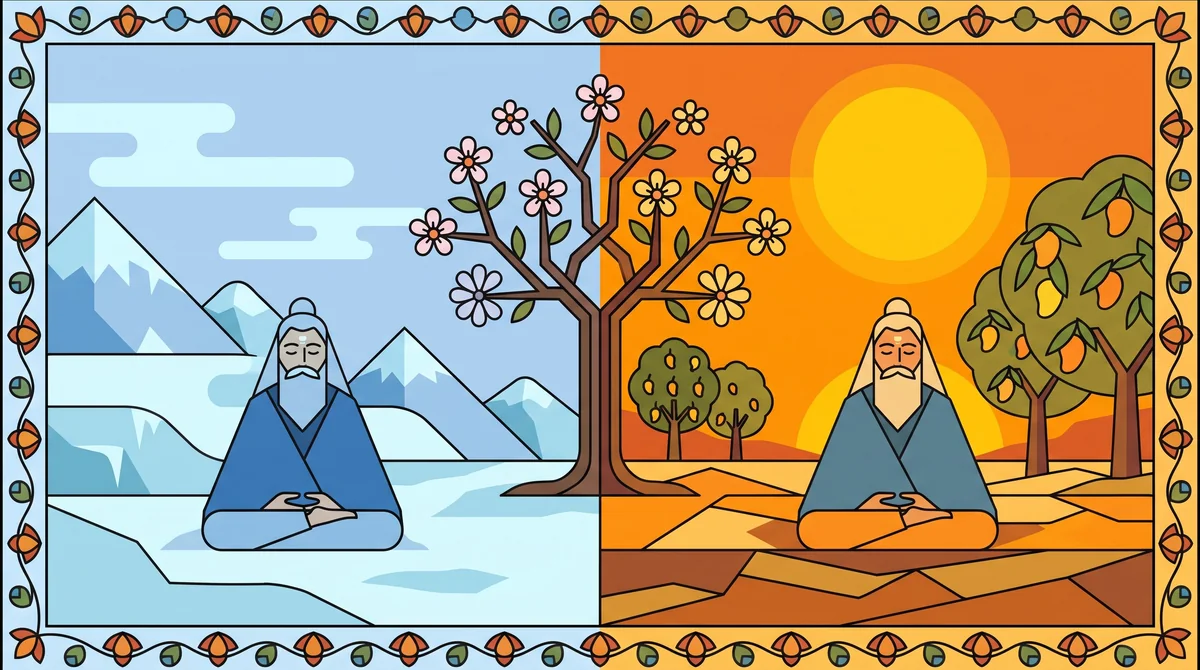
The man you were angry with last week is sleeping well. You know this, because you have checked. He ate his dinner, he attended to his work, and the sentence you rehearsed for him has not once entered his mind. You, meanwhile, have carried it. You carried it into your food, into your bed, into the hours you had set aside for chanting, and you have replayed the scene until it has worn a track through your day. Something has certainly been destroyed by this anger. Now look honestly at where the wreckage has fallen. It has fallen on your side of the wall. Kṛṣṇa states this plainly in the sixteenth chapter of the Bhagavad-gītā, and He states it in two words that most readers walk straight past: nāśanam ātmanaḥ, the destruction of the self.
Three Gates to Hell: Why the Gita Calls Anger Self-Destruction
Look at how the sixteenth chapter is arranged, because the arrangement is itself the argument. Kṛṣṇa begins with the divine qualities in Bhagavad-gītā 16.1-3, and akrodha, freedom from anger, stands among them. Then in Bhagavad-gītā 16.4 He turns and gives the opposite list: pride, arrogance, conceit, anger, harshness and ignorance. Read that list again and notice what it is not. It is not a list of crimes. There is no theft in it, no violence, no false witness against a neighbour. Kṛṣṇa is not cataloguing what a man does to society. He is cataloguing what a man has become inside. He has already shown you the mechanism once, in Bhagavad-gītā 2.62-63, where anger arises from thwarted desire and ends in the loss of intelligence, and I will not repeat that lesson here. Here He is doing something else. He is telling you where the injury lands. When He reaches the summary verse of this entire chapter, He does not say that anger wrongs the person it strikes. He says it ruins the person who holds it. That is a complete rearrangement of the moral accounting you were raised with, in which anger is a wrong done outward, to be apologised for only when the damage becomes visible to others. Hear the verse itself, Bhagavad-gītā 16.21.
tri-vidhaṁ narakasyedaṁ dvāraṁ nāśanam ātmanaḥ kāmaḥ krodhas tathā lobhas tasmād etat trayaṁ tyajet
— Bhagavad-gītā 16.21
Translation: There are three gates leading to this hell – lust, anger and greed. Every sane man should give these up, for they lead to the degradation of the soul.
Purport: Take the words apart. Dvāram means a door, a gateway. It is not a storm, not an accident, not weather falling out of the sky. A gate is a fixed structure standing at a boundary, and it does nothing at all until somebody walks through it. Nāśanam ātmanaḥ means the destruction of the self, and the ruin is reflexive: it returns upon the one who moved. Then tasmād etat trayaṁ tyajet — therefore one should give up these three. Now notice whom Kṛṣṇa is addressing. Not the saint. Not the renunciate. He says every sane man should give these up. He has placed the abandonment of anger not at the summit of spiritual achievement but at the floor of ordinary good sense, in the same category as not putting your hand into a fire. You are not being asked to become exalted. You are being asked to stop demolishing yourself.
Nasanam Atmanah: The Damage Is Done to the Angry Man First
Now I must protect you from a misreading that has spoiled many students of this chapter. Kṛṣṇa calls these qualities āsurī, demoniac, and the moment a man learns that word he begins distributing it. He finds the demoniac in his office, in his family, in the other political party, in every heart except the one reading the verse. That is the catalogue working on him instead of in him, and it is the exact opposite of what Kṛṣṇa intends. In Bhagavad-gītā 16.5 He says that the divine qualities are conducive to liberation and the demoniac qualities make for bondage, and then adds something that should settle your nerves completely: do not worry, O son of Pāṇḍu, for you are born with the divine qualities. Only afterward, in Bhagavad-gītā 16.6, does He mention that there are two kinds of created beings in this world. He is not sorting humanity into camps for you to police. He is describing a mentality that visits every conditioned heart, including yours and including mine, and He is telling you in which direction to point the lamp. Point it inward. And when you point it inward you will find that anger never arrives by itself. It comes in with a settled group of companions, always the same ones, and Kṛṣṇa names the whole party together in Bhagavad-gītā 16.18.

“Anger is the one weapon that discharges backwards, through the hand that holds it. Kṛṣṇa does not file it under offences against your brother. He files it under nāśanam ātmanaḥ — the demolition of your own position.”
Anger Bound Together With False Ego, Strength and Pride
So the practical question is not how to win the argument that is coming. It is how to stand at the gate and decline to walk through it. A gate has a threshold, and a threshold is a moment — an actual, locatable moment in your day, before the sentence leaves your mouth, when the heat climbs into the chest and the reply begins assembling itself. Kṛṣṇa's instruction in Bhagavad-gītā 3.41 is to curb it in the very beginning, while it is still small enough to be handled, because nobody has ever stopped a flooded river at its mouth. Concretely, then. When you feel it rise, say nothing for sixty seconds and chant Hare Kṛṣṇa inwardly through those seconds; do not draft the reply while you wait, because drafting is already walking through. Do not carry the grievance to a third person, which is how a moment acquires a permanent address. Regulate your sleeping and your eating, since Kṛṣṇa makes regulation the very ground of practice in Bhagavad-gītā 6.16 and 6.17. And understand this without any ambiguity: where anger is the symptom of a genuine clinical condition, take competent medical treatment exactly as you would for a fever, and remain under it. Nothing in the Gītā forbids it. What I place before you is the soul's dimension of the matter. It does not substitute for a physician, and your suffering is not evidence of spiritual failure.
ahaṅkāraṁ balaṁ darpaṁ kāmaṁ krodhaṁ ca saṁśritāḥ mām ātma-para-deheṣu pradviṣanto ’bhyasūyakāḥ
— Bhagavad-gītā 16.18
Translation: Bewildered by false ego, strength, pride, lust and anger, the demons become envious of the Supreme Personality of Godhead, who is situated in their own bodies and in the bodies of others, and blaspheme against the real religion.
Purport: Ahaṅkāra, bala, darpa, kāma, krodha — false ego, strength, pride, lust and anger. They are named in a single breath because they operate as a single machine. Anger is simply what false ego does when it is contradicted. Remove the conviction that you are the proprietor and the controller, and the identical event passes through you without igniting anything at all. But it is the second half of the verse that stings. Kṛṣṇa says such a mentality becomes envious of the Supreme Personality of Godhead, who is situated in their own bodies and in the bodies of others. In their own bodies also. So your anger is never a private transaction between two men. It is conducted in the presence of the Paramātmā seated in the other man's heart, and in the presence of the Paramātmā seated in yours.
Closing a Gate Is Simpler Than Fighting What Comes Through It
Now the deepest matter, and here the scripture does not argue with you, it simply shows you. In the ninth canto of the Śrīmad-Bhāgavatam, Durvāsā Muni, a brāhmaṇa of enormous mystic power, became angry with the devotee king Ambarīṣa over a technicality of fasting and produced a demon from his own hair to kill him. Follow the accounting. The Lord's Sudarśana cakra reduced that demon to ashes and then turned upon Durvāsā himself. Śrīmad-Bhāgavatam 9.4.50 shows him running as a snake runs before a forest fire, and 9.4.51 records that he fled through the sky, into caves, into the ocean, up to the planets of the rulers of the three worlds, and the disc was behind him in every one of them. Brahmā could not shelter him. Viṣṇu Himself would not, declaring that He is under the control of His devotees, Śrīmad-Bhāgavatam 9.4.66. In the end that sage fell at the feet of the very king he had meant to destroy, Śrīmad-Bhāgavatam 9.5.1, and only the king's own prayer cooled the fire, Śrīmad-Bhāgavatam 9.5.12. Now count the damage. Ambarīṣa lost nothing whatsoever. He had stood in one place throughout. Every particle of the destruction fell upon the man who had walked through the gate. And in Bhagavad-gītā 18.51-53 Kṛṣṇa runs those same five items in reverse: free of false ego, false strength, false pride, lust and anger, a man is certainly elevated to self-realization.
So do not wait until you have become a peaceful man before taking shelter. Take shelter in order to become one. Kṛṣṇa promises in Bhagavad-gītā 16.22 that whoever escapes these three gates gradually attains the supreme destination — gradually, He says, so do not sit in despair over the gate you walked through this morning. He describes in Bhagavad-gītā 4.10 how many persons became purified precisely by freedom from attachment, fear and anger in absorption in Him. So chant His holy names: Hare Kṛṣṇa Hare Kṛṣṇa, Kṛṣṇa Kṛṣṇa Hare Hare, Hare Rāma Hare Rāma, Rāma Rāma Hare Hare. Chant them on the morning when the anger is still hot in your mouth, for that is exactly the morning it is meant for. In Bhagavad-gītā 18.66 He promises to deliver the one who surrenders to Him, and He sets no condition about the temperature of your heart when you begin.
From the Book
This article draws on the Anger chapter of Bhagavad Gita for Everyday Life, my forthcoming book applying Kṛṣṇa’s instruction to the specific afflictions of ordinary life. The chapter treats every verse the Gītā assigns to anger, verse by verse, with the word-by-word meaning and its application to work and family.
Go deeper now: The Steady Sage.