Patal Lok, in Hindu mythology, is the lowest of seven worlds that the Puranas place beneath the earth. It is the realm of the Nagas, the great serpent beings, and it is described as a place of wealth, beauty and light. It is not hell. That one sentence answers the question most people arrive with, and the rest of this article explains it plainly: where the idea comes from, what the seven lower worlds are called, who lives in each, and why the old texts insist that the world below is lovelier than the world above.
The short answer, and the common mistake
In everyday Hindi, "patal" is used for anything deep underground, and popular films and web series have made "Patal Lok" sound like a pit of criminals and demons. The Puranas say something quite different. They describe three broad regions of the universe: the upper worlds of the gods, the middle world where we live, and a set of seven lower worlds. Hell, called Naraka, is a separate place altogether, with its own location and its own purpose, which is the working out of wrong action. Patal Lok is not a place of punishment. Nobody is sent there to suffer.
The word is also used in two ways, which causes confusion. Sometimes "Patala" means all seven lower worlds taken together, and sometimes it means only the seventh and deepest of them. When a storyteller says a hero "descended to Patal Lok", he usually means the whole region. When a Purana lists the worlds one by one, Patala is the last name on the list.
Where the description comes from
The fullest account is in the fifth canto of the Srimad Bhagavatam, also called the Bhagavata Purana, which sets out the structure of the universe in careful order. The Vishnu Purana gives a similar account, and other Puranas repeat it with small differences in names and sequence. So if you find two lists that do not match exactly, neither is a mistake. These texts were composed and recited across many centuries, and they agree on the picture even where they differ on a detail.
The Bhagavatam has a striking name for these worlds: bila-svarga, the heavens in the hollows. Its claim is that the residents below enjoy more comfort and more splendour than the gods above. The Vishnu Purana tells of the sage Narada returning from a visit and telling the gods that Patala was more delightful than their own heaven. Whatever else one makes of that, it is clearly not how anyone describes a place of torment.
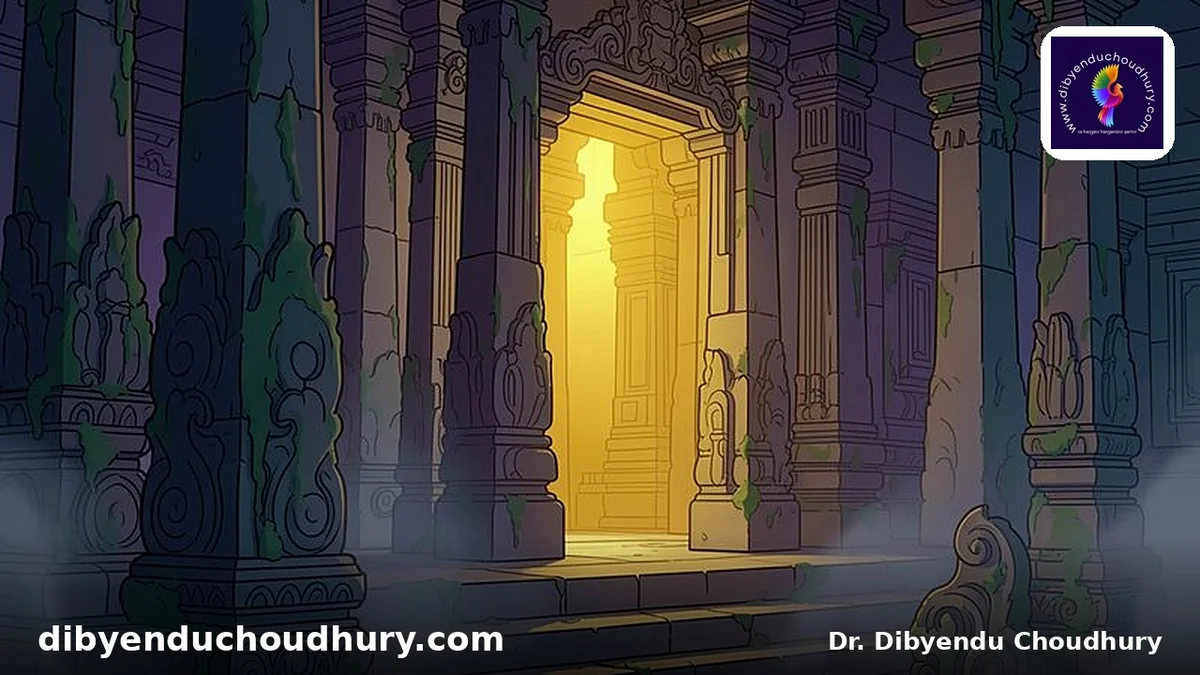
The seven lower worlds, one by one
Following the order in the Bhagavatam, the seven are as follows.
Atala is the first below the earth. It is ruled by Bala, a son of the great architect Maya, and is known for enchantment and pleasure that make a visitor forget everything else.
Vitala is associated with Lord Shiva, who dwells there with Bhavani and is worshipped as the lord of gold. The texts speak of a river of gold that flows from this world.
Sutala is the kingdom of Bali Maharaja, the generous king who gave away the three worlds to Lord Vamana and kept his word even when he understood what it would cost him. As a reward he was given Sutala, and the Lord himself is said to stand guard at his door. For many readers this is the most moving detail in the whole account: the king who lost everything by honesty lives in a world finer than the one he surrendered.
Talatala belongs to Maya Danava, the master builder and teacher of illusion, the same Maya whose skill appears elsewhere in the epics as the maker of wondrous halls and cities.
Mahatala is the home of the many-hooded serpents born of Kadru, a fierce and proud clan that includes names well known from other stories, such as Takshaka and Kaliya.
Rasatala is inhabited by powerful Daityas and Danavas, old rivals of the gods, who live there in their own strength and keep to their own realm.
Patala, the seventh, is Nagaloka, the land of the Naga lords, with Vasuki at their head. This is the Patal Lok of the question.
A world lit by jewels
One detail has fascinated listeners for a very long time. The sunlight does not reach these worlds, so there is no division of day and night, and therefore, the texts say, no fear produced by the passing of time. What lights Patala is the radiance of the gems on the hoods of the great serpents. The darkness is driven away not by a sun overhead but by jewels carried by those who live there.
The descriptions go on in the same spirit: gardens and lakes, palaces and cities planned by Maya, residents who do not suffer from illness, tiredness or old age in the way we do. Beneath all seven worlds, the Bhagavatam places Ananta, also called Shesha, the endless serpent on whose hoods the worlds rest, who is honoured as a form of the Lord himself. So the lowest point of the map is not a void. It is a foundation.
Who are the Nagas?
The Nagas are not ordinary snakes and not simply monsters. In the epics and Puranas they are a class of beings with their own kings, families, loyalties and quarrels. They guard treasure and knowledge. They can be dangerous when wronged and generous when honoured. Vasuki serves as the rope when the ocean is churned. Shesha supports the worlds. Takshaka takes a king's life to settle an old injury. They appear in stories from every part of India, and in many villages they are still worshipped at anthills and under old trees, especially on Naga Panchami.
This is why Patal Lok is better understood as a kingdom than as a cavern. It has rulers, laws, wealth and a long memory.
What the idea is doing
It is fair to ask why the tradition would describe a world beneath our feet as richer than heaven. I think the texts are making a quiet point. In Sutala, an asura king is honoured for keeping his word. In Patala, light comes from within the residents and not from above. The map refuses the easy equation of high with good and low with bad. Beings are placed by their nature and their actions, and worth is found at every level. At the same time the Bhagavatam is frank that the pleasures of these worlds are bound up with illusion, the special art of Maya, and that even the most splendid world is not the final goal. Splendour is not the same thing as freedom.
For a reader today, that is a useful correction in both directions. Patal Lok is not a pit of evil, and it is not a paradise to long for either. It is a part of a very large and carefully imagined universe in which every region has its residents, its rules and its lesson.
So, plainly explained: seven lower worlds, each with its own ruler; the seventh, Patala, belonging to the Nagas; a region lit by jewels and not by the sun; and beneath it all the endless serpent who holds the worlds up. If someone asks you what Patal Lok is, that is an answer you can give in under a minute, and it has the merit of being what the texts actually say.
Where to go from here
If you want the source, read the fifth canto of the Srimad Bhagavatam, where the lower worlds are described in sequence, and then the story of Bali and Vamana in the eighth canto, which explains how Sutala came to be given to a defeated king. If you enjoy fiction, this is the ground my own Patal Loka thriller series is built on: a temple, a missing idol, and a door that should have stayed shut.
One question to take away
Before today, did you think of Patal Lok as a hell or as a kingdom, and where did that picture come from: a grandparent's story, a film, a school lesson? Tell me in the comments; I read every reply.
If you would like notes like this in your inbox, you can join the free newsletter.
📬 Join 49,000+ Indian Professionals
The Inner Circle newsletter delivers curated MSME intelligence, leadership wisdom, and strategic insights every week — completely free. Plus receive the 20 Gita Lessons PDF as a welcome gift.
Subscribe Free →Ready to Go Further?
My mythology and fiction titles bring these stories alive for the modern reader. Available on Amazon India.
Explore My Books on AmazonPublished 26 November 2026 · dibyenduchoudhury.com